Dow Jones Industrial Average climbs 680 points fueled by December rate cut bets
- The Dow Jones gained 680 points on Tuesday despite clear market headwinds.
- Market bets of a Fed interest rate cut in December continue to crystallize.
- Despite a market party on interest rate expectations, key problem areas continue to bloat.

The Dow Jones Industrial Average (DJIA) gained a volatile 550-plus points on Tuesday, rallying out of an early volatility spat as investors rolled with the punches on conflicting headlines. Markets eventually settled into a bullish tilt during a holiday-shortened trading week, but key tech stocks are continuing to drag down the rally-leading AI segment.
AI tech rally darling Nvidia (NVDA) is down 4% on Tuesday, taking a fresh hit and extending its decline from record highs above $205 per share to 14%. According to market reporting, late entrant to the AI party and Facebook parent company Meta Platforms (META) is exploring its options to invest in acquiring Google parent Alphabet’s (GOOG) AI-focused chipsets.
When not overly concerned about pie-eyed AI-led revenue expectations, markets remain hinged singularly around the chances that the Federal Reserve (Fed) will resume delivering interest rate cuts. Rate markets are now pricing in over 82% odds of a quarter-point interest rate cut on December 10 after several key Fed officials hinted that they may be more open to immediate moves on interest rates than previously expected.
The good the bad, and the irrelevant
US Producer Price Index (PPI) inflation metrics eased down in September, with core PPI slipping to 2.6% YoY compared to the previous period’s slightly revised 2.9%. US Retail Sales figures rose in September by 0.2%. The figure shows US retail activity expanding, albeit slightly less than expected.
However, headline Retail Sales by itself paints a different picture than Retail Sales from a wider view. Mainline Retail Sales figures are not adjusted for inflation; after taking Consumer Price Index (CPI) inflation adjustments into consideration, September’s real Retail Sales figure shows a slight contraction as consumers grapple with an increasingly uncomfortable economic landscape.
According to the Conference Board’s (CB) latest Consumer Confidence Index, aggregated consumer expectations and overall economic outlook deteriorated in November, falling 6.8 points to 88.7, the indicator’s lowest reading since April. Markets broadly anticipated an upswing to 93.2.
Dow Jones price forecast
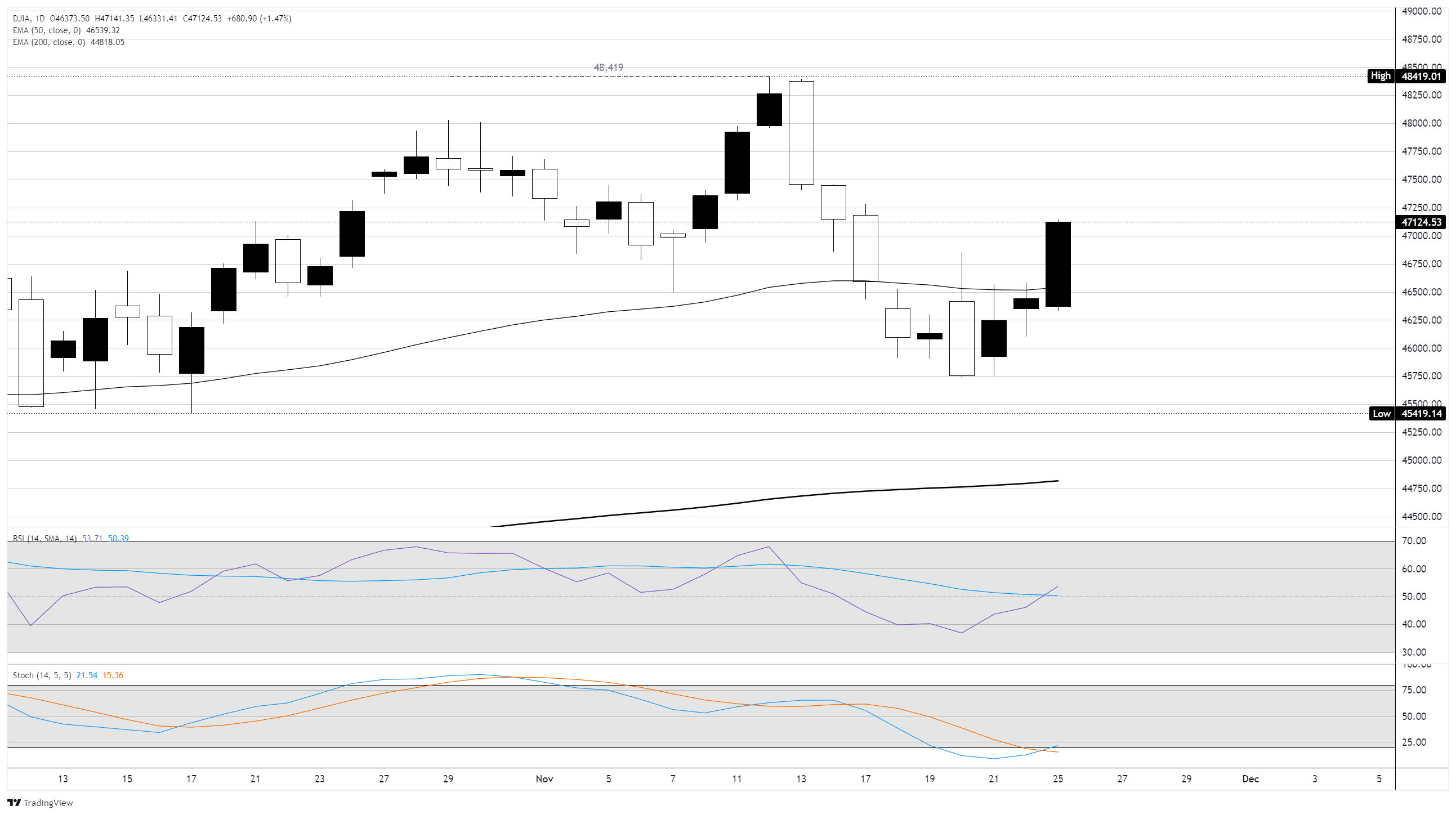
In the daily chart, DJIA trades at 47,007.20. Price holds above the 50-day EMA at 46,546.28 and well above the 200-day EMA at 44,605.18, maintaining a bullish tone. The 50-day EMA has stabilized after a mild pullback, while the 200-day EMA continues to rise. RSI at 52.56 is neutral, edging higher and signaling a modest improvement in momentum.
Stochastic at 20.67 has turned up from deeply oversold, hinting at a nascent recovery in the short-term. The descending trend line from 48,419.01 limits advances, with resistance seen near 47,925.93. A close above that barrier would open the path toward 48,419.01, while failure to break could keep price contained and invite dips toward the 50-day EMA.
Dow Jones daily chart
Fed FAQs
Monetary policy in the US is shaped by the Federal Reserve (Fed). The Fed has two mandates: to achieve price stability and foster full employment. Its primary tool to achieve these goals is by adjusting interest rates. When prices are rising too quickly and inflation is above the Fed’s 2% target, it raises interest rates, increasing borrowing costs throughout the economy. This results in a stronger US Dollar (USD) as it makes the US a more attractive place for international investors to park their money. When inflation falls below 2% or the Unemployment Rate is too high, the Fed may lower interest rates to encourage borrowing, which weighs on the Greenback.
The Federal Reserve (Fed) holds eight policy meetings a year, where the Federal Open Market Committee (FOMC) assesses economic conditions and makes monetary policy decisions. The FOMC is attended by twelve Fed officials – the seven members of the Board of Governors, the president of the Federal Reserve Bank of New York, and four of the remaining eleven regional Reserve Bank presidents, who serve one-year terms on a rotating basis.
In extreme situations, the Federal Reserve may resort to a policy named Quantitative Easing (QE). QE is the process by which the Fed substantially increases the flow of credit in a stuck financial system. It is a non-standard policy measure used during crises or when inflation is extremely low. It was the Fed’s weapon of choice during the Great Financial Crisis in 2008. It involves the Fed printing more Dollars and using them to buy high grade bonds from financial institutions. QE usually weakens the US Dollar.
Quantitative tightening (QT) is the reverse process of QE, whereby the Federal Reserve stops buying bonds from financial institutions and does not reinvest the principal from the bonds it holds maturing, to purchase new bonds. It is usually positive for the value of the US Dollar.
Author

Joshua Gibson
FXStreet
Joshua joins the FXStreet team as an Economics and Finance double major from Vancouver Island University with twelve years' experience as an independent trader focusing on technical analysis.