|

Coca-Cola stock KO price surge creates bullish sequence

Coca-Cola (NYSE: KO), a leading beverage company, recently reported better-than-expected earnings and revenue for the quarter. The strong financial results, demonstrate the company’s resilience in the face of challenging economic conditions and highlight its ability to adapt to changing market dynamics. It leads to increased investor confidence and a surge in the company’s stock price. As a result, investor confidence has increased, leading to a surge in Coca-Cola’s stock price.

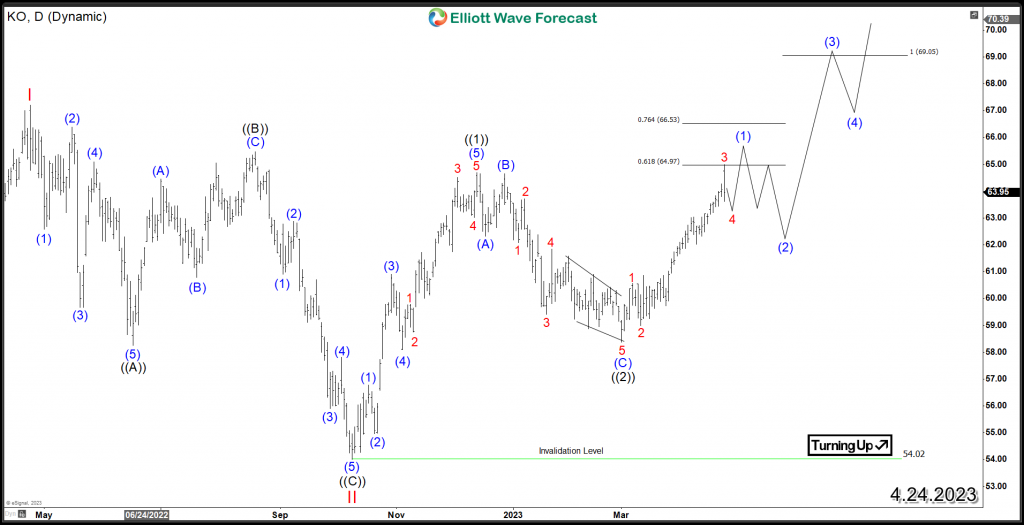
Let’s take a look at the technical Daily chart for KO. The recent surge allowed the price to make new high above wave ((1)) peak $64.70 from December 2022. The recent surge in price for KO has created a new bullish sequence on the daily chart, originating from the October 2022 low. This suggests a move into potential price target in the equal legs area of $69-$71.

Nonetheless, in the short term, the price has entered a technical area between $64.97-$66.53, which may cause a corrective pullback. Given the bullish sequence, any pullback at this stage could present a potential opportunity to buy in 3, 7, or 11 swings against March 2023 low of $58.37.

At a later stage, the break above 2022 peak will be critical to confirm a weekly bullish sequence from 2020 low which will support the stock to the upside in the coming years into higher targets.

In conclusion, the recent bullish surge in KO’s stock price is supported by technical analysis and positive earnings results. While a short-term corrective pullback may be possible, the overall outlook for KO is optimistic, with potential for further gains in the coming years. Investors should continue to monitor the stock for potential buying opportunities.

KO Elliott Wave Daily Chart
Author

Elliott Wave Forecast Team

Elliott Wave Forecast Team

ElliottWave-Forecast.com

More from Elliott Wave Forecast Team
Share:

Editor's Picks

AUD/USD remains depressed below 0.6750 after RBA minutes

AUD/USD treads water below 0.6750 in Asia on Tuesday, struggling near ten-month lows. The pair fails to find any inspiration from RBA Governor Bullock’s hawkish remarks. Moreover, Minutes from the November RBA meeting also had little impact on the Australian Dollar amid a bullish US Dollar undertone, bolstered by firming Fed hike bets and geopolitical uncertainties.

USD/JPY holds steady around 156.50 as 'Yentervention' risks loom

USD/JPY is consolidating around mid-156.00s in the Asian session on Tuesday as traders stay on high alert amid speculation that authorities will step in to support the Japanese Yen. Meanwhile, the US Dollar holds its recent gains at a 19-month high, amid firming Fed rate-hike bets and geopolitical uncertainty. This, along with the wide US-Japan rate differential, acts as a tailwind for the pair.


Gold remains offered below $3,850 on firmer US Dollar

Gold recedes below the $3,850 zone per troy ounce on Tuesday, still navigating the area of multi-month lows. The continuation of the upside momentum in the US Dollar, investors’ repricing of further Fed tightening and a decent bounce in US Treasury yields across the curve keep the precious metal under scrutiny for the second day in a row.

Ripple bulls struggle as Binance whale withdrawals surge

XRP trades marginally above $0.95 as bulls push to gain ground, but upside remains strongly capped. XRP whales withdrew $21 million from Binance on Monday, extending broader $127 million outflows since November 10.

Make or break tonight: Nvidia reports Q3 earnings
The Nasdaq lost 2.5% yesterday following an interim final rule by the US Commerce Department on US export restrictions on AI chips (to China). The rule targets a loophole where Chinese firms rent computing power from data centers in unrestricted countries. Data center operators in Singapore, Malaysia, Thailand, Indonesia and Brazil must now request a US license to buy advanced AI chips.
Gold isn't being sold for thew reason most people think
Gold (XAU/USD) remains under heavy selling pressure on Monday, hitting its lowest level in 13 months. The precious metal is struggling to recover despite escalating geopolitical tensions in the Middle East, a backdrop that would normally encourage investors to seek protection in safe-haven assets. However, the main driver behind Gold's decline is not the geopolitical uncertainty itself.