Canadian Dollar tests fresh highs, but risk aversion weighs on Loonie
- The Canadian Dollar briefly rallied to a new five-week high against the Greenback.
- Despite the fresh bid, the CAD fell back into familiar congestion as risk aversion weighs.
- The Trump administration is bound and determined to enact sweeping tariffs, crippling investor sentiment.


The Canadian Dollar (CAD) traveled a lot of ground to go nowhere on Wednesday. The Loonie rose to a new five-week peak against the US Dollar (USD), but lost ground and returned to flat on the day as investor sentiment gets pummeled by a fresh batch of roving tariff threats from US President Donald Trump.
Wide-ranging tariffs are becoming a real threat to investor sentiment after theTrump administration keyed up reminders that they still plan to pursue a package of tariffs that run the gamut from copper, to automobiles, to “reciprocal” tariffs on functionally every country that the US does business with. Countries that import Crude Oil from Venezuela are also on the docket to get dinged with an additional 20% tariff on everything going into the US, and European Union (EU) officials made tariff concerns all too real by acknowledging that the EU is bracing for tariffs of 20-25% on all goods imported by the US.
Daily digest market movers: Canadian Dollar rises then falls as safe haven flight takes control
- The Canadian Dollar rallied four-tenths of one percent to a new five-week high before falling back to Wednesday’s opening bids as Loonie traders lose hope.
- US President Donald Trump reiterated his intent to introduce an across-the-board tariff on all copper imports to match previous steel and aluminum tariffs.
- The EU acknowledged that a tariff package of 20-25% on all European goods could be coming from the Trump team, on top of an additional 20% tariff for buying Crude Oil from Venezuela.
- Tariff fears continue to simmer away and have begun to bubble over, crimping investor sentiment.
- US policymakers are beginning to flash warning signs that Trump’s tariff strategy is making interest rate cuts a difficult proposition.
Canadian Dollar price forecast
The Canadian Dollar caught a fresh bid against the US Dollar to kick off Wednesday’s price action, forcing USD/CAD to a fresh five-week low at 1.4235. However, markets reversed course and pushed the pair back toward the 1.4300 handle. USD/CAD has cycled the 50-day Exponential Moving Average (EMA) at 1.4320 for about four months, with bids caught a congestion trap forcing the pair to grind sideways on the long-term charts.
USD/CAD daily chart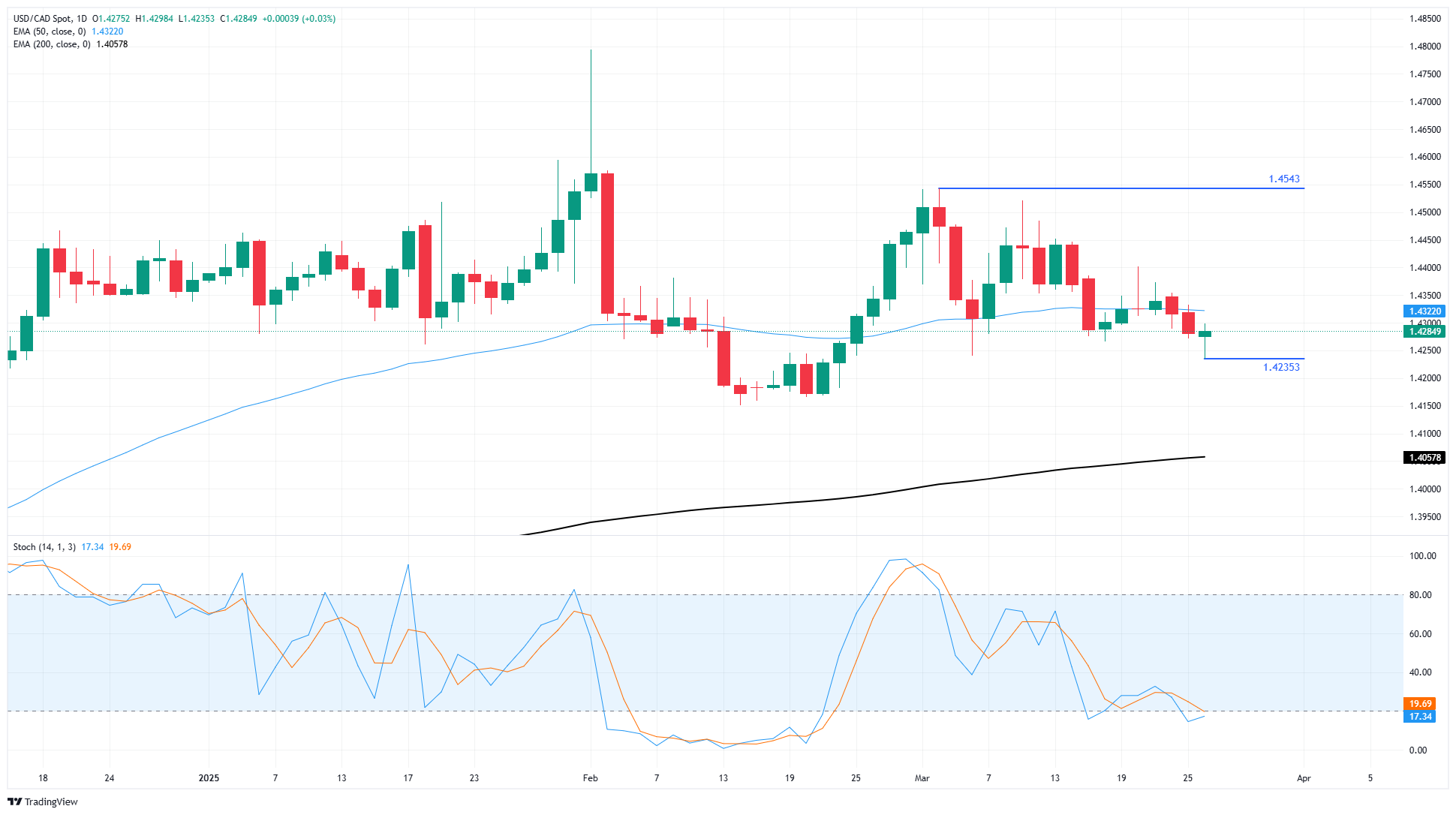
Canadian Dollar FAQs
The key factors driving the Canadian Dollar (CAD) are the level of interest rates set by the Bank of Canada (BoC), the price of Oil, Canada’s largest export, the health of its economy, inflation and the Trade Balance, which is the difference between the value of Canada’s exports versus its imports. Other factors include market sentiment – whether investors are taking on more risky assets (risk-on) or seeking safe-havens (risk-off) – with risk-on being CAD-positive. As its largest trading partner, the health of the US economy is also a key factor influencing the Canadian Dollar.
The Bank of Canada (BoC) has a significant influence on the Canadian Dollar by setting the level of interest rates that banks can lend to one another. This influences the level of interest rates for everyone. The main goal of the BoC is to maintain inflation at 1-3% by adjusting interest rates up or down. Relatively higher interest rates tend to be positive for the CAD. The Bank of Canada can also use quantitative easing and tightening to influence credit conditions, with the former CAD-negative and the latter CAD-positive.
The price of Oil is a key factor impacting the value of the Canadian Dollar. Petroleum is Canada’s biggest export, so Oil price tends to have an immediate impact on the CAD value. Generally, if Oil price rises CAD also goes up, as aggregate demand for the currency increases. The opposite is the case if the price of Oil falls. Higher Oil prices also tend to result in a greater likelihood of a positive Trade Balance, which is also supportive of the CAD.
While inflation had always traditionally been thought of as a negative factor for a currency since it lowers the value of money, the opposite has actually been the case in modern times with the relaxation of cross-border capital controls. Higher inflation tends to lead central banks to put up interest rates which attracts more capital inflows from global investors seeking a lucrative place to keep their money. This increases demand for the local currency, which in Canada’s case is the Canadian Dollar.
Macroeconomic data releases gauge the health of the economy and can have an impact on the Canadian Dollar. Indicators such as GDP, Manufacturing and Services PMIs, employment, and consumer sentiment surveys can all influence the direction of the CAD. A strong economy is good for the Canadian Dollar. Not only does it attract more foreign investment but it may encourage the Bank of Canada to put up interest rates, leading to a stronger currency. If economic data is weak, however, the CAD is likely to fall.
Author
Joshua Gibson
FXStreet
Joshua joins the FXStreet team as an Economics and Finance double major from Vancouver Island University with twelve years' experience as an independent trader focusing on technical analysis.