Canadian Dollar keeps its bullish tone around 1.3530

- Canadian Dollar bounces up with the US Dollar retreating on downbeat US data.
- US service sector activity decelerated against expectations with Prices Paid printing lowest level in years.
- Strong US ADP and hawkish comments from Fed’s Bostic have failed to support USD.
The Canadian Dollar (CAD) is trading higher on Wednesday, retracing the previous two days’ losses. The Loonie is favored by the US Dollar's knee-jerk reaction following downbeat US services activity data.
The US ISM Services PMI missed market expectations in March, with the Prices Paid sub-index showing a significant slowdown. This has eased investors' fears of a strong economy that would prompt the Federal Reserve (Fed) to dial down its monetary easing plans, which have pushed US Treasury yields and the US Dollar lower.
The downbeat services data has offset the larger-than-expected increase in the ADP Employment Report, and the hawkish remarks by Fed Chair Jerome Powell and Atlanta Fed President, Raphael Bostic, reiterating that there is no rush to cut interest rates.
Beyond that, the increasing geopolitical tensions and growing concerns about tighter supply have pushed crude prices to a fresh year-to-date (YTD) high. This is providing additional support to the commodity-linked CAD.
Daily digest market movers: USD/CAD dives as services activity data disappoint
- Canadian Dollar regained lost ground on Wednesday as soft US services activity data has sent US yields and the US Dollar lower.
- US ISM Services PMI dropped to 51.4 in March from 52.6 in February against market expectations of a slight increase to 52.7.
- The ISM Prices Paid sub-index has dropped to 53.4, its lowest level in years, from 58.6 in February and 64 in January. This signals a disinflationary contribution to the economy.
- Somewhat later, Fed Chair, Jerome Powell repeated that the bank is not in a rush to start lowering borrowing costs, although the impact on the US Dollar has been marginal.
- Earlier on Wednesday, the US ADP Employment Report showed an increase of 184,000 new payrolls in March from 155,000 in February. The market had forecasted a decline to 148,000.
- Before Powell, Atlanta Fed President Raphael Bostic held his hawkish ground on Wednesday suggesting that rate cuts might not arrive before Q4.
Canadian Dollar price today
The table below shows the percentage change of Canadian Dollar (CAD) against listed major currencies today. Canadian Dollar was the weakest against the Australian Dollar.
| USD | EUR | GBP | CAD | AUD | JPY | NZD | CHF | |
| USD | -0.62% | -0.62% | -0.26% | -0.81% | 0.08% | -0.69% | -0.52% | |
| EUR | 0.61% | 0.00% | 0.36% | -0.19% | 0.69% | -0.07% | 0.10% | |
| GBP | 0.62% | 0.00% | 0.35% | -0.19% | 0.69% | -0.07% | 0.09% | |
| CAD | 0.25% | -0.36% | -0.37% | -0.56% | 0.33% | -0.43% | -0.26% | |
| AUD | 0.80% | 0.17% | 0.16% | 0.55% | 0.88% | 0.13% | 0.25% | |
| JPY | -0.08% | -0.70% | -0.72% | -0.34% | -0.89% | -0.77% | -0.60% | |
| NZD | 0.70% | 0.07% | 0.07% | 0.42% | -0.13% | 0.71% | 0.12% | |
| CHF | 0.51% | -0.10% | -0.10% | 0.26% | -0.29% | 0.59% | -0.17% |
The heat map shows percentage changes of major currencies against each other. The base currency is picked from the left column, while the quote currency is picked from the top row. For example, if you pick the Euro from the left column and move along the horizontal line to the Japanese Yen, the percentage change displayed in the box will represent EUR (base)/JPY (quote).
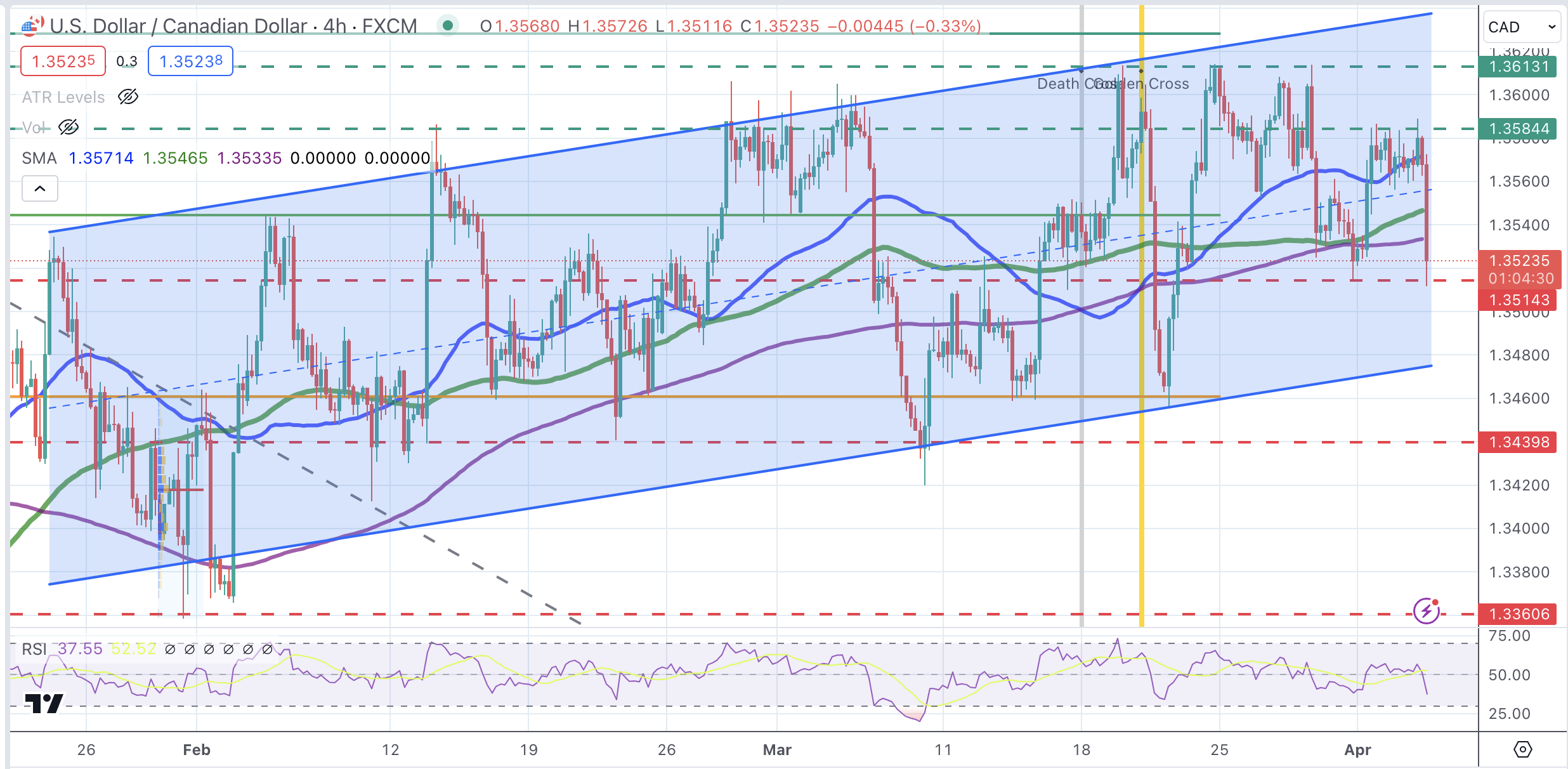
Technical analysis: The USD/CAD is under pressure with support levels at 1.3515 and 1.3475
The strong bearish reversal on the USD/CAD following the release of the ISM Services PMI has put bears back in control. They aim to breach support at 1.3515, which is under pressure at the moment.
The overall picture shows choppy and volatile trading with the pair still moving inside a slightly bullish channel. The mentioned 1.3515 level is guarding the base of the channel at 1.3475 and 1.3440. On the upside, resistances are at 1.3585 and 1.3615.
USD/CAD 4-Hour Chart
Bank of Canada FAQs
The Bank of Canada (BoC), based in Ottawa, is the institution that sets interest rates and manages monetary policy for Canada. It does so at eight scheduled meetings a year and ad hoc emergency meetings that are held as required. The BoC primary mandate is to maintain price stability, which means keeping inflation at between 1-3%. Its main tool for achieving this is by raising or lowering interest rates. Relatively high interest rates will usually result in a stronger Canadian Dollar (CAD) and vice versa. Other tools used include quantitative easing and tightening.
In extreme situations, the Bank of Canada can enact a policy tool called Quantitative Easing. QE is the process by which the BoC prints Canadian Dollars for the purpose of buying assets – usually government or corporate bonds – from financial institutions. QE usually results in a weaker CAD. QE is a last resort when simply lowering interest rates is unlikely to achieve the objective of price stability. The Bank of Canada used the measure during the Great Financial Crisis of 2009-11 when credit froze after banks lost faith in each other’s ability to repay debts.
Quantitative tightening (QT) is the reverse of QE. It is undertaken after QE when an economic recovery is underway and inflation starts rising. Whilst in QE the Bank of Canada purchases government and corporate bonds from financial institutions to provide them with liquidity, in QT the BoC stops buying more assets, and stops reinvesting the principal maturing on the bonds it already holds. It is usually positive (or bullish) for the Canadian Dollar.
Author

Guillermo Alcala
FXStreet
Graduated in Communication Sciences at the Universidad del Pais Vasco and Universiteit van Amsterdam, Guillermo has been working as financial news editor and copywriter in diverse Forex-related firms, like FXStreet and Kantox.