British Pound Sterling climbs on a problem it has worse
- GBP/USD trades at a five-month high, roughly four cents above its early-August low.
- UK ten-year gilt yields hold above 5%, the highest in the G7.
- No UK data this week against core PCE, Jackson Hole and a Fed Chair keynote.

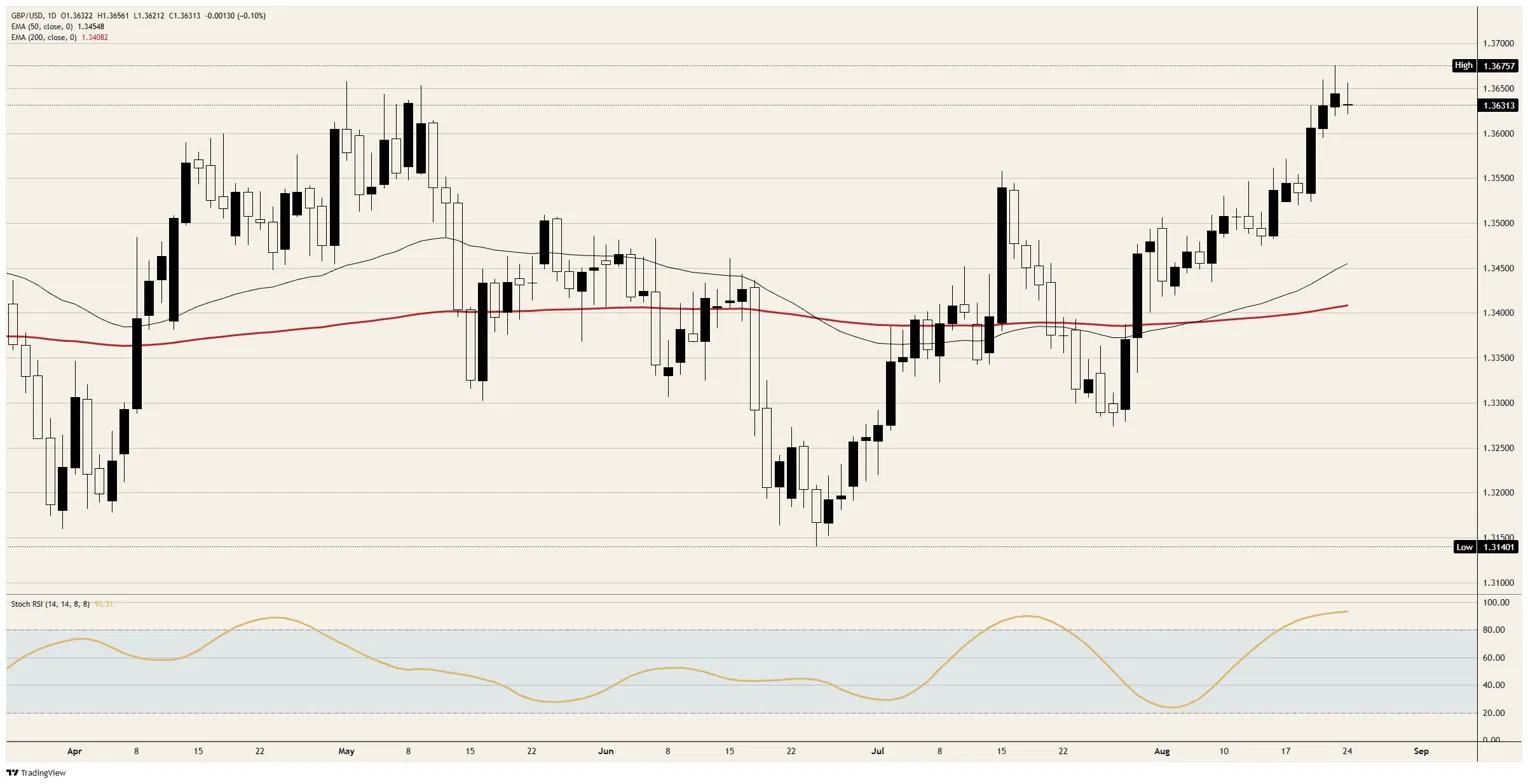
Sterling holds just above 1.3600 into the North American afternoon, marginally lower on the day and inside a range of barely 35 pips, having printed a five-month high short of 1.3700 late last week. The August advance has added roughly four cents from the early-August base, and it has done so with almost nothing arriving from Britain to justify it.
That absence is the story rather than a footnote to it. The Bank of England (BoE) has been on hold since July, the next decision is September 17, and the domestic calendar between here and then is empty. Every pip of this move was priced somewhere else.
The rally has an American author
The Treasury announced on August 19 that it would at least double the size of its long-dated buyback operations from September 9, a fortnight after publishing the quarter's schedule and a week after the thirty-year yield reached levels last seen in 2007. The Dollar has been on the back foot since, down roughly 2.5% over the past month on a trade-weighted basis.
Monday delivered the second instalment. Reporting that the department could tap its roughly one trillion Dollar general account to fund the enlarged purchases pushed the ten-year yield beneath 4.72% and the thirty-year toward 5.25%, and the Dollar managed only a fractional bounce out of it. What has unsettled currency desks is the correlation running through last week, when yields rose and the Dollar fell together. Reserve currencies are not supposed to do that.
The distinction matters for how the Pound eventually gets hurt. Futures still carry a Federal Reserve increase before year end as close to fully priced, so this is not a Dollar being sold on a dovish rate path. It is a Dollar being sold on the suspicion that the government issuing it would rather manage the yield curve than let it clear.
Britain owns the same problem, priced worse
Britain's ten-year gilt yields above 5%, roughly a third of a percentage point more than the American paper being sold over debt sustainability, and it has held that level all month. Federal debt above 40 trillion Dollars is the number moving the Dollar. Nobody is applying the same arithmetic to a borrower whose long end already trades wider.
The domestic prints do not help the case either. July inflation accelerated to 2.9% YoY, the fastest since March, with core at 2.6% and both sitting above what a 3.75% Bank Rate is meant to be delivering. The labour market is going the other way, unemployment stuck at 4.9% and payrolled employment down 86K over the year. The autumn Budget on October 28 has not been priced by anything at all.
None of it has cost the Pound a thing, because the yield gap that used to pay Dollar holders has gone. Bank Rate at 3.75% now sits level with the top of the Federal Reserve's target range, so the carry argument that capped Sterling for years no longer applies. The debasement trade found the one major currency that out-yields the Dollar and declined to check what Britain pays to borrow.
Every catalyst this week is American
Tuesday is thin, with the four-week average of the private payrolls tracker at 12:15 GMT, June house prices at 13:00 and August consumer confidence alongside July new home sales at 14:00. Wednesday is the first real test. Core Personal Consumption Expenditures (PCE) prices are seen at 0.2% MoM for July from 0.1% with the annual rate holding 3.3%, and the same 12:30 GMT block carries the second look at Q2 Gross Domestic Product (GDP) at 1.5% annualised and July durable goods at 0.7%.
The symposium at Jackson Hole then runs Thursday through Saturday, with jobless claims seen at 208K on Thursday and the Fed Chair's keynote on Friday at 14:00 GMT. Friday also brings the Chicago Purchasing Managers Index (PMI) at 57, the final August Michigan sentiment reading at 51, and the preliminary benchmark revision to nonfarm payrolls. After a 23K contraction in the July report, that revision is the release most capable of embarrassing the Dollar, and it lands in the same hour as the keynote.
Levels to watch
Resistance: The 1.3650 area caps the immediate move and last week's high just short of 1.3700 is the line that matters. Through it there is no supply left on this frame.
Support: The 1.3600 handle is the first floor and has held every dip since August 19. Beneath it, 1.3550 is the shelf the breakout came from, and losing that exposes 1.3500.
Bias: Bullish while 1.3600 holds. The daily Stochastic Relative Strength Index (Stoch RSI) above 93 is a warning rather than a signal, and the specific thing that ends this run is a Fed Chair using Friday to remind the market a December increase is still priced. A daily close beneath 1.3550 turns it, with the 50-day Exponential Moving Average (EMA) near 1.3450 the next genuine magnet.
GBP/USD daily chart
Pound Sterling FAQs
The Pound Sterling (GBP) is the oldest currency in the world (886 AD) and the official currency of the United Kingdom. It is the fourth most traded unit for foreign exchange (FX) in the world, accounting for 12% of all transactions, averaging $630 billion a day, according to 2022 data. Its key trading pairs are GBP/USD, also known as ‘Cable’, which accounts for 11% of FX, GBP/JPY, or the ‘Dragon’ as it is known by traders (3%), and EUR/GBP (2%). The Pound Sterling is issued by the Bank of England (BoE).
The single most important factor influencing the value of the Pound Sterling is monetary policy decided by the Bank of England. The BoE bases its decisions on whether it has achieved its primary goal of “price stability” – a steady inflation rate of around 2%. Its primary tool for achieving this is the adjustment of interest rates. When inflation is too high, the BoE will try to rein it in by raising interest rates, making it more expensive for people and businesses to access credit. This is generally positive for GBP, as higher interest rates make the UK a more attractive place for global investors to park their money. When inflation falls too low it is a sign economic growth is slowing. In this scenario, the BoE will consider lowering interest rates to cheapen credit so businesses will borrow more to invest in growth-generating projects.
Data releases gauge the health of the economy and can impact the value of the Pound Sterling. Indicators such as GDP, Manufacturing and Services PMIs, and employment can all influence the direction of the GBP. A strong economy is good for Sterling. Not only does it attract more foreign investment but it may encourage the BoE to put up interest rates, which will directly strengthen GBP. Otherwise, if economic data is weak, the Pound Sterling is likely to fall.
Another significant data release for the Pound Sterling is the Trade Balance. This indicator measures the difference between what a country earns from its exports and what it spends on imports over a given period. If a country produces highly sought-after exports, its currency will benefit purely from the extra demand created from foreign buyers seeking to purchase these goods. Therefore, a positive net Trade Balance strengthens a currency and vice versa for a negative balance.
Author

Joshua Gibson
FXStreet
Joshua joins the FXStreet team as an Economics and Finance double major from Vancouver Island University with twelve years' experience as an independent trader focusing on technical analysis.