British Pound stalls as UK GDP shrinks, diplomacy boosts risk mood
- UK economy contracts in April, pressuring the Pound ahead of the BoE decision.
- US-Iran signing readiness drags WTI lower, easing inflation fears.
- Michigan sentiment improves as one-year inflation expectations edge lower.

The Pound Sterling (GBP) turns negative against the US Dollar (USD) on Friday after UK data showed the economy contracted in April, while rising prospects of an agreement between the US and Iran improved risk appetite. Yet, the Greenback erased its earlier losses and traded above its opening price. At the time of writing, the GBP/USD pair trades at 1.3413, virtually unchanged.
Risk on mood as Washington and Tehran are set to sign
Sentiment improved after newswires reported that Washington and Tehran are closing in on a deal, which, according to Western media, could be signed in Geneva, Switzerland, between June 15-17. Iranian officials denied those claims, as reported by Tehran-linked media, and the Iranian Foreign Minister said that the Islamabad Memorandum of Understanding (MOU) has never been closer and is pending finalization, and that the media should refrain from speculating about its content.
Breaking news reported by Al Arabiya said that the US and Iran informed mediators of their readiness to sign, citing diplomatic sources. Consequently, Oil prices have fallen, with West Texas Intermediate (WTI) trading down over 2.20% to $84.47 per barrel.
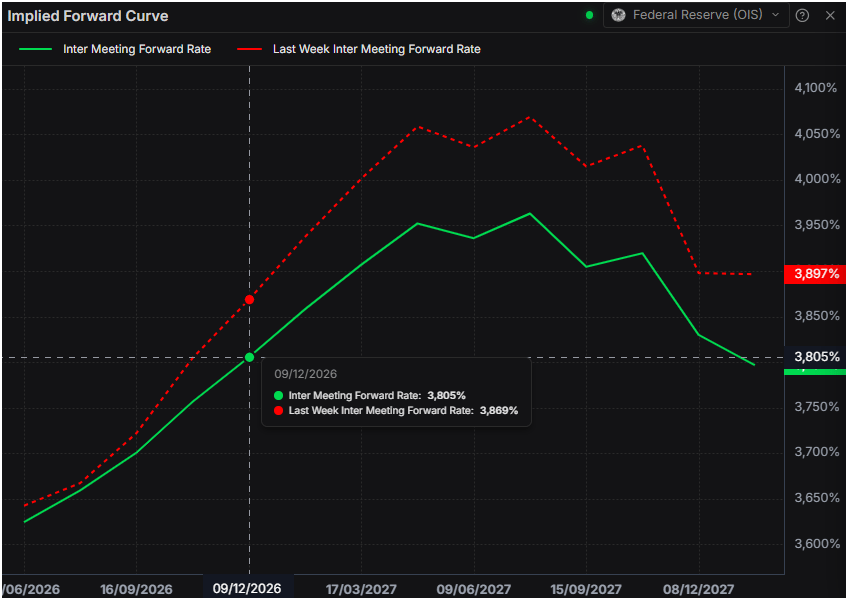
Fed rate cut odds toward the end of 2026, trimmed from 88% to 68%
The news had eased inflationary pressures. Money markets are expecting 16 basis points (bps) of rate hikes by the US Federal Reserve towards the end of the year, down from 22 bps a day ago, according to Prime Terminal data.
The US Dollar Index (DXY), which tracks the buck’s value against a basket of currencies, holds steady at 99.68, a headwind for GBP/USD.
The US Consumer Sentiment, as reported by the University of Michigan (UoM), rose from 44.8 to 48.9 in June’s preliminary reading, while inflation expectations for one year eased from 4.8% to 4.6%.
In the UK, Gross Domestic Product (GDP) contracted by 0.1% in April, after a 0.3% growth in March. Next week, the UK economic calendar will feature inflation and employment figures ahead of the Bank of England's rate decision, which is expected to keep rates unchanged.
In the US, the data schedule will feature the Fed’s monetary policy decision and Retail Sales.
GBP/USD Price Forecast: Technical outlook
In the daily chart, GBP/USD trades at 1.3411, keeping a mildly bearish near-term tone as spot holds beneath a cluster of key trend and average-based barriers. Price now sits under the upward support trend line’s break point at 1.3415 and below the latest reading of the simple moving average cluster around 1.3468, suggesting rallies are being capped rather than sustained. The downward resistance trend line, with a break price near 1.3562, continues to frame the broader corrective phase, while the Relative Strength Index (14) hovering just below the 50 mark hints at fading bullish momentum rather than outright oversold conditions.
On the topside, initial resistance is seen at the reclaimed uptrend break area around 1.3415, where sellers are likely to defend the former support. Above that, the grouped 50-, 100- and 200-period simple moving averages around 1.3468 form a more substantial cap, ahead of the downtrend break level at 1.3562, which guards a deeper recovery. On the downside, the absence of clearly defined indicator-based floors below spot leaves sterling vulnerable to further slippage, with traders likely to look to recent swing lows on the chart as the next potential demand zones should 1.3411 give way on a daily close.
(The technical analysis of this story was written with the help of an AI tool.)
Pound Sterling FAQs
The Pound Sterling (GBP) is the oldest currency in the world (886 AD) and the official currency of the United Kingdom. It is the fourth most traded unit for foreign exchange (FX) in the world, accounting for 12% of all transactions, averaging $630 billion a day, according to 2022 data. Its key trading pairs are GBP/USD, also known as ‘Cable’, which accounts for 11% of FX, GBP/JPY, or the ‘Dragon’ as it is known by traders (3%), and EUR/GBP (2%). The Pound Sterling is issued by the Bank of England (BoE).
The single most important factor influencing the value of the Pound Sterling is monetary policy decided by the Bank of England. The BoE bases its decisions on whether it has achieved its primary goal of “price stability” – a steady inflation rate of around 2%. Its primary tool for achieving this is the adjustment of interest rates. When inflation is too high, the BoE will try to rein it in by raising interest rates, making it more expensive for people and businesses to access credit. This is generally positive for GBP, as higher interest rates make the UK a more attractive place for global investors to park their money. When inflation falls too low it is a sign economic growth is slowing. In this scenario, the BoE will consider lowering interest rates to cheapen credit so businesses will borrow more to invest in growth-generating projects.
Data releases gauge the health of the economy and can impact the value of the Pound Sterling. Indicators such as GDP, Manufacturing and Services PMIs, and employment can all influence the direction of the GBP. A strong economy is good for Sterling. Not only does it attract more foreign investment but it may encourage the BoE to put up interest rates, which will directly strengthen GBP. Otherwise, if economic data is weak, the Pound Sterling is likely to fall.
Another significant data release for the Pound Sterling is the Trade Balance. This indicator measures the difference between what a country earns from its exports and what it spends on imports over a given period. If a country produces highly sought-after exports, its currency will benefit purely from the extra demand created from foreign buyers seeking to purchase these goods. Therefore, a positive net Trade Balance strengthens a currency and vice versa for a negative balance.
Author

Christian Borjon Valencia
FXStreet
Markets analyst, news editor, and trading instructor with over 14 years of experience across FX, commodities, US equity indices, and global macro markets.