British Pound slips as hot US PCE outshines hawkish BoE signals
- GBP/USD falls 0.26% despite hawkish testimony from several BoE policymakers.
- US Core PCE accelerates to 3.3%, while GDP surges 4.3%.
- December rate hike probabilities reach 92% for Fed, 82% for BoE.

The Pound Sterling dives lower against the US Dollar as the latest US inflation report reinforced expectations that the Federal Reserve (Fed) could raise rates in December, while Bank of England (BoE) officials turned hawkish amid testimony at the UK Parliament. The GBP/USD trades at 1.3079, down 0.26%.
Sterling weakens as persistent US inflation reinforces December Fed hike speculation
The US Core Personal Consumption Expenditures (PCE) Price Index rose from 3.1% to 3.3% YoY, while the headline figure increased from 3.7% to 3.8% as expected, according to the US Bureau of Economic Analysis. At the same time, Gross Domestic Product (GDP) numbers for Q3 in its second estimate crushed the previous reading of 3.4%, as the economy surged 4.3%.
Other data revealed that Durable Goods Orders in October slowed from 2% to 0.2%, while Initial Jobless Claims for the week ending November 31, dipped from 202K to 189K, well below forecasts of 200K.
The data reinforced that the US economy remains resilient and that the regime change at the Fed is justified, as inflation remains a full 1% above its 2% goal. Money markets had priced in a 92% chance of a 25-basis-point rate increase at the December meeting, according to the CME FedWatch Tool.
The US Dollar Index (DXU), which tracks the performance of the Greenback versus six currencies, edged lower 0.19% to 103.65.
In the UK, BoE Governor Andrew Bailey said that “It is more likely than not that we will have to raise interest rates more if energy prices stay elevated,” at a testimony in the UK Parliament’s Treasury Committee on Wednesday.
Three other BoE officials appeared. BoE Deputy Governor Clare Lombardelli sees a “higher risk of second-round effects” on inflation, while member Catherine Mann called for additional hikes due to higher inflation expectations.
In the dovish camp, Swati Dhingra noted signs of disinflation and said, “Inflation pressures are more contained than in 2022.”
Ahead, US markets will be closed this week in observance of the Thanksgiving Holiday, meaning trading volume will be thinner towards the end of the week.
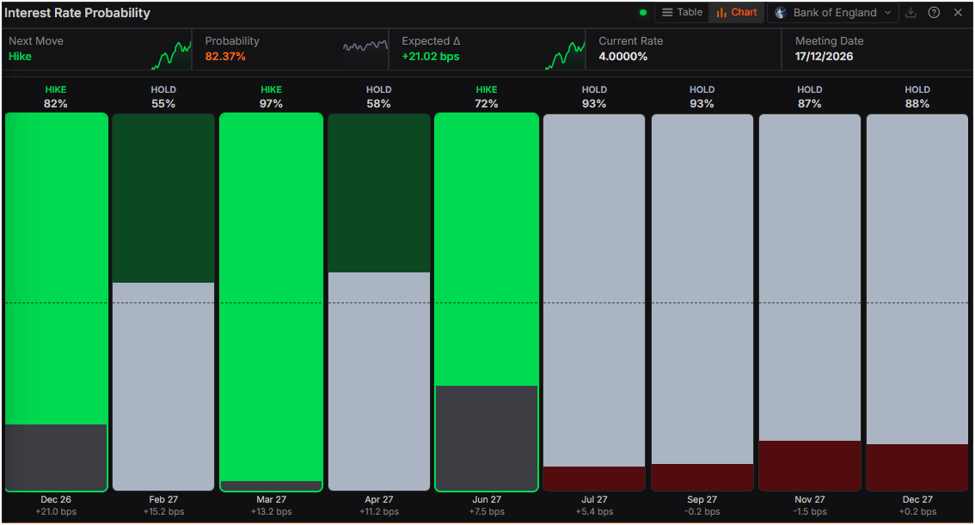
Following BoE’s official comments, traders see an 82% chance that the UK central bank will raise rates by 25 basis points at the December 17 meeting.
GBP/USD Price Forecast: Technical outlook
In the daily chart, GBP/USD trades at 1.3109, extending its slide beneath the simple moving average cluster now aligned near 1.3279 and staying under multiple descending and former support trend lines that have turned into overhead barriers between 1.3192 and 1.3352. This location below the main averages keeps the near‑term bias bearish, while the Relative Strength Index (14) around 38 suggests prevailing but not extreme downside momentum, hinting that sellers still control the tape although short‑term conditions are becoming moderately oversold.
On the topside, initial resistance is marked by the broken downtrend line around 1.3192, followed by the composite simple moving average zone near 1.3279, with a higher descending resistance trend line capping the market around 1.3352; more distant barriers emerge at the prior break levels of the larger rising structures near 1.3761 and 1.3915. On the downside, with no clear indicator‑based floors immediately below price, traders will likely look to recent swing lows on the chart as tentative support, where a break under the latest trough would reinforce the bearish structure and open the door to further declines.
(The technical analysis of this story was written with the help of an AI tool. Know more.)
Pound Sterling Price Today
The table below shows the percentage change of British Pound (GBP) against listed major currencies today. British Pound was the strongest against the Australian Dollar.
| USD | EUR | GBP | JPY | CAD | AUD | NZD | CHF | |
|---|---|---|---|---|---|---|---|---|
| USD | -0.16% | 0.03% | -0.25% | -0.46% | 0.49% | 0.06% | -0.66% | |
| EUR | 0.16% | 0.19% | -0.10% | -0.30% | 0.66% | 0.21% | -0.51% | |
| GBP | -0.03% | -0.19% | -0.29% | -0.49% | 0.47% | 0.03% | -0.70% | |
| JPY | 0.25% | 0.10% | 0.29% | -0.20% | 0.74% | 0.30% | -0.42% | |
| CAD | 0.46% | 0.30% | 0.49% | 0.20% | 0.95% | 0.51% | -0.22% | |
| AUD | -0.49% | -0.66% | -0.47% | -0.74% | -0.95% | -0.44% | -1.16% | |
| NZD | -0.06% | -0.21% | -0.03% | -0.30% | -0.51% | 0.44% | -0.72% | |
| CHF | 0.66% | 0.51% | 0.70% | 0.42% | 0.22% | 1.16% | 0.72% |
The heat map shows percentage changes of major currencies against each other. The base currency is picked from the left column, while the quote currency is picked from the top row. For example, if you pick the British Pound from the left column and move along the horizontal line to the US Dollar, the percentage change displayed in the box will represent GBP (base)/USD (quote).
Author
Christian Borjon Valencia
FXStreet
Markets analyst, news editor, and trading instructor with over 14 years of experience across FX, commodities, US equity indices, and global macro markets.