British Pound craters as Warsh’s guidance void fuels US Dollar rally
- GBP/USD breaks below 1.3300, hitting fresh two-month lows.
- Warsh withholds projections, leaving markets guessing on policy path.
- Fed statement removes guidance while stressing elevated inflation risks.

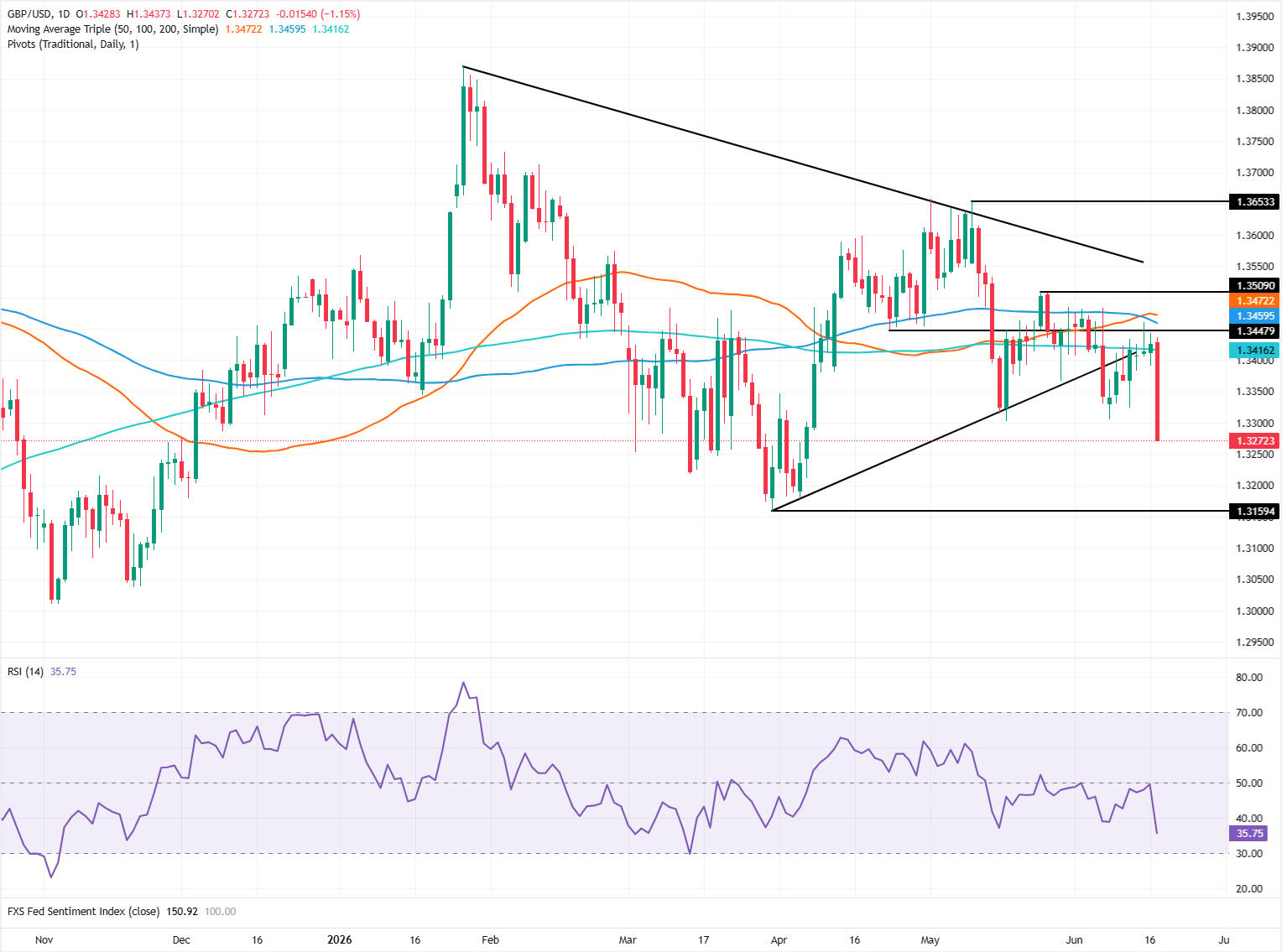
The Pound Sterling tanked by over 1% on Wednesday after the Federal Reserve decided to maintain rates, but the dot-plot in the Summary of Economic Projections (SEP) showed that most officials expect a rate cut. At the time of writing, the GBP/USD has collapsed below the 1.3300 figure, to fresh two-month lows.
GBP/USD hits two-month lows as Fed keeps inflation fight central.
Fed Chair Kevin Warsh's press conference was characterised by a lack of forward guidance, in which he recognised that he didn’t submit his economic projections, more importantly, the path of interest rates. Nevertheless, he said that “inflation is well ahead of the 2% goal,” and that FOMC members are unanimous that they will deliver price stability.
Regarding the statement, he said it just provides the facts. Warsh added that he will be using task forces on communications, balance sheet, data sources, productivity, jobs, and inflation, among others, to evaluate the current Fed frameworks.
When asked about the dual mandate, he said that the Fed does not have a “cruel choice” between price stability and maximum employment but acknowledged that the Fed “have work tod do on price stability front.”
Fed monetary policy statement
In the statement, the Fed eliminated forward guidance language, marking Kevin Warsh’s first lead on monetary policy. The Fed recognized that the economy continues to grow strongly despite uncertainties surrounding the Middle East conflict, and noted that the jobs market remains stable, with the unemployment rate staying nearly unchanged.
Furthermore, “Inflation remains elevated relative to the Committee’s 2 per cent goal, in part reflecting supply shocks that have driven price increases in certain sectors, including energy. The Committee will deliver price stability.”
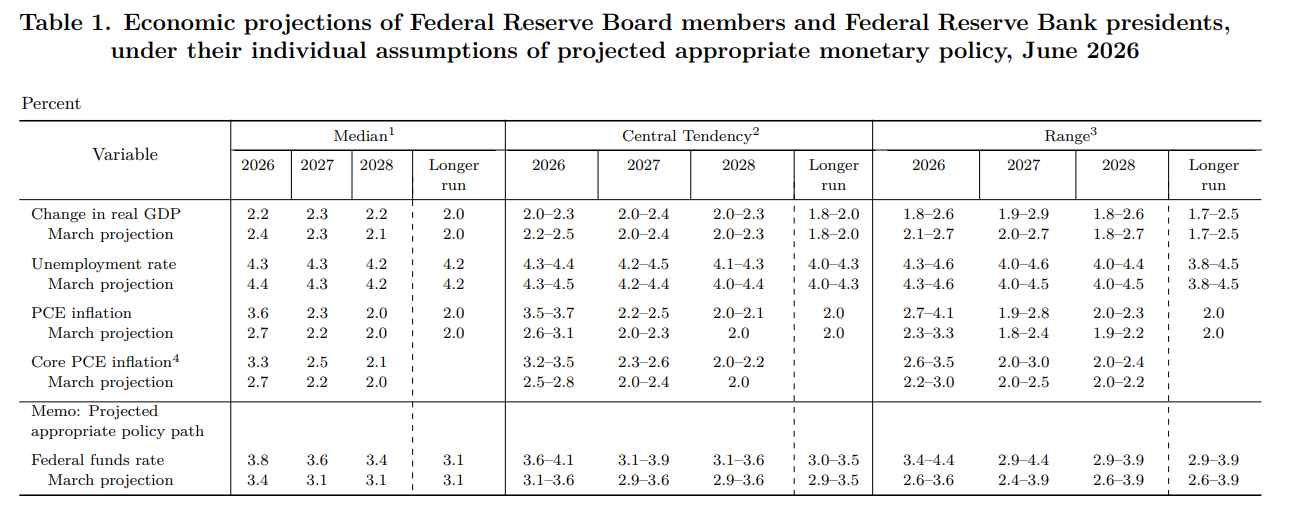
The Summary of Economic Projections (SEP) indicates that the median forecast is for the Fed Funds Rate to finish at 3.8%, up from 3.4% in March. The economy is expected to expand by 2.2% by the end of 2026. Meanwhile, Core PCE, the Fed’s preferred inflation measure, is projected at 3.3%, which is 1.3% above the Fed’s 2% target.
GBP/USD reaction to the decision
The GBP/USD continues to extend its losses past the 1.3300 figure, as Fed Chair Kevin Warsh said the central bank has work to do on price stability. This pushed US Treasury yields higher, with the US 2-year T-note, the most sensitive to interest rate expectations, up 15 basis points at 4.20%.
Fed FAQs
Monetary policy in the US is shaped by the Federal Reserve (Fed). The Fed has two mandates: to achieve price stability and foster full employment. Its primary tool to achieve these goals is by adjusting interest rates. When prices are rising too quickly and inflation is above the Fed’s 2% target, it raises interest rates, increasing borrowing costs throughout the economy. This results in a stronger US Dollar (USD) as it makes the US a more attractive place for international investors to park their money. When inflation falls below 2% or the Unemployment Rate is too high, the Fed may lower interest rates to encourage borrowing, which weighs on the Greenback.
The Federal Reserve (Fed) holds eight policy meetings a year, where the Federal Open Market Committee (FOMC) assesses economic conditions and makes monetary policy decisions. The FOMC is attended by twelve Fed officials – the seven members of the Board of Governors, the president of the Federal Reserve Bank of New York, and four of the remaining eleven regional Reserve Bank presidents, who serve one-year terms on a rotating basis.
In extreme situations, the Federal Reserve may resort to a policy named Quantitative Easing (QE). QE is the process by which the Fed substantially increases the flow of credit in a stuck financial system. It is a non-standard policy measure used during crises or when inflation is extremely low. It was the Fed’s weapon of choice during the Great Financial Crisis in 2008. It involves the Fed printing more Dollars and using them to buy high grade bonds from financial institutions. QE usually weakens the US Dollar.
Quantitative tightening (QT) is the reverse process of QE, whereby the Federal Reserve stops buying bonds from financial institutions and does not reinvest the principal from the bonds it holds maturing, to purchase new bonds. It is usually positive for the value of the US Dollar.
Author

Christian Borjon Valencia
FXStreet
Markets analyst, news editor, and trading instructor with over 14 years of experience across FX, commodities, US equity indices, and global macro markets.