|

Breaking: EUR/USD drops below 1.0200 for the first time since December 2002

Breaking: EUR/USD drops below 1.0200 for the first time since December 2002

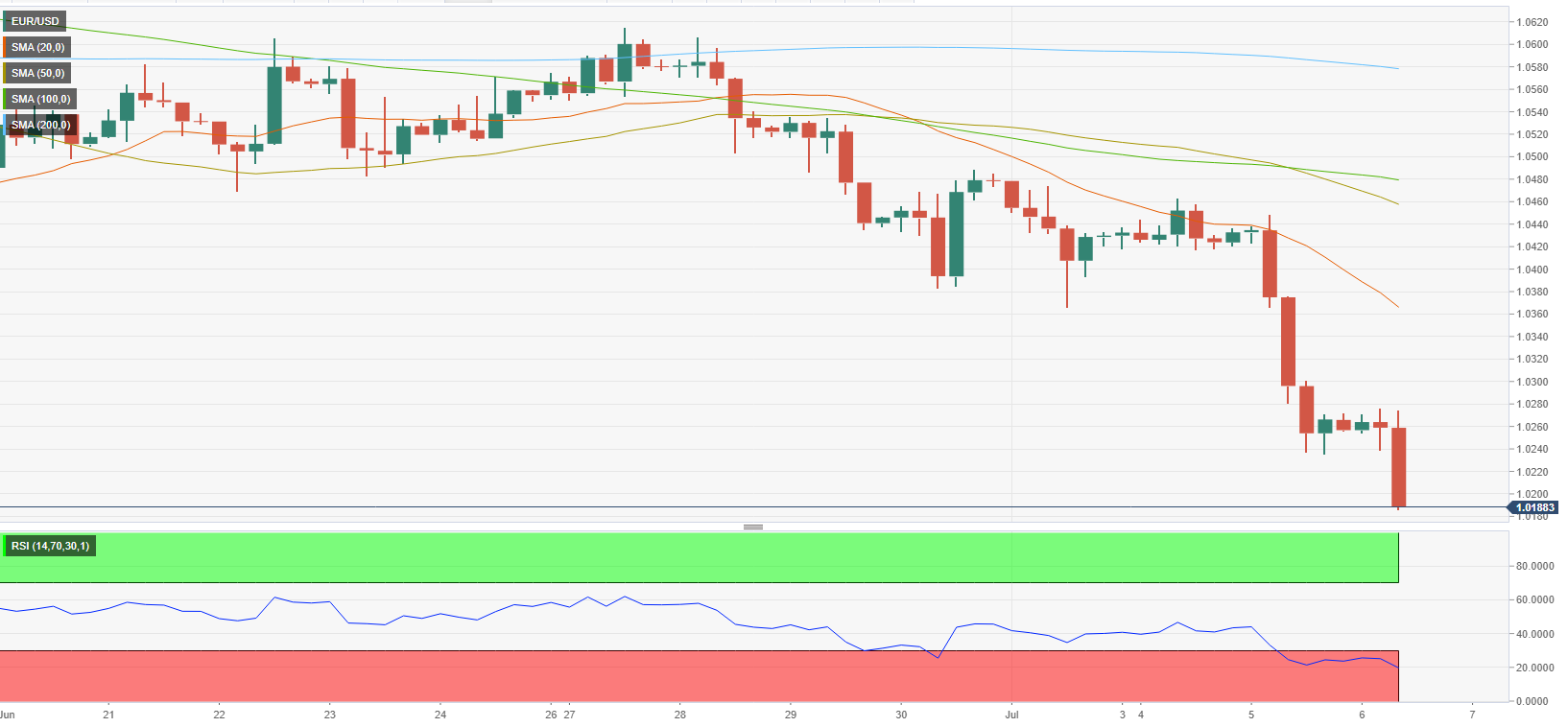
Following a brief consolidation phase, EUR/USD came under strong bearish pressure during the European trading hours and dropped below 1.0200 for the first time since December 2002.

The pair is already down nearly 3% since the beginning of July. Investors grow increasingly concerned over the energy crisis causing the European economy to tip into recession before the end of the year. Earlier in the day, the data published by Eurostat revealed that Retail Sales in May rose by 0.2% on a monthly basis, missing the market expectation for an increase of 0.4%. 

Although risk flows seem to have returned on Wednesday with Norway's government intervening to stop the strikes in the energy sector, the shared currency is having a difficult time finding demand. 

Later in the day, the ISM Services PMI report from the US will be looked upon for fresh impetus. Later in the day, the US Federal Reserve will release the minutes of the FOMC's June policy meeting.

EUR/USD four-hour chart
Author

FXStreet Team

Composed of a group of economic journalists and FX experts, the FXStreet content team produces and oversees all content published on FXStreet. It provides a purely journalistic approach to the Forex market.


More from FXStreet Team
Share:

Editor's Picks

AUD/USD bears retain control near YTD low, 0.6650 tested

AUD/USD sits at fresh YTD lows near 0.6550 in Friday's Asian session and looks vulnerable to further downside. The US Dollar holds near April 2025 highs amid renewed US-Iran tensions and aggressive Fed rate-hike bets. Moreover, Thursday’s dismal Aussie jobs data, the RBA’s dovish tilt and PBOC's status-quo continue to weigh on the Aussie, validating the negative outlook for the currency pair.

USD/JPY flatlines above mid-159.00s; moves little after Japan’s National CPI

USD/JPY holds above mid-159.00s in the Asian session on Friday, reacting little to Japan’s National CPI, which reaffirmed December BoJ rate hike. However, the uncertainty over the BoJ’s future policy path continues to undermine the Japanese Yen. Moreover, hawkish Fed and renewed US-Iran tensions keep the US Dollar firm near a 19-month low, supporting the pair despite looming intervention risks.


Gold extends sell-off below $3,600 on hawkish Fed repricing

Gold hits a fresh low since September 2025, falling further below $3,600 in the Asian session on Friday amid extremely oversold conditions. Aggressive Fed rate hike bets act as a headwind for the non-yielding bullion. Moreover, fears of renewed US-Iran tensions keep the safe-haven US Dollar firm near a 19-month peak, which exacerbated Gold's pain.

Bitcoin slides below $62,000, AI tokens outperform following Anthropic IPO

Bitcoin and the broader crypto market extended losses on Thursday following Anthropic's record-breaking initial public offering, while AI-related tokens remained resilient, posting gains despite weakness across major digital assets. The top crypto fell below $62,000 after Anthropic's stock market debut.

Anthropic sees a strong start, markets slide and the week ahead
For anyone harbouring the hope that today’s Anthropic IPO would help to stabilise the AI trade, those hopes appear to have been in vain with markets selling off across the board, and US markets giving up their earlier gains. The reason behind the sudden change in sentiment isn’t entirely clear even with Anthropic trading comfortably above its IPO price of $83.
Gold's 14-month low looks mild next to Silver's fall from $121 to $44
Gold has lost a third of its value since January as traders bet on more Federal Reserve rate increases. Silver has lost nearly two-thirds, because the buyers still holding Gold up have no equivalent in the Silver market. Gold is trading below $3,700 for the first time since September 2025, a little more than a third under the record near $5,600 it set in late January.