Australian Dollar trades higher against US Dollar ahead of US NFP data
- Australian Dollar gains despite the RBA seem unlikely to hike interest rates again in the near term.
- Investors keenly await the US NFP data for September, releasing at 12:30 GMT.
- The US economy is expected to have created 90K fresh jobs in September.

The Australian Dollar (AUD) is 0.17% higher at around 0.6640 against the US Dollar (USD) during the European trading session on Friday. The Aussie pair gains as the Australian Dollar rises despite experts doubting about more Reserve Bank of Australia (RBA) interest rate hikes.
Australian Dollar Price Today
The table below shows the percentage change of Australian Dollar (AUD) against listed major currencies today. Australian Dollar was the strongest against the Canadian Dollar.
| USD | EUR | GBP | JPY | CAD | AUD | NZD | CHF | |
|---|---|---|---|---|---|---|---|---|
| USD | 0.06% | -0.10% | -0.22% | 0.16% | -0.09% | -0.10% | -0.29% | |
| EUR | -0.06% | -0.16% | -0.27% | 0.07% | -0.12% | -0.15% | -0.34% | |
| GBP | 0.10% | 0.16% | -0.13% | 0.23% | 0.02% | 0.00% | -0.19% | |
| JPY | 0.22% | 0.27% | 0.13% | 0.38% | 0.13% | 0.12% | -0.06% | |
| CAD | -0.16% | -0.07% | -0.23% | -0.38% | -0.26% | -0.28% | -0.46% | |
| AUD | 0.09% | 0.12% | -0.02% | -0.13% | 0.26% | -0.02% | -0.19% | |
| NZD | 0.10% | 0.15% | -0.00% | -0.12% | 0.28% | 0.02% | -0.17% | |
| CHF | 0.29% | 0.34% | 0.19% | 0.06% | 0.46% | 0.19% | 0.17% |
The heat map shows percentage changes of major currencies against each other. The base currency is picked from the left column, while the quote currency is picked from the top row. For example, if you pick the Australian Dollar from the left column and move along the horizontal line to the US Dollar, the percentage change displayed in the box will represent AUD (base)/USD (quote).
This week, the RBA hiked interest rates by 25 basis points (bps) to 4.6%, as expected, and Governor Michele Bullock kept the door open for further policy tightening. However, strategists at Brown Brothers Harriman (BBH) highlighted that Bullock’s remarks suggested less urgency for additional tightening.” They point out that Bullock’s “hope that the four hikes this year would prove sufficient alongside confirmation that the Board considered a pause at today’s meeting took some of the hawkish edge off the decision.”
Meanwhile, the US Dollar trades subduedly ahead of the United States (US) Nonfarm Payrolls (NFP) data for September, which will be published at 12:30 GMT.
At press time, the US Dollar Index (DXY), which gauges the Greenback’s value against six major currencies, is marginally down to near 102.00.
BBH points out that expectations for the upcoming US labor market report have been marked down notably, with “consensus … looking for NFP gains of +90k vs. +162k in August.” The bank adds that Bloomberg’s “whisper number is +84k,” while alternative gauges such as “ADP private payrolls and Revelio Labs employment imply NFP gains of +67K,” underscoring the risk of a materially softer headline print relative to last month’s outcome.
AUD/USD Technical Analysis
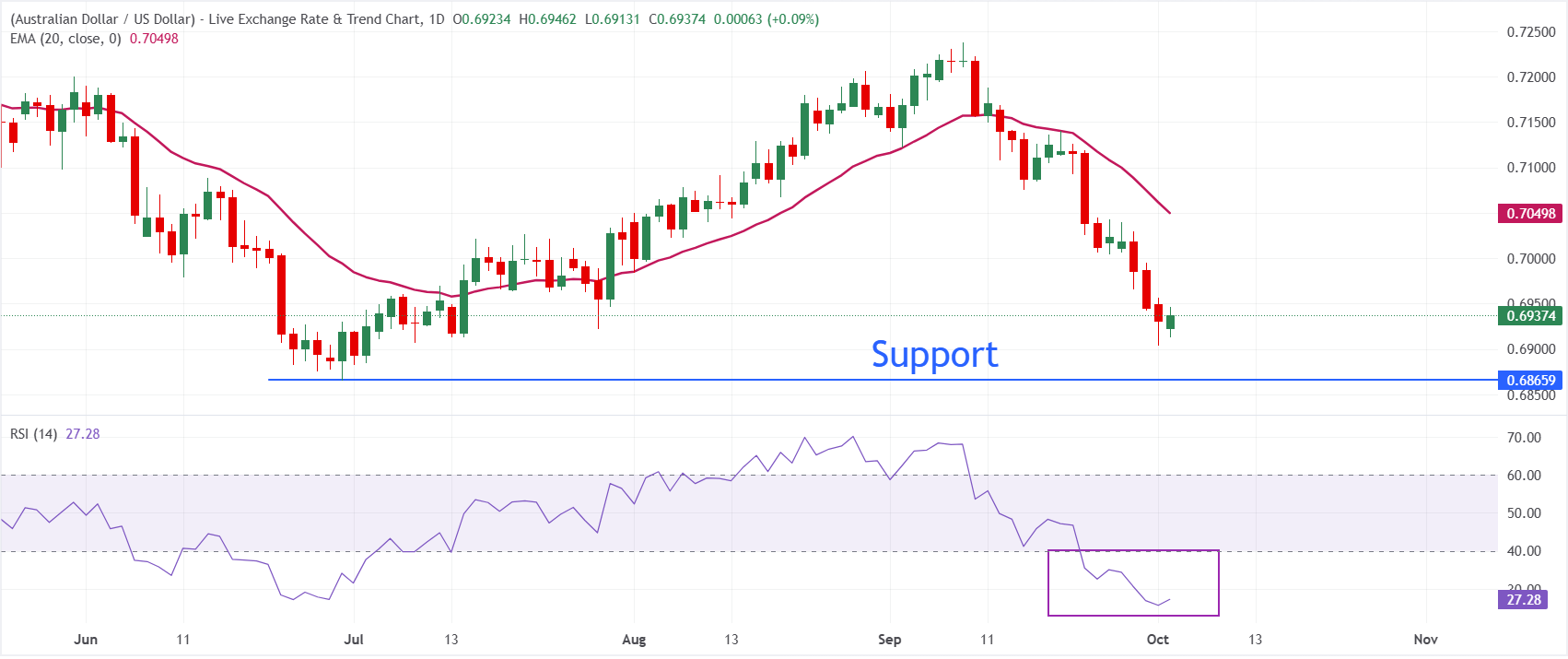
In the daily chart, AUD/USD trades at 0.6937, keeping a bearish near-term bias as spot holds beneath the 20-period exponential moving average (EMA) at 0.7050. The pair has retreated sharply from recent highs, and while the Relative Strength Index (14) sits in oversold territory near 27, this momentum backdrop only hints at stretched downside rather than a clear reversal, with price action still capped by the overlying EMA.
On the topside, initial resistance is located at the 20-day EMA around 0.7050, which acts as the first hurdle for any corrective bounce. As long as AUD/USD remains below this technical barrier, sellers are likely to retain control, and any recovery attempts would be viewed as corrective within the broader bearish phase.
(The technical analysis of this story was written with the help of an AI tool. Know more.)
Nonfarm Payrolls FAQs
Nonfarm Payrolls (NFP) are part of the US Bureau of Labor Statistics monthly jobs report. The Nonfarm Payrolls component specifically measures the change in the number of people employed in the US during the previous month, excluding the farming industry.
The Nonfarm Payrolls figure can influence the decisions of the Federal Reserve by providing a measure of how successfully the Fed is meeting its mandate of fostering full employment and 2% inflation. A relatively high NFP figure means more people are in employment, earning more money and therefore probably spending more. A relatively low Nonfarm Payrolls’ result, on the either hand, could mean people are struggling to find work. The Fed will typically raise interest rates to combat high inflation triggered by low unemployment, and lower them to stimulate a stagnant labor market.
Nonfarm Payrolls generally have a positive correlation with the US Dollar. This means when payrolls’ figures come out higher-than-expected the USD tends to rally and vice versa when they are lower. NFPs influence the US Dollar by virtue of their impact on inflation, monetary policy expectations and interest rates. A higher NFP usually means the Federal Reserve will be more tight in its monetary policy, supporting the USD.
Nonfarm Payrolls are generally negatively-correlated with the price of Gold. This means a higher-than-expected payrolls’ figure will have a depressing effect on the Gold price and vice versa. Higher NFP generally has a positive effect on the value of the USD, and like most major commodities Gold is priced in US Dollars. If the USD gains in value, therefore, it requires less Dollars to buy an ounce of Gold. Also, higher interest rates (typically helped higher NFPs) also lessen the attractiveness of Gold as an investment compared to staying in cash, where the money will at least earn interest.
Nonfarm Payrolls is only one component within a bigger jobs report and it can be overshadowed by the other components. At times, when NFP come out higher-than-forecast, but the Average Weekly Earnings is lower than expected, the market has ignored the potentially inflationary effect of the headline result and interpreted the fall in earnings as deflationary. The Participation Rate and the Average Weekly Hours components can also influence the market reaction, but only in seldom events like the “Great Resignation” or the Global Financial Crisis.
Author

Sagar Dua
FXStreet
Sagar Dua is associated with the financial markets from his college days. Along with pursuing post-graduation in Commerce in 2014, he started his markets training with chart analysis.