Australian Dollar struggles to extend gains to near 0.7000, US CPI comes into focus
- Australian Dollar rises to near 0.6980 against the US Dollar amid a pullback in US bond yields.
- Market experts see this correction in US bond yields as temporary.
- The Fed is almost certain to deliver one more interest rate hike this year.

The Australian Dollar (AUD) is up 0.3% at around 0.6980 against the US Dollar (USD) during the European trading session on Friday. However, the pair is struggling to extend gains beyond 0.6990.
The Australian currency has been an outperformer on Friday as market sentiment remains risk-on due to a pullback in United States (US) Treasury Yields.
Australian Dollar Price Today
The table below shows the percentage change of Australian Dollar (AUD) against listed major currencies today. Australian Dollar was the strongest against the Japanese Yen.
| USD | EUR | GBP | JPY | CAD | AUD | NZD | CHF | |
|---|---|---|---|---|---|---|---|---|
| USD | 0.03% | -0.02% | 0.27% | 0.09% | -0.27% | -0.11% | -0.13% | |
| EUR | -0.03% | -0.04% | 0.25% | 0.05% | -0.29% | -0.10% | -0.17% | |
| GBP | 0.02% | 0.04% | 0.29% | 0.12% | -0.24% | -0.06% | -0.07% | |
| JPY | -0.27% | -0.25% | -0.29% | -0.18% | -0.54% | -0.37% | -0.38% | |
| CAD | -0.09% | -0.05% | -0.12% | 0.18% | -0.38% | -0.20% | -0.20% | |
| AUD | 0.27% | 0.29% | 0.24% | 0.54% | 0.38% | 0.18% | 0.19% | |
| NZD | 0.11% | 0.10% | 0.06% | 0.37% | 0.20% | -0.18% | -0.00% | |
| CHF | 0.13% | 0.17% | 0.07% | 0.38% | 0.20% | -0.19% | 0.00% |
The heat map shows percentage changes of major currencies against each other. The base currency is picked from the left column, while the quote currency is picked from the top row. For example, if you pick the Australian Dollar from the left column and move along the horizontal line to the US Dollar, the percentage change displayed in the box will represent AUD (base)/USD (quote).
As of writing, S&P 500 futures are up 0.33% to near 7,800, reflecting string market mood. 10-year US bond yields are 0.42% higher to near 5.26%, but have corrected after failing extend the rally beyond 5.36%.
What is capping AUD’s upside?
The antipodean struggles to gain further as market experts see US bond Yields resuming the broader trend, with geopolitical tensions remaining intact.
Strategists at ING said in a note that Treasuries took a breather, but they stress that they "don’t see signs of a broader correction brewing." They highlight the geopolitical backdrop, noting that while US President Donald Trump has indicated the US "won’t attack Iran before the 3 November midterms," the oil market "is reluctant to price out the geopolitical premium that has kept prices above $100/bbl despite improved Gulf supply."
Going forward, the major trigger for US bond yields will be the US Consumer Price Index (CPI) data for September, which will be released on Wednesday. The data is expected to drive Federal Reserve’s (Fed) interest rate expectations significantly.
Currently, market participants are confident that the Fed will deliver one more interest rate hike this year.
AUD/USD Technical Analysis
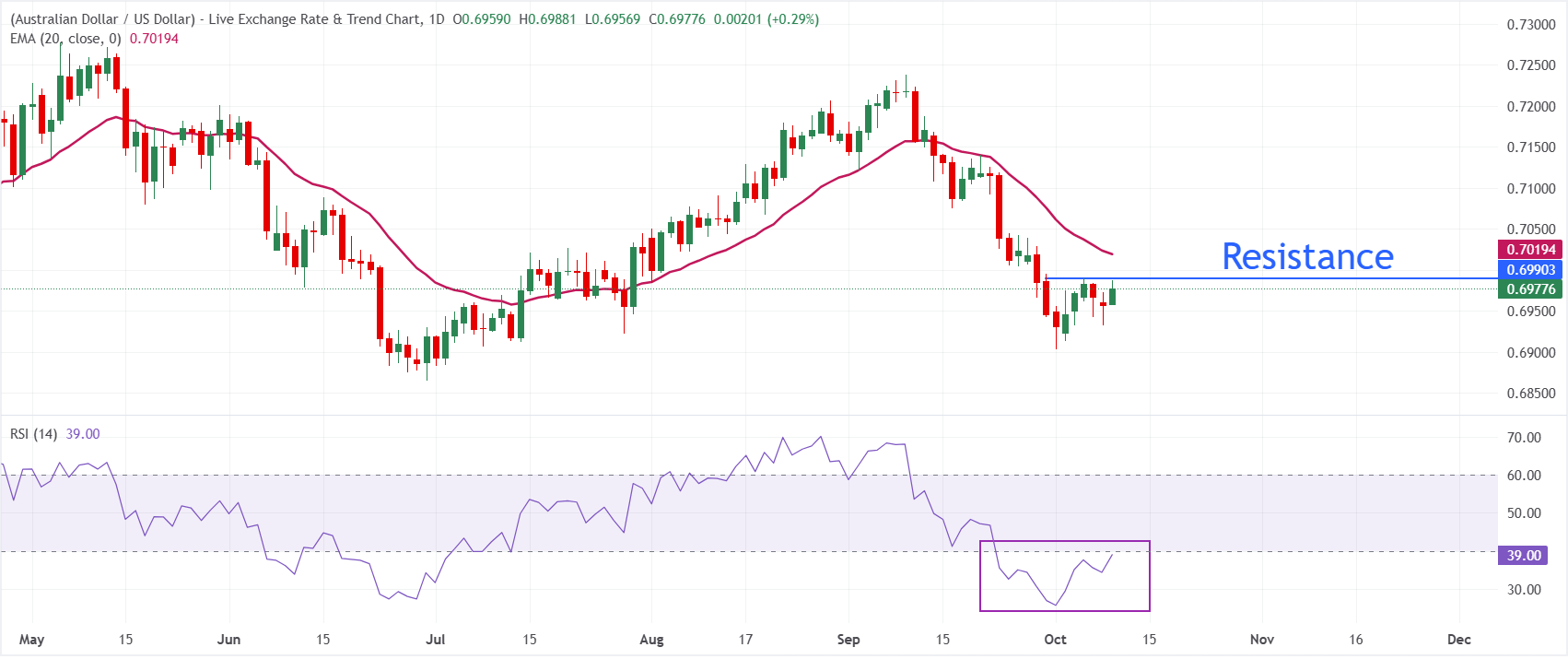
In the daily chart, AUD/USD trades at 0.6978, keeping a bearish near-term tone as spot holds beneath the 20-period exponential moving average (EMA) at 0.7019. The pair has slipped below this short-term trend gauge, suggesting that rebounds are likely to be capped while downside pressure persists, with the Relative Strength Index (RSI) near 39 hinting at weak but not oversold momentum.
On the topside, initial resistance is located at the 20-day EMA around 0.7019, and a sustained break above this barrier would be needed to ease the prevailing downside bias. With no nearby technical supports highlighted by the current dataset, price action remains vulnerable to further slippage as long as AUD/USD trades under the EMA, leaving the bears in control of the short-term outlook.
(The technical analysis of this story was written with the help of an AI tool. Know more.)
Risk sentiment FAQs
In the world of financial jargon the two widely used terms “risk-on” and “risk off'' refer to the level of risk that investors are willing to stomach during the period referenced. In a “risk-on” market, investors are optimistic about the future and more willing to buy risky assets. In a “risk-off” market investors start to ‘play it safe’ because they are worried about the future, and therefore buy less risky assets that are more certain of bringing a return, even if it is relatively modest.
Typically, during periods of “risk-on”, stock markets will rise, most commodities – except Gold – will also gain in value, since they benefit from a positive growth outlook. The currencies of nations that are heavy commodity exporters strengthen because of increased demand, and Cryptocurrencies rise. In a “risk-off” market, Bonds go up – especially major government Bonds – Gold shines, and safe-haven currencies such as the Japanese Yen, Swiss Franc and US Dollar all benefit.
The Australian Dollar (AUD), the Canadian Dollar (CAD), the New Zealand Dollar (NZD) and minor FX like the Ruble (RUB) and the South African Rand (ZAR), all tend to rise in markets that are “risk-on”. This is because the economies of these currencies are heavily reliant on commodity exports for growth, and commodities tend to rise in price during risk-on periods. This is because investors foresee greater demand for raw materials in the future due to heightened economic activity.
The major currencies that tend to rise during periods of “risk-off” are the US Dollar (USD), the Japanese Yen (JPY) and the Swiss Franc (CHF). The US Dollar, because it is the world’s reserve currency, and because in times of crisis investors buy US government debt, which is seen as safe because the largest economy in the world is unlikely to default. The Yen, from increased demand for Japanese government bonds, because a high proportion are held by domestic investors who are unlikely to dump them – even in a crisis. The Swiss Franc, because strict Swiss banking laws offer investors enhanced capital protection.
Author

Sagar Dua
FXStreet
Sagar Dua is associated with the financial markets from his college days. Along with pursuing post-graduation in Commerce in 2014, he started his markets training with chart analysis.