AUD/USD Price Forecast: A fresh downside leg looks likely below 0.6900
- Australian Dollar declines to near 0.6950 against the US Dollar amid the risk-off mood.
- Danske Bank sees 10Y and 30Y US Treasury yields rising to 6%.
- The RBA is not expected to hike interest rates in November meeting.

The Australian Dollar (AUD) is down 0.23% at around 0.6950 against the US Dollar (USD) during the European trading session on Thursday. The Aussie pair is under pressure as the antipodean underperforms amid a cautious market mood.
Australian Dollar Price Today
The table below shows the percentage change of Australian Dollar (AUD) against listed major currencies today. Australian Dollar was the weakest against the Swiss Franc.
| USD | EUR | GBP | JPY | CAD | AUD | NZD | CHF | |
|---|---|---|---|---|---|---|---|---|
| USD | -0.02% | 0.10% | 0.08% | 0.02% | 0.23% | 0.05% | -0.08% | |
| EUR | 0.02% | 0.14% | 0.11% | 0.02% | 0.20% | 0.08% | -0.07% | |
| GBP | -0.10% | -0.14% | -0.02% | -0.10% | 0.07% | -0.04% | -0.17% | |
| JPY | -0.08% | -0.11% | 0.02% | -0.08% | 0.08% | -0.06% | -0.15% | |
| CAD | -0.02% | -0.02% | 0.10% | 0.08% | 0.16% | 0.03% | -0.07% | |
| AUD | -0.23% | -0.20% | -0.07% | -0.08% | -0.16% | -0.10% | -0.25% | |
| NZD | -0.05% | -0.08% | 0.04% | 0.06% | -0.03% | 0.10% | -0.08% | |
| CHF | 0.08% | 0.07% | 0.17% | 0.15% | 0.07% | 0.25% | 0.08% |
The heat map shows percentage changes of major currencies against each other. The base currency is picked from the left column, while the quote currency is picked from the top row. For example, if you pick the Australian Dollar from the left column and move along the horizontal line to the US Dollar, the percentage change displayed in the box will represent AUD (base)/USD (quote).
At press time, S&P 500 futures are down 0.27% to near 7,780, reflecting a risk-off market sentiment. The appeal of riskier assets has diminished amid fears that the rally in United States (US) bond yields could intensify. In European trade, 10-year US bond yields are up 0.7% to near 5.33%.
Analysts at Danske Bank have highlighted that US bond yields are in a longer-term uptrend not only because of the supply of Treasuries, but also from higher bond issuance by hyperscalers. Against this setting, the bank cautions that “we do see the risk of 10Y and 30Y Treasuries hitting 6% as investors demand a higher premium for the long end,” underscoring concerns that term premia may need to rise further to clear upcoming issuance.
On the monetary policy front, financial markets don’t expect the Reserve Bank of Australian (RBA) to hike interest rates in the upcoming policy meeting in November. Money markets currently price in a 27% chance of a consecutive rate hike to 4.85% at the next RBA Board meeting, ASX Rate Tracker showed. This year, the RBA has already raised interest rates by a percent to 4.6%.
Meanwhile, elevated US bond yields continue to lend support to the US Dollar. As of writing, the US Dollar Index (DXY), which gauges the Greenback’s value against six major currencies, trades firmly near its annual high of 102.54 posted earlier this week.
AUD/USD Technical Analysis
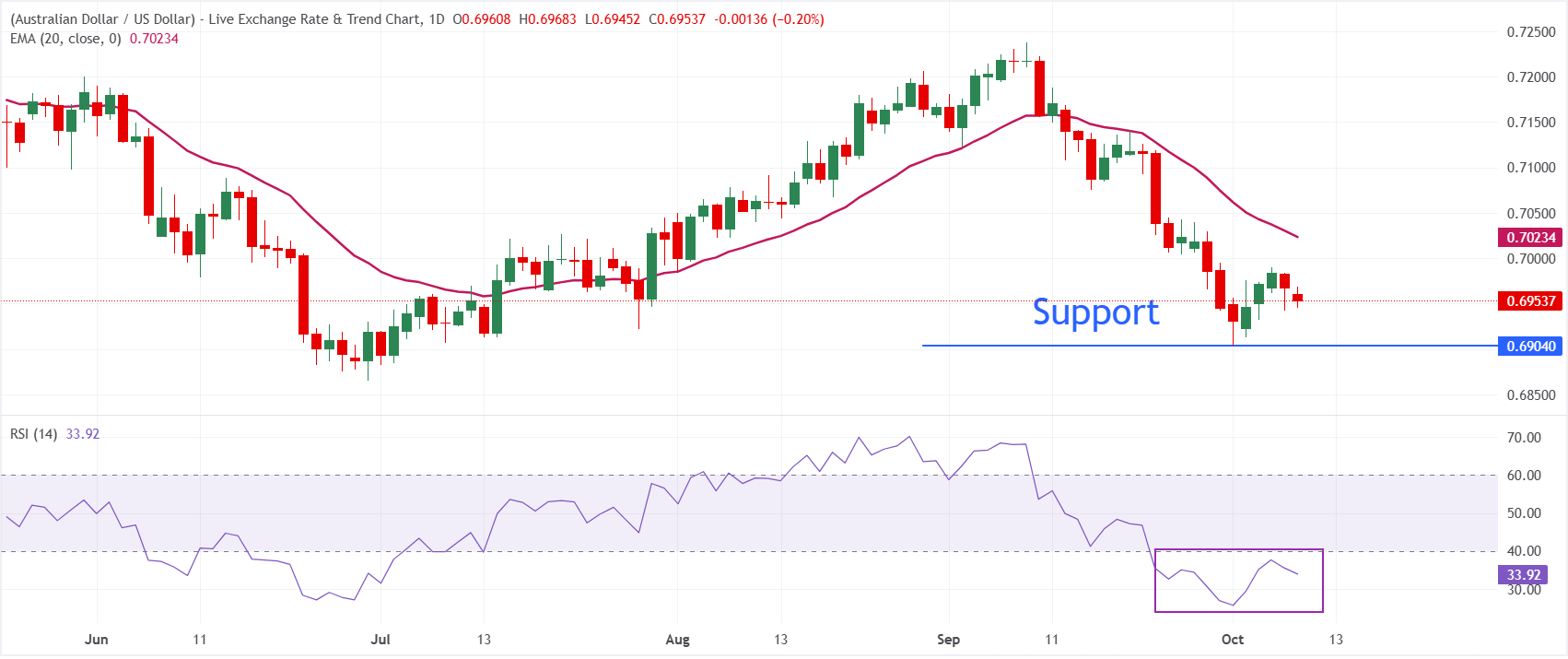
In the daily chart, AUD/USD trades at 0.6954, keeping a bearish near-term bias as spot holds beneath the 20-period Exponential Moving Average (EMA) at 0.7023. The pair has slipped away from its earlier upside phase and now trades below this short-term trend proxy, while the Relative Strength Index (RSI) at 33.9 remains under the neutral 50 mark, hinting at lingering downside pressure rather than a completed oversold condition.
On the topside, the psychological level of 0.7000 is the immediate hurdle before the the 20-day EMA around 0.7023, acting as dynamic barrier. On the downside, the October 1 low at 0.6904 is the key supoort zone; below that pair would be exposed to the June 30 low at 0.6865.
(The technical analysis of this story was written with the help of an AI tool. Know more.)
Risk sentiment FAQs
In the world of financial jargon the two widely used terms “risk-on” and “risk off'' refer to the level of risk that investors are willing to stomach during the period referenced. In a “risk-on” market, investors are optimistic about the future and more willing to buy risky assets. In a “risk-off” market investors start to ‘play it safe’ because they are worried about the future, and therefore buy less risky assets that are more certain of bringing a return, even if it is relatively modest.
Typically, during periods of “risk-on”, stock markets will rise, most commodities – except Gold – will also gain in value, since they benefit from a positive growth outlook. The currencies of nations that are heavy commodity exporters strengthen because of increased demand, and Cryptocurrencies rise. In a “risk-off” market, Bonds go up – especially major government Bonds – Gold shines, and safe-haven currencies such as the Japanese Yen, Swiss Franc and US Dollar all benefit.
The Australian Dollar (AUD), the Canadian Dollar (CAD), the New Zealand Dollar (NZD) and minor FX like the Ruble (RUB) and the South African Rand (ZAR), all tend to rise in markets that are “risk-on”. This is because the economies of these currencies are heavily reliant on commodity exports for growth, and commodities tend to rise in price during risk-on periods. This is because investors foresee greater demand for raw materials in the future due to heightened economic activity.
The major currencies that tend to rise during periods of “risk-off” are the US Dollar (USD), the Japanese Yen (JPY) and the Swiss Franc (CHF). The US Dollar, because it is the world’s reserve currency, and because in times of crisis investors buy US government debt, which is seen as safe because the largest economy in the world is unlikely to default. The Yen, from increased demand for Japanese government bonds, because a high proportion are held by domestic investors who are unlikely to dump them – even in a crisis. The Swiss Franc, because strict Swiss banking laws offer investors enhanced capital protection.
Author

Sagar Dua
FXStreet
Sagar Dua is associated with the financial markets from his college days. Along with pursuing post-graduation in Commerce in 2014, he started his markets training with chart analysis.