|

American Airlines (AAL) getting ready to break higher [Video]

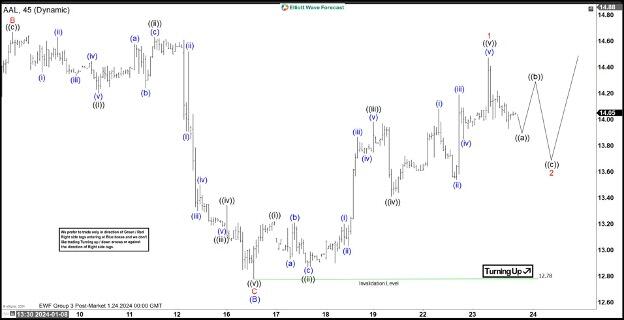
Short term view on American Airlines (AAL) suggests that rally to 14.65 on December 15, 2023 high ended wave (A). Pullback in wave (B) is proposed complete at 12.78 as the 45 minutes chart below shows. Internal subdivision of wave (B) unfolded as a zigzag Elliott Wave structure. Down from wave (A), wave A ended at 12.89 and rally in wave B ended at 14.67. Wave C lower subdivided into 5 waves. Down from wave B, wave ((i)) ended at 14.2 and wave ((ii)) ended at 14.63. Wave ((iii)) ended at 13.18 and wave ((iv)) ended at 13.34. Final leg wave ((v)) ended at 12.78 which completed wave C of (B).

The stock has turned higher in wave (C). Up from wave (B), wave ((i)) ended at 13.22 and dips in wave ((ii)) ended at 12.87. The stock resumed higher in wave ((iii)) towards 13.98 and pullback in wave ((iv)) ended at 13.41. Final leg higher wave ((v)) ended at 14.47 which completed wave 1. Stock should now pullback in wave 2 to correct cycle from 1.17.2024 low before it resumes higher. Internal subdivision of wave 2 should unfold in 3, 7, or 11 swing. As far as pivot at 12.78 low stays intact, expect the stock to resume higher again after wave 2 pullback ends.

American Airlines (AAL) 45 minutes Elliott Wave chart
AAL Elliott Wave video

Author

Elliott Wave Forecast Team

Elliott Wave Forecast Team

ElliottWave-Forecast.com

More from Elliott Wave Forecast Team
Share:

Editor's Picks

AUD/USD consolidates above 0.7000/two-month low; bearish potential intact

The AUD/USD pair oscillates in a narrow range during the Asian session, and moves little following the release of mixed inflation figures from China. Spot prices currently trade around the 0.7025 region, nearly unchanged for the day, and remain within striking distance of a nearly two-month low set on Tuesday. Renewed hostilities between the US and Iran temper hopes for a deal to end the over three-month-old war.

Japanese Yen languishes despite wholesale inflation accelerates in May

USD/JPY flatlines after experiencing volatility, trading around 160.40 during the Asian hours on Wednesday. The pair continues to hold its ground, reflecting a struggling Japanese Yen that has failed to find support despite a massive acceleration in wholesale inflation. Driven by surging energy costs linked to the ongoing Middle East conflict, Japan’s Producer Price Index jumped 6.3% year-over-year in May. This hot printing comfortably outpaced April’s upwardly revised 5.3% figure and surpassed market consensus of 5.5%, marking the fastest pace of wholesale price growth in three years.

$4,200: Gold retains bearish bias near March low ahead of US CPI

Gold recovers slightly after touching a fresh low since March 23, though it retains a bearish bias near the $4,200 mark through the early European session. Renewed hostilities between the US and Iran fuel inflationary concerns and bolster bets for more hawkish central banks, which is seen as a key factor driving flows away from the non-yielding yellow metal. Furthermore, the decline could be attributed to technical selling following the recent breakdown below the very important 200-day SMA.

Cardano's downtrend deepens despite on-chain bottoming signals

Cardano edges lower to $0.1600 signaling a potential extension of the 30% loss from last week. The altcoin remains under intense selling pressure, weighing on its retail support. Still, a spike in dormant supply re-entering circulation signals that the selling pressure has run its course, a pattern that often precedes a rebound.

US CPI data set to show inflation at three-year high in May, backing Fed hawkish tilt

The US Bureau of Labor Statistics will publish the May Consumer Price Index (CPI) data on Wednesday. The report is expected to show another step up in consumer inflation, driven by the persistently high Oil prices due to the ongoing crisis in the Middle East.

The US economy defies the rules: 100 days into the Oil shock and the recession signal is still missing

More than three months after the start of the Iran war and the resulting disruption to global energy markets, the US economy continues to display remarkable resilience. The conflict has triggered a sharp rise in Oil prices, reignited inflationary pressures and fueled widespread concerns about a potential economic slowdown.