AI boom and HBM demand to boost Micron's DRAM revenues in Q3

Key takeaways
- Micron is set to report Q3 fiscal 2026 results, with DRAM expected to drive strong growth.
- MU's DRAM revenues are estimated at $26.27B, reflecting robust AI-led demand and better pricing.
- Micron's HBM supply ties with NVIDIA, AMD and Marvell strengthen its AI market position.
Micron Technology, Inc. (MU) is set to report its third-quarter fiscal 2026 results after the market closes on June 24, and expectations are quite strong. The company has become one of the biggest beneficiaries of the AI boom, supported by rising investments in artificial intelligence (AI) and deep relationships with leading technology companies.
The Zacks Consensus Estimate for third-quarter revenues and non-GAAP earnings per share indicates a year-over-year surge of 276.1% and 998.4%, respectively. Such extraordinary growth reflects the strong demand environment for memory chips. Micron’s Dynamic Random Access Memory (“DRAM”) business is expected to remain the main growth engine in the quarter, benefiting from improving industry conditions and robust AI-driven demand.
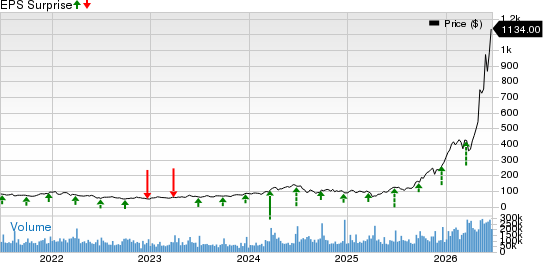
Micron Technology, Inc. price and EPS surprise
HBM and AI adoption create a major tailwind for MU’s DRAM
Micron Technology is currently operating in one of the strongest markets it has seen in years. The rapid growth of AI applications is creating enormous demand for memory and storage products, placing Micron Technology in a favorable position. Large language models and generative AI applications require huge amounts of data processing, making high-performance DRAM increasingly important.
The DRAM segment is expected to be the biggest contributor to Micron Technology’s third-quarter growth. The Zacks Consensus Estimate for DRAM revenues stands at $26.27 billion, indicating a massive 271.6% year-over-year increase.
This growth reflects not only Micron Technology’s strong execution but also the improving conditions across the memory industry. After dealing with oversupply and weak pricing in recent years, the DRAM market has become much healthier. A better supply-demand balance has strengthened pricing power, helping Micron Technology expand margins.
Another major advantage is Micron Technology’s leadership in high-bandwidth memory (HBM). The company’s mass production of its HBM for NVIDIA Corporation’s (NVDA) next-generation AI chips, including the H200, GB200 and GB300 GPUs, has positioned it as a vital supplier for AI powerhouses. With HBM supply still limited and AI demand remaining exceptionally strong, Micron Technology appears well-positioned to benefit from higher pricing and stronger DRAM revenues during the quarter.
Strategic partnerships strengthen Micron’s AI position
Micron Technology’s partnerships with major tech players such as NVIDIA, Advanced Micro Devices, Inc. (AMD) and Marvell Technology, Inc. (MRVL) are giving it a big edge in the AI race. These partnerships create stable demand and strengthen Micron Technology’s position as a key supplier in the AI and high-performance computing markets.
Its partnership with NVIDIA is particularly important. NVIDIA has selected Micron Technology as a major HBM supplier for its Blackwell GPUs and Vera Rubin AI platform, giving the company direct exposure to one of the fastest-growing segments in the semiconductor industry. As AI infrastructure spending continues to rise, this relationship could remain a meaningful growth driver.
Advanced Micro Devices also represents a valuable customer. Micron Technology’s HBM3E memory products are being used in AMD’s Instinct MI350 AI accelerators, which are gaining traction as companies expand their AI capabilities. This growing adoption is likely to support Micron Technology’s results during the quarter.
Micron Technology is also collaborating with Marvell Technology to develop advanced memory solutions for AI applications. As Marvell expands its custom AI silicon business, Micron Technology’s memory products are becoming an important part of these high-performance systems. These partnerships show that the memory chip maker is becoming a go-to supplier for companies building AI data centers and related technology.
Want the latest recommendations from Zacks Investment Research? Download 7 Best Stocks for the Next 30 Days. Click to get this free report
Author

Zacks
Zacks Investment Research
Zacks Investment Research provides unbiased investment research and tools to help individuals and institutional investors make confident investing decisions.
















