0.7000: Why the Australian Dollar is heading for deeper pullback after RBA broke its rate-hike spree
The Australian Dollar (AUD) has entered a corrective phase, surrendering part of its recent gains against the US Dollar, after the Reserve Bank of Australia (RBA) opted to break its tightening cycle and hold its benchmark cash rate at 4.35%.
Having delivered three consecutive 25-basis-point interest rate increases earlier in the year, policymakers are now pivoting to a data-dependent pause to evaluate the lagged impact of their restrictive policies.
While the central bank refuses to completely shut the door on further hikes due to sticky consumer price inflation, cooling domestic growth and a de-escalation of geopolitical risks in the Middle East have prompted prominent analysts to adopt a more bearish near-term outlook for the currency.
Yield differentials, geopolitical de-escalation cap the Aussie
Analysts at Brown Brothers Harriman (BBH) note that the Australian Dollar is losing momentum as the initial market euphoria from a US-Iran peace agreement begins to fade. They emphasize that while the RBA has preserved its hawkish optionality, the underlying financial fundamentals, specifically unfavorable interest rate gaps between Australia and the United States, strongly favor a deeper near-term pullback for the asset.
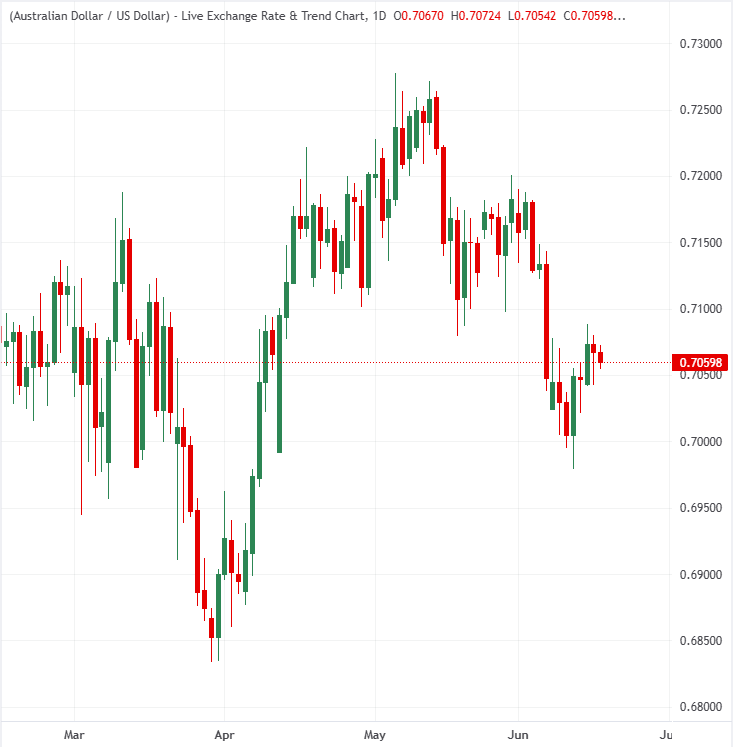
Australia-US 2-year bond yield spreads suggests AUD/USD can undershoot 0.7000 in the near-term.
Slowing economy, lower energy costs damp rate hike bets
Analysts at MUFG point out that the RBA's decision to hold rates unanimously reflects growing signs that previous monetary tightening is successfully cooling the domestic economy. With consumer spending slowing, housing markets softening, and falling global energy prices easing baseline inflationary pressures, the aggressive interest-rate expectations that previously supported the Aussie Dollar are unwinding.
The recent paring of RBA rate hike expectations and correction lower for commodity prices are currently contributing to the Australian dollar giving back some of the strong gains recorded earlier this year.
Banks anticipate downward-biased trajectory for the Australian Dollar
Analysts project a corrective near-term trend for the Australian Dollar, indicating that its earlier bullish momentum has stalled. Brown Brothers Harriman explicitly warns that the AUD/USD currency pair is vulnerable to breaking beneath the critical 0.7000 threshold. MUFG projects a period of underperformance and near-term consolidation, concluding that as the central bank remains comfortable on hold to assess cooling growth and softer global commodity markets, the Aussie will continue to give back its prior year-to-date gains.
(This article was created with the help of an Artificial Intelligence tool and reviewed by an editor.)
Author

FXStreet Insights Team
FXStreet
The FXStreet Insights Team is a group of journalists that handpicks selected market observations published by renowned experts. The content includes notes by commercial as well as additional insights by internal and external analysts.
















