The Euro takes a priced-in hike into a week that belongs to American inflation
- EUR/USD stalls under 1.1000 at a 19-month low after a five-session slide from 1.1250.
- Eurozone core inflation was revised up to 2.6% and the Euro still fell.
- Eurozone PMIs on Monday, US core PCE on Wednesday, ECB accounts on Thursday.


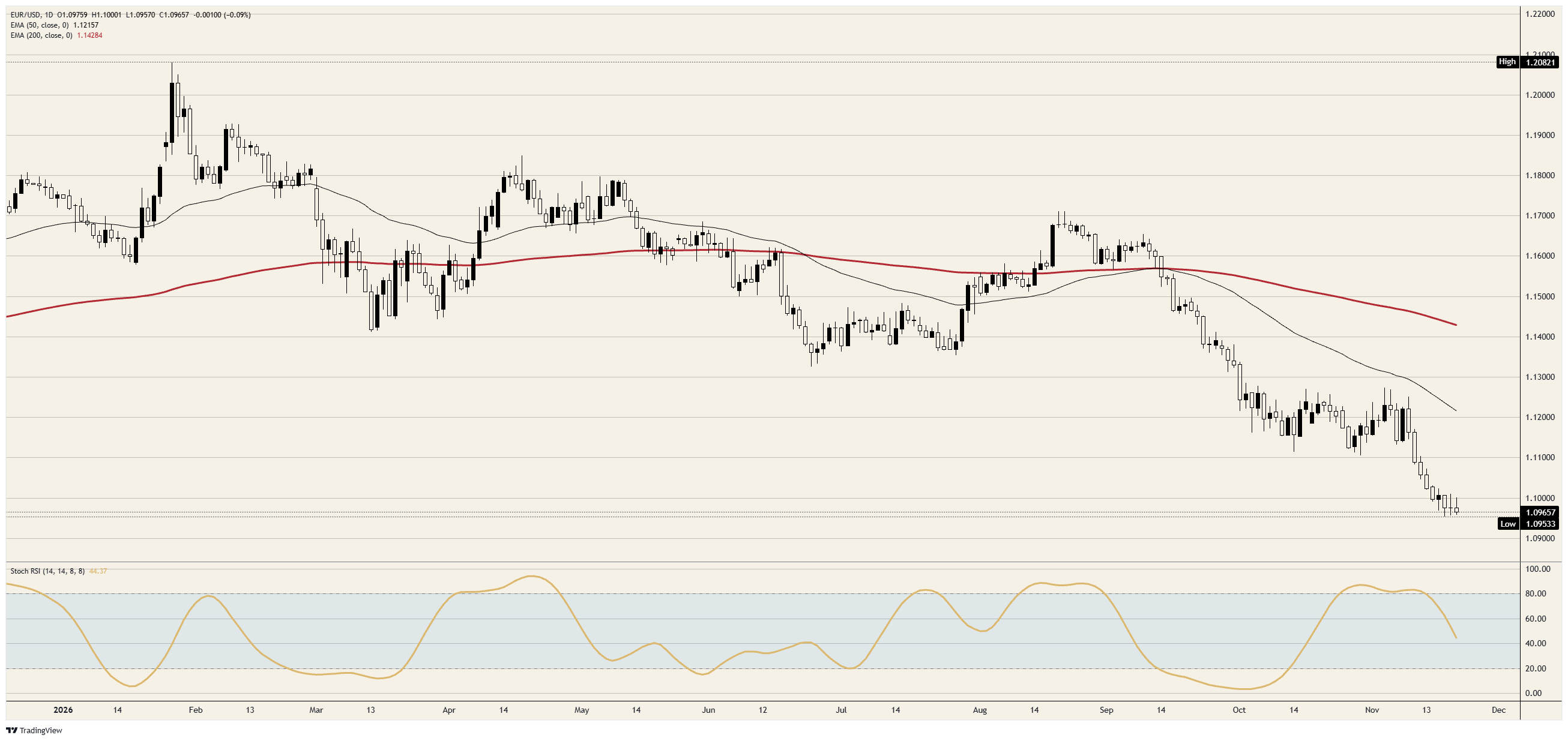
1.1000 has turned EUR/USD back in each of the past three sessions, and it did so in a week when most of the news leaned the Euro's way. Eurozone core inflation was revised higher, the ZEW sentiment survey beat its forecast, and the US factory numbers missed. The pair trades just above 1.0950 regardless, its lowest in 19 months, and has gone nowhere since Monday's break of the round number.
Good news for the Euro bought nothing above 1.1000
Eurostat's final October figures on Wednesday put core inflation at 2.6% YoY, up from a first estimate of 2.5%, and confirmed the headline rate at 4.0%. Tuesday's ZEW survey of economic sentiment came in at 26.5 against a 19.1 forecast. Traders put the odds of a European Central Bank (ECB) hike on December 17 above 90%, a move that would take the deposit rate from 2.50% to 2.75%.
The pair made its low for the year on the day of the inflation revision. A hike that's more than 90% priced has less than 10% left to add to a currency, so stronger inflation data now confirms a decision the market has already traded.
The Fed voted to hold and has argued about hiking ever since
The US calendar leaned the Euro's way as well. The Empire State and Philadelphia Fed factory surveys both came in at less than half their forecasts, industrial production fell 0.4% in October, and weekly jobless claims rose to 203K.
The Dollar didn't need the data. Minutes of the Fed's October meeting, released on Wednesday, showed almost all officials expect further hikes and a couple open to more than a quarter-point in December, and Fed Governor Waller asked for a half-point the same day. The Fed's rate is 3.75%-4.00% against the ECB's 2.50%, a gap of at least 1.25 points before either moves. October's vote was 10-2 to hold, both dissenters wanted a hike, and the committee has spent November debating how quickly to do what it voted not to do.
A December hike raises France's bill too
An ECB hike doesn't land evenly across the bloc. The extra yield investors demand to hold French 10-year debt over Germany's reached about 1.6 points earlier in November, the widest since the Eurozone debt crisis, and France's 2027 budget is still being fought over in parliament. Bank of France Governor Moulin said on Friday that France faces a budget crisis and is in a very different situation from Greece, the second time since early October he has raised the comparison in order to dismiss it.
For EUR/USD, higher ECB rates lift the yield on holding Euros and the cost of rolling French debt at the same time, which may be why a well-flagged hike hasn't put a floor under the pair. European Union (EU) leaders meet on November 26 and 27 with that budget fight unresolved.
PMIs, then PCE, then an account of a meeting already traded
The Hamburg Commercial Bank (HCOB) Purchasing Managers Index (PMI) surveys for November are due on Monday at 09:00 GMT, after a composite reading of 51.7 in October, with the US versions at 14:45 GMT. ECB Chief Economist Lane speaks the same day at 14:30 GMT.
Wednesday at 13:30 GMT is the release that matters most to the pair: October core Personal Consumption Expenditures (PCE) inflation, forecast at 3.2% YoY after 3.1%, alongside a first estimate of third-quarter Gross Domestic Product (GDP) forecast at 3.5% annualized. Traders pared their December Fed bets on Friday as US stocks sold off, so a core number at or above forecast could rebuild them and take the pair through 1.0950. A miss would hand the Euro a second look at 1.1000 with the Fed's preferred measure on its side.
US markets are shut on Thursday for Thanksgiving, which leaves the ECB's account of its October 29 meeting, due at 12:30 GMT, to a thin market. The account will show how close the Governing Council came to hiking in October, which is detail about a decision traders have already made on its behalf.
Technical levels
Resistance: 1.1000 has capped three straight sessions, with each high within about 10 pips of it. Above it, 1.1050 is where the pair paused on November 12 and 13 before breaking lower, and 1.1100 is the October floor it fell through on November 11.
Support: Wednesday's low just above 1.0950 is the 19-month low and has held on both sessions since. There's no 2026 level beneath it on the daily chart, which leaves 1.0900 as the next round number.
Bias: The lean is short while the pair stays under 1.1000. A daily close below 1.0950 targets 1.0900 first and 1.0850 after it. The daily Stochastic Relative Strength Index (Stoch RSI) is in the mid-40s and falling, so momentum isn't stretched enough to argue for a bounce on its own. A daily close above 1.1050 would put the pair back in the range it broke, and the short case ends there.
EUR/USD daily chart
Euro FAQs
The Euro is the currency for the 20 European Union countries that belong to the Eurozone. It is the second most heavily traded currency in the world behind the US Dollar. In 2022, it accounted for 31% of all foreign exchange transactions, with an average daily turnover of over $2.2 trillion a day. EUR/USD is the most heavily traded currency pair in the world, accounting for an estimated 30% off all transactions, followed by EUR/JPY (4%), EUR/GBP (3%) and EUR/AUD (2%).
The European Central Bank (ECB) in Frankfurt, Germany, is the reserve bank for the Eurozone. The ECB sets interest rates and manages monetary policy. The ECB’s primary mandate is to maintain price stability, which means either controlling inflation or stimulating growth. Its primary tool is the raising or lowering of interest rates. Relatively high interest rates – or the expectation of higher rates – will usually benefit the Euro and vice versa. The ECB Governing Council makes monetary policy decisions at meetings held eight times a year. Decisions are made by heads of the Eurozone national banks and six permanent members, including the President of the ECB, Christine Lagarde.
Eurozone inflation data, measured by the Harmonized Index of Consumer Prices (HICP), is an important econometric for the Euro. If inflation rises more than expected, especially if above the ECB’s 2% target, it obliges the ECB to raise interest rates to bring it back under control. Relatively high interest rates compared to its counterparts will usually benefit the Euro, as it makes the region more attractive as a place for global investors to park their money.
Data releases gauge the health of the economy and can impact on the Euro. Indicators such as GDP, Manufacturing and Services PMIs, employment, and consumer sentiment surveys can all influence the direction of the single currency. A strong economy is good for the Euro. Not only does it attract more foreign investment but it may encourage the ECB to put up interest rates, which will directly strengthen the Euro. Otherwise, if economic data is weak, the Euro is likely to fall. Economic data for the four largest economies in the euro area (Germany, France, Italy and Spain) are especially significant, as they account for 75% of the Eurozone’s economy.
Another significant data release for the Euro is the Trade Balance. This indicator measures the difference between what a country earns from its exports and what it spends on imports over a given period. If a country produces highly sought after exports then its currency will gain in value purely from the extra demand created from foreign buyers seeking to purchase these goods. Therefore, a positive net Trade Balance strengthens a currency and vice versa for a negative balance.
Author
Joshua Gibson
FXStreet
Joshua joins the FXStreet team as an Economics and Finance double major from Vancouver Island University with twelve years' experience as an independent trader focusing on technical analysis.

















