Australian Dollar trades sideways against US Dollar ahead of US market holiday
- AUD/USD wobbles near 0.6630 amid holiday in US markets.
- Strong US economic growth and accelerated inflation bolster case for more Fed tightening.
- Australian CPI rises at a faster-than-expected pace in October.


The Australian Dollar (AUD) trades in a tight range at around 0.6630 against the US Dollar (USD) during the European trading session on Thursday. The Aussie pair consolidates as trading activity seems quiet amid holiday in United States (US) markets due to Thanksgiving Day.
As of writing, the US Dollar Index (DXY), which gauges the Greenback’s value against six major currencies, trades flat at around 103.75.
Broadly, the outlook of the US Dollar seems upbeat as strong US economic growth and elevated inflationary pressures are paving the way for a series of Federal Reserve (Fed) interest rate hikes in the near term.
US data underline still-elevated inflation alongside stronger growth
Analysts at Danske Bank note that October US PCE inflation “was broadly in line with expectations but remain elevated,” with “headline and core PCE both rose 0.3% m/m SA (cons: 0.3%, prior: 0.3%), taking core inflation to 3.3% y/y (cons: 3.2%, prior: 3.1%).” They highlight that while “energy price growth slowed as expected, core goods inflation picked up notably and core services inflation remains on the high side of what is consistent with 2% inflation,” underscoring persistent underlying price pressures.
On activity, Danske Bank points out that “Q3 GDP growth was revised up notably to 4.3% q/q SAAR from 3.4% (cons: 3.5%), driven by stronger private consumption and investment, with final sales to domestic purchasers rising to 5.8% y/y from 4.9%.” The combination of firmer growth and still-elevated core inflation reinforces the picture of a resilient US economy and a labour market that remains consistent with a solid demand backdrop.
Meanwhile, hotter-than-projected Australian Consumer Price Index (CPI) data for October has brough a little drop in dovish Reserve bank of Australia (RBA) expectations.
Brown Brothers Harriman (BBH) notes that Australia’s October inflation data surprised on the upside, with headline CPI rising to "4.9% y/y (consensus: 4.7%) vs. 4.3% in September," driven by "Electricity, New dwellings expenditure, and Transport." The bank highlights that "both readings topped the RBA’s December forecast of 4.5% for headline inflation and 3.6% for trimmed mean inflation," and that inflation is "moving further above the RBA’s 2-3% target, weakening the case for an early cut." Reflecting this shift, BBH points out that "RBA cash rate futures now put the odds of a 25bps cut in March at 13%, down from 25%."
AUD/USD Technical Analysis
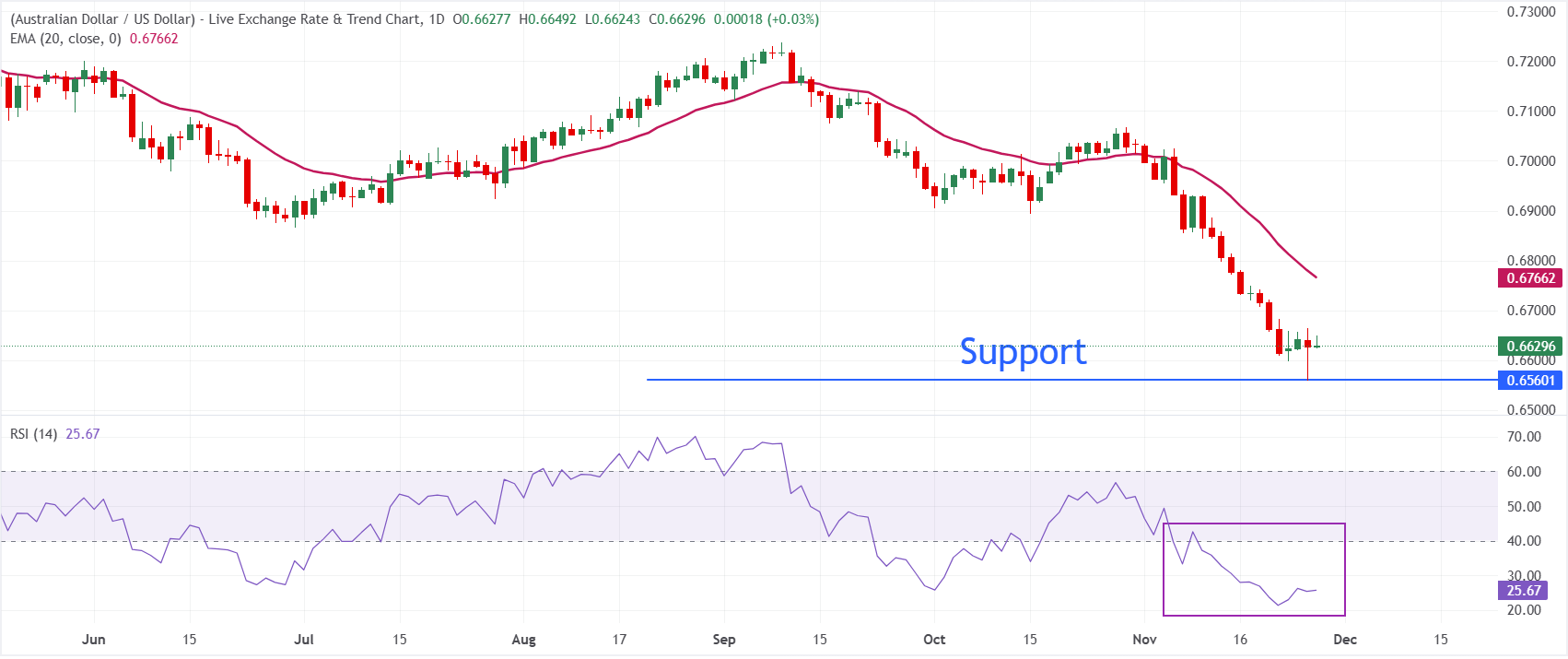
In the daily chart, AUD/USD trades around 0.6630, extending its decline and keeping a bearish near-term bias as spot remains below the 20-period exponential moving average (EMA) at 0.6766, which acts as immediate resistance overhead. The positioning under this short-term EMA suggests the pair stays in a downward corrective phase, while the Relative Strength Index (RSI) at 25.65 hovers in oversold territory, hinting that downside momentum is stretched but not yet showing a clear reversal signal.
On the topside, the 20-day EMA at 0.6766 is the first resistance to beat and a level that would need to be reclaimed to ease the current bearish pressure. On the downside, with RSI deeply oversold, the focus is on whether price can stabilize around the 0.6630 zone, as any failure to base here would leave the pair vulnerable to a continuation of the downtrend despite the increasingly stretched momentum backdrop.
(The technical analysis of this story was written with the help of an AI tool. Know more.)
Economic Indicator
Consumer Price Index (YoY)
The Consumer Price Index (CPI), released by the Australian Bureau of Statistics on a monthly basis, measures the changes in the price of a comprehensive basket of goods and services acquired by household consumers. The indicator is the primary measure of headline inflation after a new methodology was applied to transition from quarterly to monthly readings, applying to data from April 2024 onwards. The YoY reading compares prices in the reference month to the same month a year earlier. A high reading is seen as bullish for the Australian Dollar (AUD), while a low reading is seen as bearish.
Read more.Last release: Wed Nov 25, 2026 00:30
Frequency: Monthly
Actual: 4.9%
Consensus: 4.8%
Previous: 4.3%
Source: Australian Bureau of Statistics
Author
Sagar Dua
FXStreet
Sagar Dua is associated with the financial markets from his college days. Along with pursuing post-graduation in Commerce in 2014, he started his markets training with chart analysis.
















