Using VWAP To Increase Order Flow Signal Returns

At Littlefish, we are constantly testing and trialing our indicators to enhance the returns these indicators can deliver. One of the excellent ways of achieving improvement in returns is combining indicators for additional confirmation for trading sets ups.
Today I would like to take look at one of my favorite combination plays. Using the VWAP indicator as a tool for front running the turn in Order Flow. This combination play provides high probability entries and increases the the profits available from Order Flow trading.
VWAP stands for Volume Weighted Average Price and is derived by applying the most well known concept of technical analysis, the moving average, to the theory of volume. It measures the average price weighted by volume, and is mostly commonly used on intraday charts to determine the market direction.
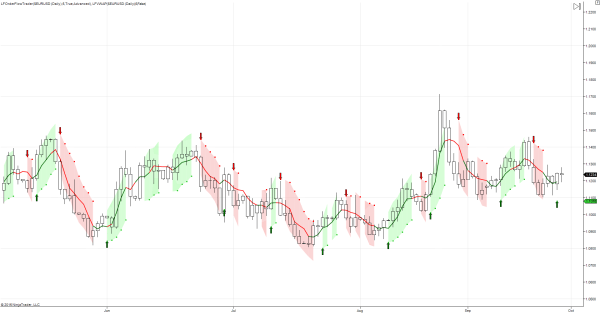
VWAP is calculated by taking the Dollar value of all trading periods and then dividing by the total trading volume for the current day.
The easiest way to measure VWAP is to use it as a simple moving average. Therefore, if price is above the VWAP, price is rising, but if price is below the VWAP, it suggests that price is falling. As we mentioned above, the VWAP can indicate where trends are developing in the market.
It is the ability to define trend development or reversal that make this tool so powerful when combined with simple support and resistance levels.
My preferred setting for the VWAP and Order Flow trader indicators are 5 period length calculated on close.
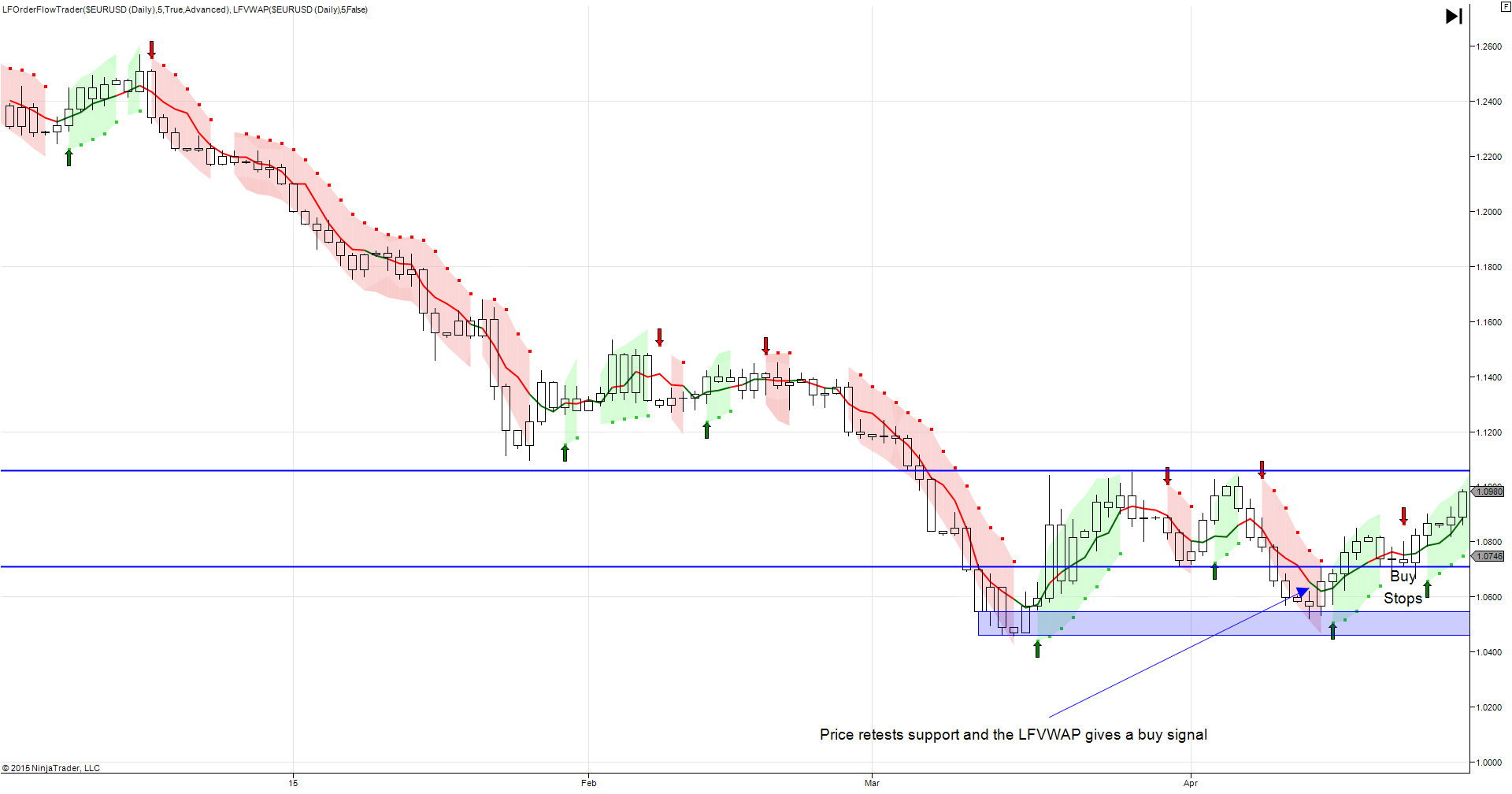
As you can see from the chart example below the EURUSD was trading in a down trend testing the 1.04/05 level where Order Flow trader flipped bullish as price moved away from that level I mark it on the chart. I watch the price action for a retest of support as this level that may set up a daily double bottom structure. This set up offers a high probability counter trend trading opportunity when confirmed with VWAP and Order Flow trader.
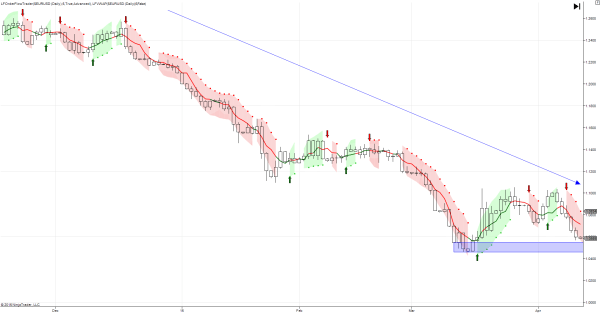
Having marked the potential support structure. I monitor price action for a retest of the bids watching the VWAP indicator to paint green over the candle or candles that test the support zone.
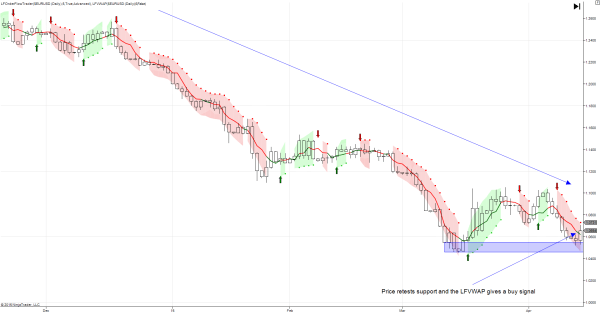
Now I have a retest of support with an VWAP buy signal. I enter Buy stops orders above the high of signal candle and I place protective sell stop orders below lows of the support level. I place an initial target at one multiple of the initial risk of the trade as highlighted in the chart below
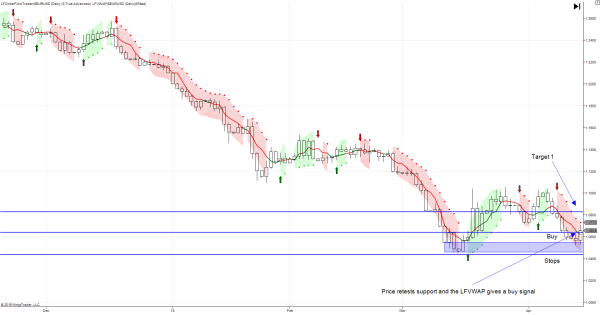
Now I have been triggered into the trade I turn my attention to Order Flow trader watching for a confirmation signal to give me a signal to add to my position and press an already profitable trade.
As you will see from the chart below Order Flow trader confirms the VWAP buy signal. With this additional signal I add to my position entering a buy order above the high of the daily close that produces the signal.
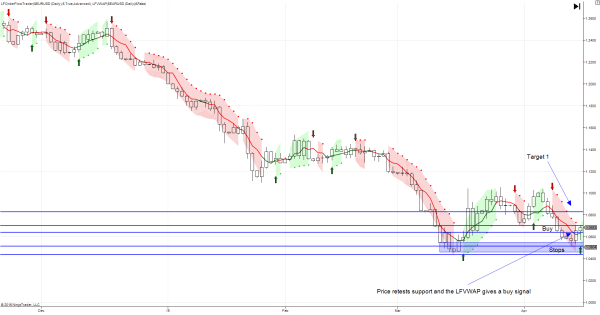
The price action develops favorably for the combined positions and tests the initial target level. At this point I close half my position. After testing the primary profit objective the VWAP flashes a sell signal at which point I move the stops on the remaining position to the original entry level. I now allow the price action to either take out the remainder of the position at break even or extend further in my favour.

Price action comes close to my break even stop but doesn’t trigger an exit. The action then reverses in my favour and breaks higher at which point I begin to monitor upside objectives.
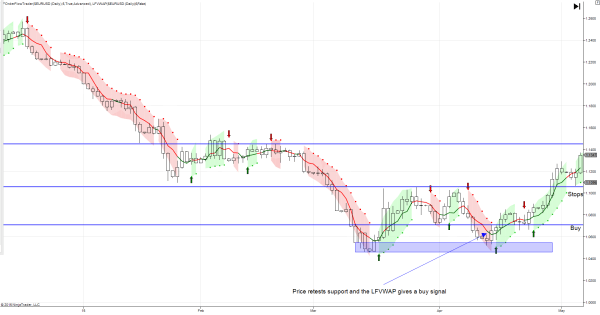
I mark the next upside resistance level. My trading plan suggests I should target a break of resistance, to then act as support. This part of my plan ultimately allows me to trail my stops and secure further profits on the trade. The next resistance level is marked on the chart below.
As price tests the resistance level I monitor VWAP and Order Flow trader for reversal signals. Price breaks the resistance zone and pushes higher as such I trail my stops just below the new broken resistance level which should act as support. I then repeat the process highlighting the next upside objective as seen in the chart below.
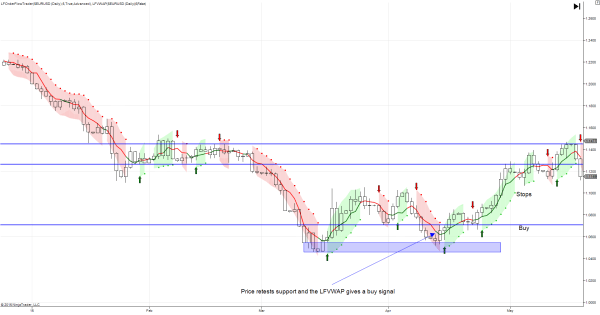
As price tests the next resistance level I once again closely monitor VWAP and Order Flow trader for potential reversal signals. Price tests the resistance level and VWAP flashes a sell signal this is my prompt to trail my stops up to the just below the candle that closes with a sell signals from VWAP.
I use the Order Flow trader trailing stop function to adjust stops giving the trade a chance to breathe but at the same time not giving back too much of the equity I have captured. As I trail my stops the next candle triggers my trailing stops and I exit the remainder of my position.
In the trade defined above the combination of the VWAP and Order Flow trader allows me to logically and methodically take advantage of simple support and resistance trading.
This combination strategy allows me to deliver professional risk rewards metrics. Risking 200pips on the initial entry I covered my risk on the trade with the first exit at +200pips the second entry which also had a 200pip risk was exited at a profit of +635pips.
Today I would like to take look at one of my favorite combination plays. Using the VWAP indicator as a tool for front running the turn in Order Flow. This combination play provides high probability entries and increases the the profits available from Order Flow trading.
Tools of The Trade
Volume Weighted Average Price – or VWAP, for short. VWAP is the key to understanding the distribution of volume…VWAP stands for Volume Weighted Average Price and is derived by applying the most well known concept of technical analysis, the moving average, to the theory of volume. It measures the average price weighted by volume, and is mostly commonly used on intraday charts to determine the market direction.
VWAP is calculated by taking the Dollar value of all trading periods and then dividing by the total trading volume for the current day.
The easiest way to measure VWAP is to use it as a simple moving average. Therefore, if price is above the VWAP, price is rising, but if price is below the VWAP, it suggests that price is falling. As we mentioned above, the VWAP can indicate where trends are developing in the market.
It is the ability to define trend development or reversal that make this tool so powerful when combined with simple support and resistance levels.
My preferred setting for the VWAP and Order Flow trader indicators are 5 period length calculated on close.
The Trading Technique
I monitor my time frame of choice seeking potential trade opportunities. I watch the charts looking for support and resistance structures to develop. Once I have these levels marked I then watch for a VWAP signal to enter a trade, with the option to add to my position if I get a corresponding Order Flow Trader confirmation.As you can see from the chart example below the EURUSD was trading in a down trend testing the 1.04/05 level where Order Flow trader flipped bullish as price moved away from that level I mark it on the chart. I watch the price action for a retest of support as this level that may set up a daily double bottom structure. This set up offers a high probability counter trend trading opportunity when confirmed with VWAP and Order Flow trader.
Having marked the potential support structure. I monitor price action for a retest of the bids watching the VWAP indicator to paint green over the candle or candles that test the support zone.
Now I have a retest of support with an VWAP buy signal. I enter Buy stops orders above the high of signal candle and I place protective sell stop orders below lows of the support level. I place an initial target at one multiple of the initial risk of the trade as highlighted in the chart below
Now I have been triggered into the trade I turn my attention to Order Flow trader watching for a confirmation signal to give me a signal to add to my position and press an already profitable trade.
As you will see from the chart below Order Flow trader confirms the VWAP buy signal. With this additional signal I add to my position entering a buy order above the high of the daily close that produces the signal.
The price action develops favorably for the combined positions and tests the initial target level. At this point I close half my position. After testing the primary profit objective the VWAP flashes a sell signal at which point I move the stops on the remaining position to the original entry level. I now allow the price action to either take out the remainder of the position at break even or extend further in my favour.
Price action comes close to my break even stop but doesn’t trigger an exit. The action then reverses in my favour and breaks higher at which point I begin to monitor upside objectives.
I mark the next upside resistance level. My trading plan suggests I should target a break of resistance, to then act as support. This part of my plan ultimately allows me to trail my stops and secure further profits on the trade. The next resistance level is marked on the chart below.
As price tests the resistance level I monitor VWAP and Order Flow trader for reversal signals. Price breaks the resistance zone and pushes higher as such I trail my stops just below the new broken resistance level which should act as support. I then repeat the process highlighting the next upside objective as seen in the chart below.
As price tests the next resistance level I once again closely monitor VWAP and Order Flow trader for potential reversal signals. Price tests the resistance level and VWAP flashes a sell signal this is my prompt to trail my stops up to the just below the candle that closes with a sell signals from VWAP.
I use the Order Flow trader trailing stop function to adjust stops giving the trade a chance to breathe but at the same time not giving back too much of the equity I have captured. As I trail my stops the next candle triggers my trailing stops and I exit the remainder of my position.
In the trade defined above the combination of the VWAP and Order Flow trader allows me to logically and methodically take advantage of simple support and resistance trading.
This combination strategy allows me to deliver professional risk rewards metrics. Risking 200pips on the initial entry I covered my risk on the trade with the first exit at +200pips the second entry which also had a 200pip risk was exited at a profit of +635pips.
Author

Littlefish FX Analysts
Littlefish FX
Our expert team of analysts, traders and IT developers have developed innovative and cutting-edge Order Flow Systems giving Littlefish FX a bank-level view of the Foreign Exchange Market.
More from Littlefish FX Analysts