Trading Guide: US ISM Non-Manufacturing PMI
If you like trading the news, you might want to take a look at the U.S. ISM non-manufacturing PMI release and how it could affect EUR/USD. I have some tips and tricks for y'all right here!
What is the ISM non-manufacturing PMI all about?
First up, let me tell you what those two acronyms mean. ISM stands for Institute of Supply Management, which is the agency responsible for measuring the Purchasing Managers' Index or PMI for both the manufacturing and non-manufacturing industries in the United States.
The non-manufacturing PMI takes into account the business conditions in the services sector, such as employment, production, new orders, prices, and inventories, to determine whether the industry expanded or contracted during the month. A reading above 50.0 indicates industry expansion while a reading below 50.0 reflects a contraction.
Since the non-manufacturing PMI shows how the services sector fared during a period, it is generally considered a leading indicator of economic growth, along with the manufacturing PMI.
How did the previous releases turn out?
Did you know that the U.S. non-manufacturing PMI has been above the 50.0 mark since December 2009? That means the services sector has been expanding for the past three years!
Of course the pace of expansion varies from month to month, as the index has seen its share of worse than expected results. But after dipping from 53.1 to 52.7 in June, the non-manufacturing PMI has been on a tear as it kept climbing over the past few months.
For September, the index landed at 55.1, higher than the estimated 53.7 reading. Note that the actual figure has been beating expectations for the past three months as well.
How could EUR/USD react?
Better than expected actual results usually trigger EUR/USD rallies while weaker than expected results typically result in a EUR/USD selloff right after the report is released. The rally usually lasts anywhere between 50 to 70 pips, as you can see from the charts below.
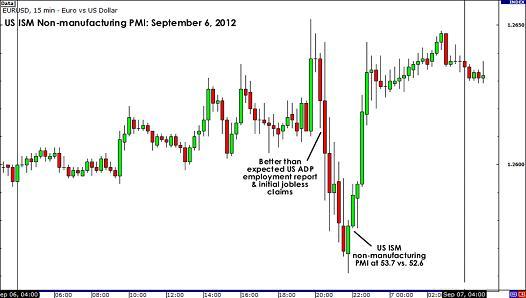
During the ISM non-manufacturing release on September 6, 2012, EUR/USD rallied from the 1.2580 area until close to the 1.2650 minor psychological resistance. At that time, the actual PMI came in better than consensus as it showed a 53.7 reading instead of 52.6.
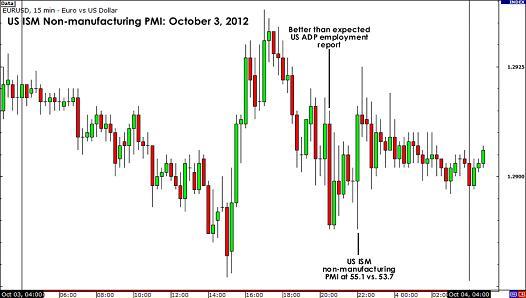
The October release showed more or less the same price pattern as EUR/USD rallied from a low of 1.2875 until the 1.2925 mark, before consolidating around 1.2900 for the rest of the U.S. session. At that time, the ISM non-manufacturing PMI also beat the consensus which was at 53.7 and came in at 55.1.
Note, however, that both September and October releases of the U.S. ISM non-manufacturing PMI were preceded by the ADP non-farm employment change report. In both instances, the ADP figure came in stronger than expected and triggered a Greenback rally, setting the stage for EUR/USD to bounce right back up after the strong PMI release.
Author

Pere Monguió
FXStreet
Pere Monguió, Head of Content at FXStreet, studied Advertisement and Public Relations at the Universitat Autònoma de Barcelona.