Heuristics in Decision Making
Trading is a very difficult job, not only because of the technical requirements but also because of the mental toughness and discipline it requires. In this article I'm going to talk about heuristics, which are “rules of thumb” that we use when faced with difficult decisions and when facing uncertainty. Whereas in real life heuristics can come in handy, when facing trading decisions heuristics are actually harmful. Here is my personal rationalization on the theme.
1. What are Heuristics
Heuristics can be defined as efficient rules which people often use to make judgements or decisions and come in handy when the amount of information required in order to make a logical and completely informed decision is either too great to administer or is just out of our reach. So we are human, and our brain has a way of it's own for dealing with these situations: mental shortcuts. Research has shown that heuristics are good enough for most purposes without being too demanding on the brain's resources:
- they are rapid;
- they can be made without full information;
- in certain situations they can be as accurate as more complicated procedures.
However, they also lead to certain biases, which are counterproductive when interacting with the financial markets.
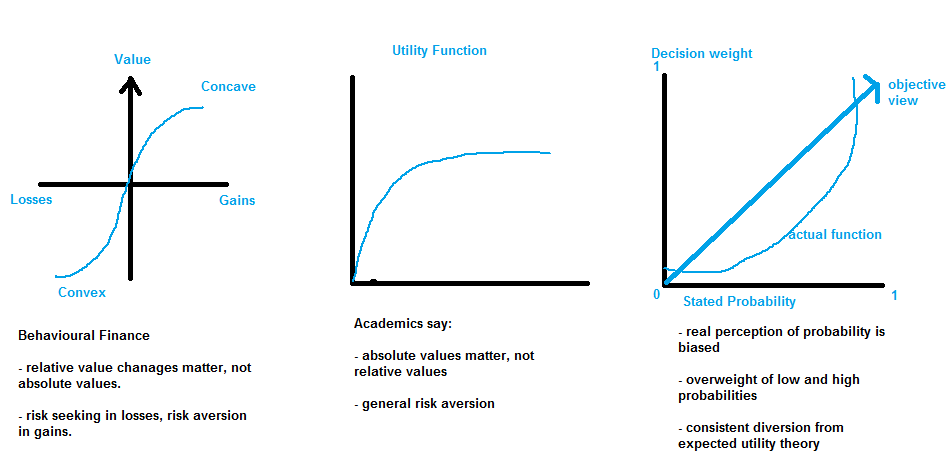
YES! We are Human!
Source: proprietary elaboration
2. What are the main biases
Following are the main biases that heuristics generate, some real-world examples and potential solutions I feel may be useful to traders and investors alike.
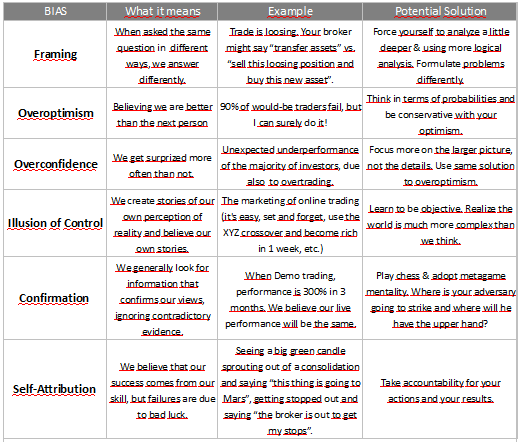
To sum up: one of the main qualities a person should have, in order to overcome the difficulties of trading & investing, is equilibrium. Here, I intend equilibrium from a psychological perspective. Understand if you are being blinded by a bias, and work around it. Try to be patient and explore the situation at hand (on the chart) and trade what you see as opposed to what you think.
Good Luck!
REFERENCES
1. http://en.wikipedia.org/wiki/Heuristic
2. Judgment under Uncertainty: Heuristics and Biases, Amos Tversky; Daniel Kahneman, Science, New Series, Vol. 185, No. 4157. (Sep. 27, 1974), pp. 1124-1131.
1. What are Heuristics
Heuristics can be defined as efficient rules which people often use to make judgements or decisions and come in handy when the amount of information required in order to make a logical and completely informed decision is either too great to administer or is just out of our reach. So we are human, and our brain has a way of it's own for dealing with these situations: mental shortcuts. Research has shown that heuristics are good enough for most purposes without being too demanding on the brain's resources:
- they are rapid;
- they can be made without full information;
- in certain situations they can be as accurate as more complicated procedures.
However, they also lead to certain biases, which are counterproductive when interacting with the financial markets.
YES! We are Human!
Source: proprietary elaboration
2. What are the main biases
Following are the main biases that heuristics generate, some real-world examples and potential solutions I feel may be useful to traders and investors alike.
To sum up: one of the main qualities a person should have, in order to overcome the difficulties of trading & investing, is equilibrium. Here, I intend equilibrium from a psychological perspective. Understand if you are being blinded by a bias, and work around it. Try to be patient and explore the situation at hand (on the chart) and trade what you see as opposed to what you think.
Good Luck!
REFERENCES
1. http://en.wikipedia.org/wiki/Heuristic
2. Judgment under Uncertainty: Heuristics and Biases, Amos Tversky; Daniel Kahneman, Science, New Series, Vol. 185, No. 4157. (Sep. 27, 1974), pp. 1124-1131.
Author
_Profile.jpg)
JupaFX
Independent Analyst
More from JupaFX