Losing money on the US dollar? Learn to smile

The US Dollar can be counterintuitive
Many presume that a strong US economy and high US interest rates translate into a strong US dollar and vice-versa. Granted, that may be true sometimes, but it doesn't hold true all the time. To increase your success at forex trading, it is always best to consider the US dollar in the context of the prevailing wider macroeconomic picture.
US Dollar Index (DXY) vs. US 2-Year Bond Yield
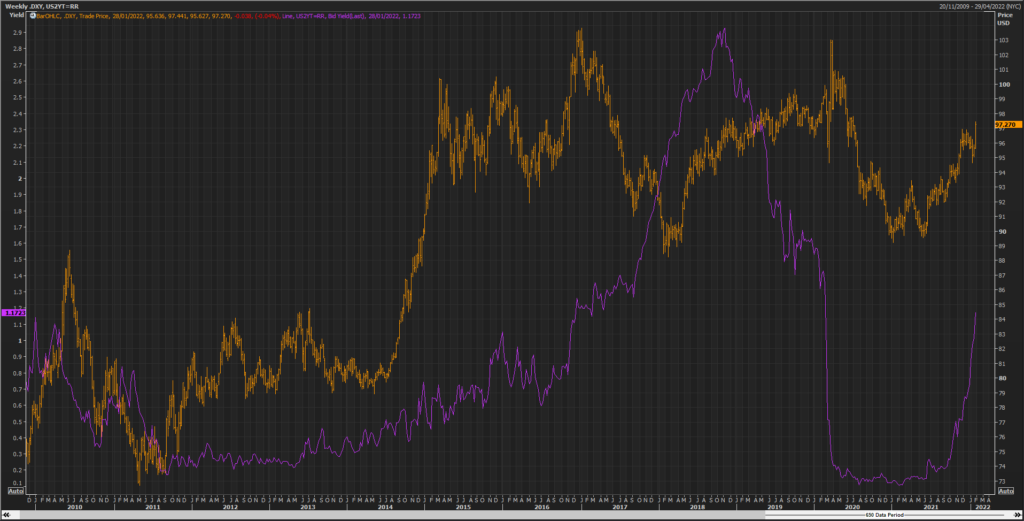
The DXY is not always correlated with US yields
Dollar smile theory can help you
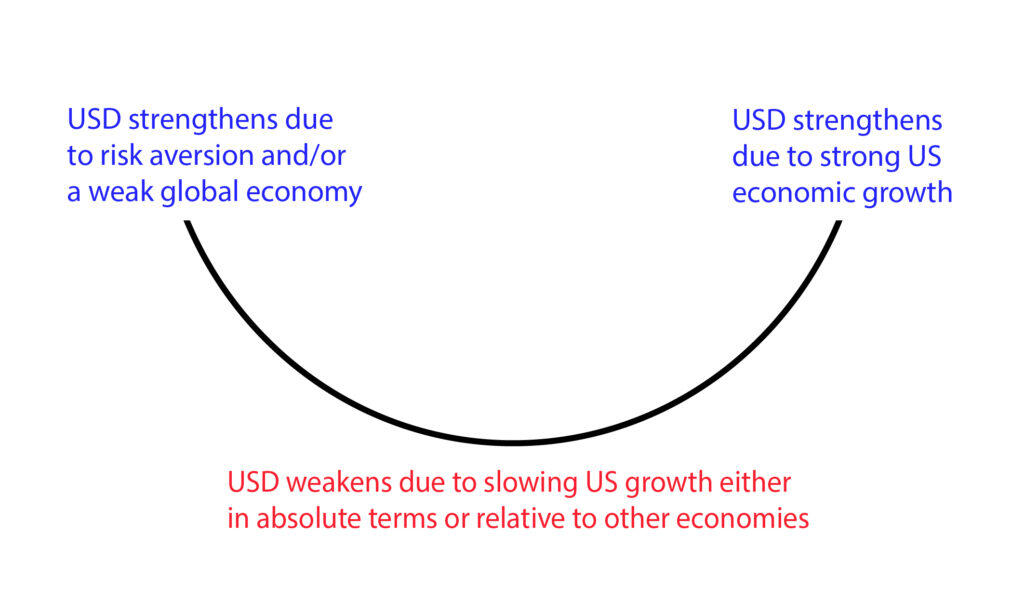
Stephen Jen, a former economist at the International Monetary Fund and Morgan Stanley, defined "Dollar Smile Theory" to provide traders and investors an easier way to frame what can sometimes seem counterintuitive moves in the US dollar.
Dollar smile theory
Breaking it down
The US dollar strengthens when the global economy is stressed or when risk aversion is high for other reasons such as heightened geopolitical tensions. At these times, the US dollar, the world's reserve currency takes on its safe-haven role. Global investors tend to plow their money into US Treasury securities for their safety, thereby selling foreign denominated securities and buying the US dollar.
Likewise, the US dollar can also strength when the US economy is performing strongly. This is typically accompanied by the prospect of higher US interest rates leading to financial flows to US securities, which leads to US dollar buying.
A weaker US dollar usually accompanies slower US economic growth: both weaker in comparison to the pastor on a relative basis with other economies. For example, in terms of the latter, if the difference between US economic performance versus the euro area narrows or inverts. Under these circumstances financial flows tend to flow out of the US and into foreign currency-denominated securities, increasing US dollar selling.
Author

Carl Paraskevas
VARIANSE
Carl Paraskevas has over twenty years’ experience in finance and banking, primarily in research related roles at several institutions.