Does the Forex Market Have Gaps? Oh Yes It Does!
Hello traders! In previous Lessons From the Pros newsletters, we've discussed many of the differences and a few of the similarities between the spot foreign currency market and other markets you may be trading, such as the U.S. stock market or futures markets. This week I want to show you how the weekend gap can occasionally be a good trading opportunity for the Forex trader.
Before we get too far, we must define what a gap is. Investopedia.com defines a "gap" as:
A break between prices on a chart that occurs when the price of a stock makes a sharp move up or down with no trading occurring in between. Gaps can be created by factors such as regular buying or selling pressure, earnings announcements, a change in an analyst's outlook or any other type of news release.
The vast majority of time gaps occur from the previous day's close to the next day's open. Occasionally, gaps will occur DURING the regular trading day - this is rare. While stocks can and will have gaps nearly every trading day ranging from a penny to many dollars difference between yesterday's close and today's open, the spot Forex market is only closed from Friday afternoon to Sunday afternoon. We routinely have gaps in our currency pairs of a few pips, but sometimes the gap is several dozen pips. In the following chart, I've highlighted two gaps, the first is over the weekend of July 29 - 31 for about 19 pips (1.4397 down to 1.4376), the second gap over the weekend of August 5 - 7. This gap was a very impressive 125 pips (from 1.4277 up to 1.4412)!
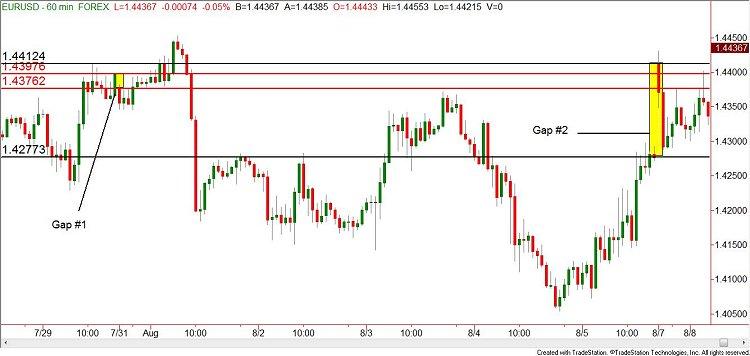
On a side note, in our current market environment with rumors and news releases disputing rumors that end up being true, I am very hesitant to hold any trades over the weekend when these gaps could occur. All it takes is one significant gap of a few hundred pips in the wrong direction to wipe out several days or weeks of good gains! This is not an extra source of risk that I would be comfortable with.
In the following chart, there are two obvious supply/resistance zones identified from the week of July 24th. With the previous mentioned gap up of over 100 pips into the supply zone, we had an opportunity to sell in the fresh zone (first red arrow) with a small risk of approximately 50 pips and a target of nearly 300 at the demand zone. In addition to the lower demand zone target, the more aggressive gap trader will be interested in a trade that "fills the gap" -basically, when price gaps away from the close, then moves back to the closing price is "filling the gap." After the gap was filled, the price action rebounded to the supply zone (second red arrow). And no, I won't even mention the double top at the supply zone.
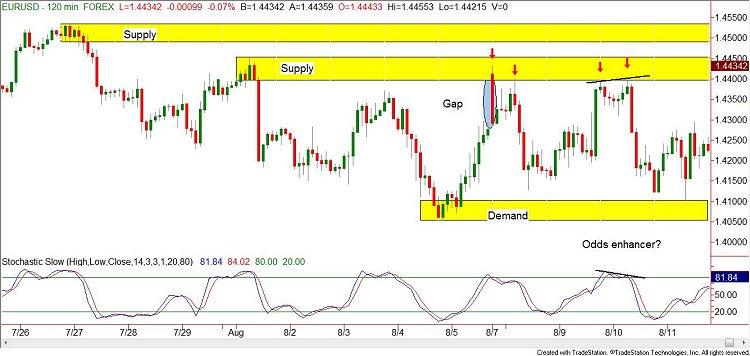
Looking at the second pair of red arrows, notice them just touching the same supply zone. While the theory that several touches will weaken any zone is usually true, this time the zone has continued to hold with no deep penetrations into the zone. In the article, "What the Dentist Taught Me About Oscillators," we discussed divergences to help us determine if we should take a trade or not. Notice the higher highs in price, but the lower highs on our Slow Stochastics. This divergence gives us a clue that price MIGHT turn around. When combined with a solid level of supply, this odds enhancer will help you trade better!
One last warning about trading the weekend gaps. In normal trading, the spreads on our currency pair are nice and small, anywhere from 1 pip up to 4 or 5 pips. However, when the market opens on Sunday afternoon, the spreads are often much wider - approaching 10 pips for many currency pairs! This adds to the risk on any trade. If you are uncomfortable with this added risk, don't trade the gap! Wait a few hours until the Asian session has fully opened and the spreads have closed. You can still use the supply and demand zones around the gap for trading later in the evening.
Author

Rick Wright
Online Trading Academy
Rick studied economics and psychology at Iowa State University, and entered into the brokerage business in 1992. He earned the NASD Series 4,7,9,10,24,55,63, and 65 licenses. He helped grow an online brokerage business which was eventually sold off.