How to Understand What Drives Currency Values Over the Long-Term
Like all other financial markets, the forex market is easier to understand and forecast if one takes a longer term view. For the long-term, patient forex investor, there are only a few factors that need to be considered:
- Trade Deficits. Trade deficits are when a country is importing more than it is exporting. When a country imports more than it exports, its constituents are selling its currency to buy a foreign currency -- and using this foreign currency to buy goods/services that are imported. As a result, the natural impact of trade deficits will be to create selling of the currency used by the country with the host deficit, which will push down its value. Trade deficit numbers are routinely reported by government bureaus, and can provide an easy way for individual traders to see big trends in how capital is flowing around the world.
- Budget Deficits. Budget deficits occur when a government spends more than it takes in, thus adding to its national debt. If a country is running a budget deficit, it will have to try to raise money by issuing debt. If the country's native population lacks savings and if foreign entities are unwilling to lend money, there is greater pressure that the government, via its central bank, will print money -- also known as "monetizing debt." This will have the impact of diluting the currency's value by creating more currency units in circulation competing for the same goods and services.
- Central Bank Activity. The actions of central banks are extremely important to monitor -- perhaps more important than any other consideration. Central banks vary in how transparent they are; the US Federal Reserve, for instance, issues weekly updates on monetary statistics, while other central banks like the Monetary Authority of Singapore publish reports just twice a year. Paying attention to central bank comments and to money supply statistics, though, can provide traders with concrete information regarding how capital is flowing. Is the central bank expanding the money supply? Do they favor low interest rates or high interest rates? If a central bank is expanding the money supply and favors low interest rates, it will have the effect of devaluing its currency; the opposite is true for central banks that tighten the money supply and raise interest rates.
And that's basically all traders need to keep an eye on to understand capital flows that will impact currency valuations in the long-term. To find a currency that will depreciate in value and is worth selling, simply look for twin deficits (budget and trade), low domestic savings, and a central bank pursuing low interest rates and aggressive expansion of the money supply. One such example of such a currency is the US dollar, which has been running twin deficits coupled with a central bank acting on inflationary monetary policy. And sure enough, its currency has been falling in value against virtually all other currencies since 2001. Traders who have observed these simple factors have profited handsomely simply by holding these long-term positions.
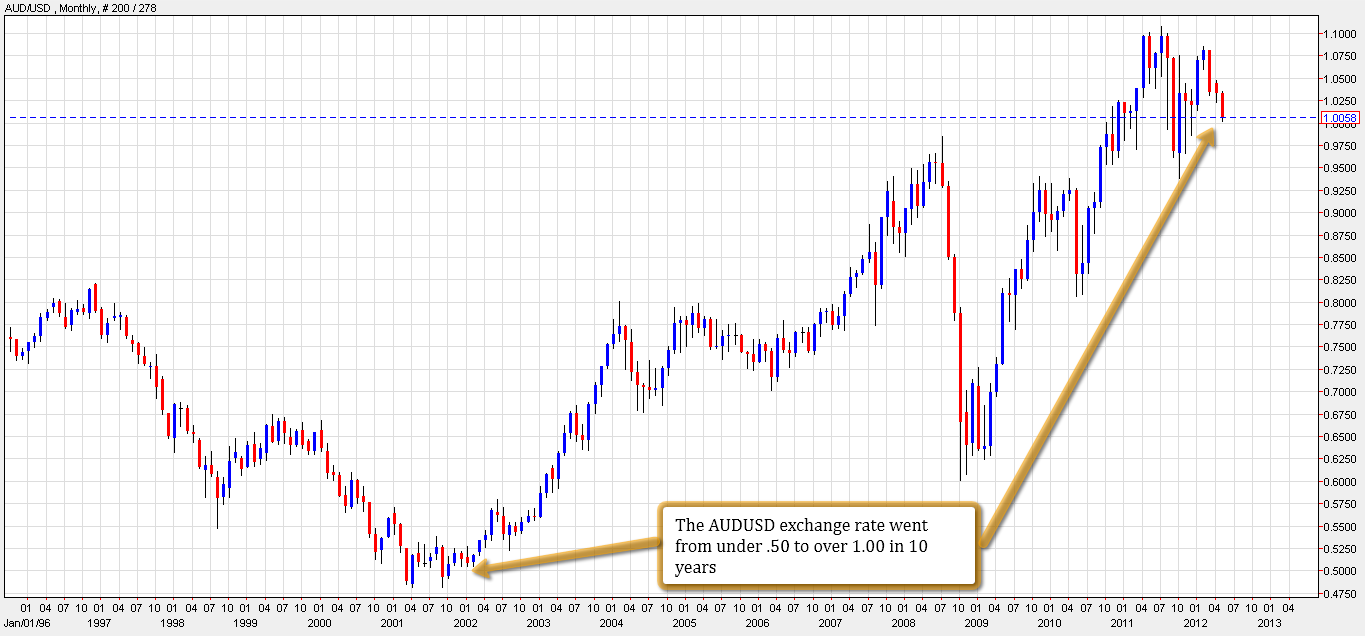
On the flip side, currencies that boast trade surpluses (meaning exports are greater than imports), budget surpluses (the government takes in more than it spends), and has a central bank that is interested in higher interest rates and less expansive monetary policy are likely to rise in value over the long-term. Such currencies are rare in our troubled global economy in which central banks are aggressively expanding the money supply and offering low interest rates in an attempt to jump start their economies, but on a relative basis, Australia has offered higher interest rates as well as budget and trade surpluses. Traders who observed this could have seen how the Australian dollar was positioned to rise in value relative to the US dollar -- and indeed, over the past 10 years, the Australian dollar has doubled in value relative to the US dollar. The chart below illustrates.
That is really all there is to it for those with the patience and discipline to pursue long-term opportunities in the forex market. For those looking to more precisely time opportunities so that they can safely take on larger positions, some basic technical analysis coupled with the simple macroeconomic factors presented here will enable even greater opportunities.
Author

Online Trading Academy Team
Online Trading Academy