What is USDT & how does it differ from the US Dollar?
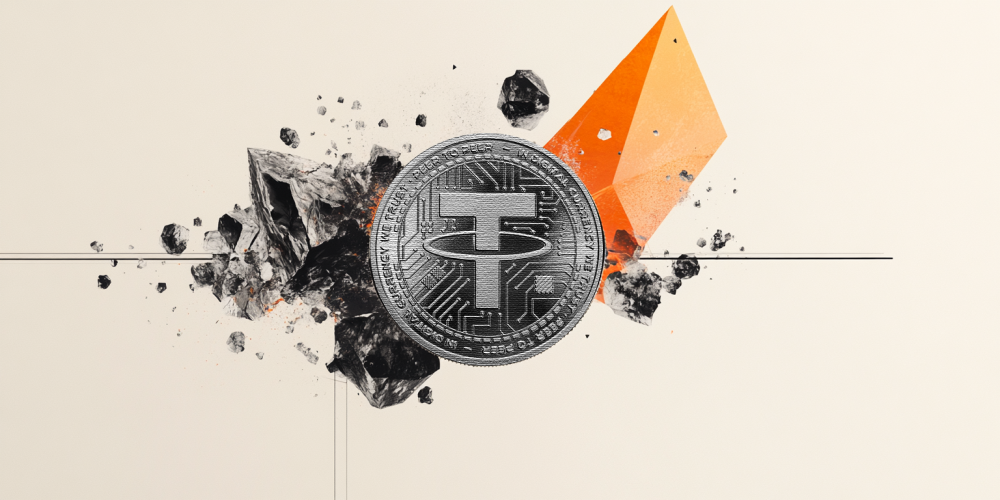
USDT (Tether) is the world's largest stablecoin — a privately issued digital token designed to hold a value of approximately one US dollar, backed by reserves rather than government authority.
With a market cap near $189.6 billion as of May 2026 (roughly 59% of the $322 billion total stablecoin market), it moves dollar value across blockchains and borders without touching conventional banking. It is not the US dollar, and that gap has real financial consequences.
Let’s discuss:
- How stable the peg really is
- Where it falls short of real USD
- How people actually use it day-to-day
- Where USDT came from and its regulatory history
- What the regulatory and competitive outlook holds
Where did USDT come from?
Stablecoins were invented to solve crypto's oldest problem — volatility makes Bitcoin impractical as a unit of account when prices can swing 10% in an afternoon.
Tether's solution, launched in 2014 under the original name Realcoin, was straightforward — issue blockchain tokens pegged one-to-one to the dollar and hold reserves to back them.
The early years were useful but controversial. In 2021, the US Commodity Futures Trading Commission fined Tether $41 million for making misleading statements about USDT's backing (a settlement that still shapes how serious observers evaluate the company). Tether now publishes quarterly attestations prepared by BDO, though critics note these fall short of a full independent audit.
By 2026, the scale had changed the conversation entirely. Tether's Q1 2026 disclosure reported total assets of approximately $191.8 billion against liabilities of $183.5 billion (a surplus of $8.23 billion), with roughly $141 billion in US Treasury bill exposure, $20 billion in physical gold, and $7 billion in Bitcoin. A company of this size is no longer a fringe crypto experiment.
How do people actually use USDT?
The honest answer depends heavily on geography. In the US and Western Europe, USDT is mostly a trading instrument — a place to park value between crypto positions without returning to a bank account. Outside those markets, the use cases get considerably more varied.
In countries with weak local currencies, capital controls, or limited access to US banking, USDT functions as a de facto dollar savings account.
A freelancer in Nigeria can receive payment in USDT and sidestep both naira depreciation and the friction of international wire transfers. A small importer in Turkey can hold working capital in digital dollars rather than watching the lira erode.
Common applications include:
- Crypto trading as a base currency
- Peer-to-peer settlement where banks are slow
- Remittances to markets with limited banking access
- Dollar-denominated savings in high-inflation economies
- Cross-border business payments and freelancer payouts
One practical caveat — USDT is not as frictionless as cash.
Users manage wallet addresses, choose blockchains (Ethereum, Tron, and Solana are the main ones), pay network fees, and bear full responsibility for sending to correct addresses. An incorrect network selection can result in permanent loss of funds (with no customer service to call).
For Canadians sending money abroad, regulated services like RemitBee offer comparable speed and cost advantages with FINTRAC compliance, guaranteed transfers, and zero fees on amounts over $500 CAD — without the self-custody risks. The demand USDT taps into (fast, low-cost international transfers) is real; the risk profiles are simply different.
How stable is USDT's peg?
In ordinary conditions, USDT holds remarkably close to $1. DeFiLlama's May 2026 data showed the token trading at par, with only minor deviations visible.
The peg is maintained through reserve backing, market arbitrage (large traders profit from buying at a discount and redeeming at par), and exchange liquidity.
The more relevant question is how stability holds under stress.
S&P Global's 2025 assessment downgraded USDT to its weakest stability category, citing gaps in reserve composition and transparency, while acknowledging the token's consistent peg performance during volatile periods. That split verdict captures the situation accurately.
Stability factor | USDC (Circle) | USDT (Tether) |
Reserve composition | 100% cash and government MMFs | T-bills, gold, and Bitcoin mix |
Reserve transparency | SEC-registered fund, high disclosure | Quarterly attestation (not full audit) |
S&P stability rating | Stronger category | Downgraded to weakest |
Peg track record | Stable | Stable, with 2023 redemption pressure |
The $8.23 billion surplus buffer provides a margin — but gold and Bitcoin fluctuate in price while T-bills don't, making the reserve mix less conservative than USDC's structure.
How is USDT different from the US dollar?
The gap between USDT and USD narrows in calm conditions and widens under stress. Several differences are structural rather than circumstantial.
Issuer risk
Physical dollars and FDIC-insured deposits don't depend on any single private company. USDT does — if Tether's reserves, banking relationships, or legal standing were impaired, token holders bear that directly.
Redemption friction
Converting USDT back to dollars requires going through Tether directly (with minimum thresholds), an exchange, or peer-to-peer markets.
During the March 2023 banking stress, USDC briefly de-pegged when Circle disclosed $3.3 billion in exposure to Silicon Valley Bank. Friction becomes visible exactly when it's most unwanted.
Legal standing
USDT carries no government guarantee, no deposit insurance, and limited legal protections in most jurisdictions.
Under the GENIUS Act (enacted July 18, 2025), starting in July 2028, US persons may hold stablecoins only from permitted issuers — and Tether, not being a US-licensed entity, has unresolved compliance positioning under that framework.
Yield gap
Holding USDT pays nothing. Tether earns income on T-bill reserves but doesn't pass that yield to ordinary holders (unlike a money market fund, which does reflect prevailing interest rates).
What does USDT's future look like?
The Federal Reserve reported in April 2026 that stablecoins grew roughly 50% in market capitalization during 2025, with transaction volume and DeFi use rising alongside. The trajectory points upward — the question is who captures the growth.
The GENIUS Act creates both opportunities and threats for Tether. Regulatory clarity accelerates institutional adoption broadly, but the permitted-issuer requirement (effective July 2028) favors US-based entities like Circle.
Tether has signaled interest in a US-compliant product, but its structure currently sits outside the emerging US regulatory perimeter.
Competition is intensifying. Circle's USDC offers cleaner reserves and deeper regulatory positioning. Tokenized bank deposits are entering the space. PayPal's PYUSD is building distribution through existing payment rails. Tether's advantage — global exchange liquidity and network effects — is durable but not permanent.
The BIS warned in 2025 that stablecoin growth at scale could trigger forced reserve sales during redemption stress, touching Treasury bills, repo markets, and bank deposits. That systemic dimension explains why regulatory pressure is accelerating rather than easing.
USDT's most likely path is continued dominance in crypto markets and cross-border payment flows, with gradual adaptation to compliance requirements.
Whether Tether holds 59% of the larger stablecoin market in 2028 depends on how it resolves its regulatory positioning — and on whether its reserve transparency closes the gap with competitors.
Author

Muhammad Uddin
RemitBee
Muhammad Uddin is a financial content writer with a focus on global markets, foreign exchange, and digital payments. He creates clear, research-driven content aimed at helping readers better understand market trends and financial topics.