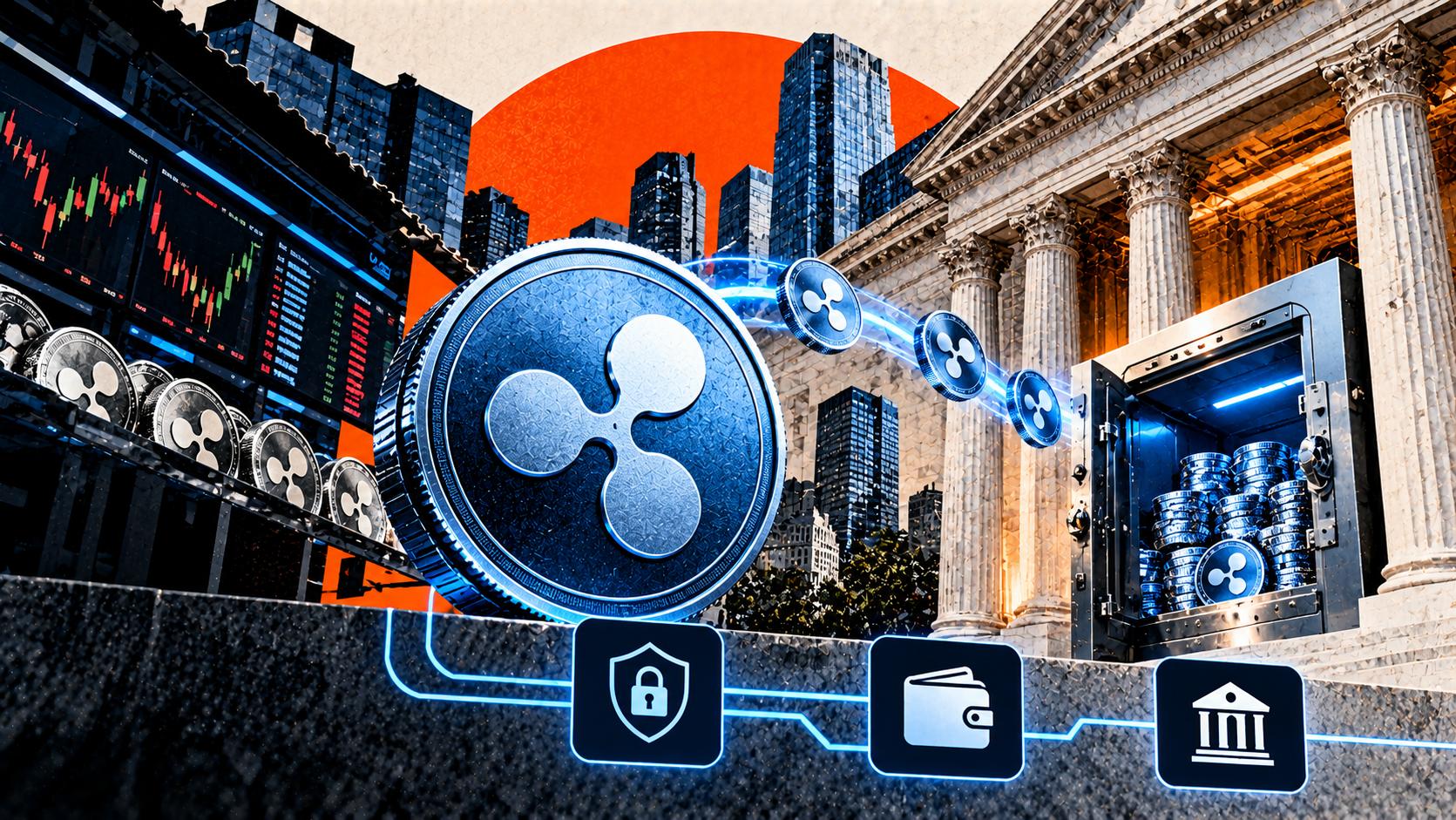
Ripple Treasury launches first Treasury Management System
- Ripple announced on Wednesday the launch of Digital Asset Accounts and Unified Treasury within Ripple Treasury.
- CFOs and treasury teams can view, hold, receive, and manage both fiat and digital assets in a single system.
- Ripple claims no other treasury management system offers native digital asset integration, marking a major competitive milestone.

Ripple announced on Wednesday the launch of Digital Asset Accounts and Unified Treasury within Ripple Treasury, marking a significant step toward integrating digital assets into core corporate finance operations.
Launch of the first Treasury Management System with native digital asset capabilities
Ripple announced on Wednesday the launch of Digital Asset Accounts and Unified Treasury within Ripple Treasury – the first native digital asset capabilities embedded directly into a treasury management system.
The firm has pushed the corporate treasury into a new phase with this launch, as they aim, together, to remove one of the biggest barriers to adoption, i.e., complexity.
Now, CFOs and their treasury teams can view, hold, receive, and manage fiat and digital liquidity held within their bank and custody providers in a single system. This eliminates the need for separate platforms, reconciliation workflows, and manual consolidation.
“No other treasury management system offers this, marking a decisive competitive milestone for both Ripple Treasury and its customers,” said Ripple in its press release.
What’s next?
Ripple’s latest move signals that corporate treasury is entering a new phase, in which digital assets are being integrated into core financial operations rather than treated as separate instruments.
Following its acquisition of GTreasury last year, the firm is now leveraging decades of treasury infrastructure to bridge traditional finance with blockchain-based solutions, while accelerating the shift toward a unified liquidity management framework.
Brad Garlinghouse, CEO of Ripple, said on X, “The secret sauce is simple: give Corporates a trusted, regulated entry point embedded in workflows they already use, remove the friction between managing different accounts (fiat or digital). Both of those are now solved today with Ripple Treasury.”
Garlinghouse further said, “Ripple Treasury is on a tear – last year facilitating $13T in payments for customers. This year, with the addition of native digital asset capabilities?”
Cryptocurrency metrics FAQs
The developer or creator of each cryptocurrency decides on the total number of tokens that can be minted or issued. Only a certain number of these assets can be minted by mining, staking or other mechanisms. This is defined by the algorithm of the underlying blockchain technology. On the other hand, circulating supply can also be decreased via actions such as burning tokens, or mistakenly sending assets to addresses of other incompatible blockchains.
Market capitalization is the result of multiplying the circulating supply of a certain asset by the asset’s current market value.
Trading volume refers to the total number of tokens for a specific asset that has been transacted or exchanged between buyers and sellers within set trading hours, for example, 24 hours. It is used to gauge market sentiment, this metric combines all volumes on centralized exchanges and decentralized exchanges. Increasing trading volume often denotes the demand for a certain asset as more people are buying and selling the cryptocurrency.
Funding rates are a concept designed to encourage traders to take positions and ensure perpetual contract prices match spot markets. It defines a mechanism by exchanges to ensure that future prices and index prices periodic payments regularly converge. When the funding rate is positive, the price of the perpetual contract is higher than the mark price. This means traders who are bullish and have opened long positions pay traders who are in short positions. On the other hand, a negative funding rate means perpetual prices are below the mark price, and hence traders with short positions pay traders who have opened long positions.
Author

Manish Chhetri
FXStreet
Manish Chhetri is a crypto specialist with over four years of experience in the cryptocurrency industry.