Five stablecoins eclipse Bitcoin by dominating more than 60% of the on-chain transactions
- Crypto analysis platform CoinMetrics founder Nic Carter discussed the relevance of stablecoins in the market during the recent Token 2049 event.
- While Bitcoin dominates nearly 70% of the crypto market cap, its usage in transactions makes up less than 15% of the on-chain volume.
- USDT, USDC and DAI lead the stablecoins, although they are consistently losing demand, with the cohort’s market cap declining by 20% year to date.

Bitcoin is considered to be the king of cryptocurrencies – and rightfully so: BTC is responsible for half the market capitalization of the crypto space. However, when it comes to utilization, the biggest crypto asset in the world does not win. Instead, the assets that are ruling this space happen to be none other than stablecoins.
Stablecoins outshine Bitcoin
Before crypto exchanges enabled the option of using USD to buy and sell cryptocurrencies, stablecoins were used as the medium. Over time, their utility reduced, but the demand for these stable assets has seemingly not declined as much. This was highlighted by crypto analysis platform CoinMetrics’ founder Nic Carter during the Token 2049 event held recently.
Carter pointed out that stablecoins collectively are only responsible for a little over 10% of the crypto market capitalization. The total crypto market cap of $1 trillion only has about eight stablecoins in the top 100 crypto assets list. Of this $1 trillion, nearly 50% is contributed by Bitcoin alone, which has a market cap of more than $519 billion.
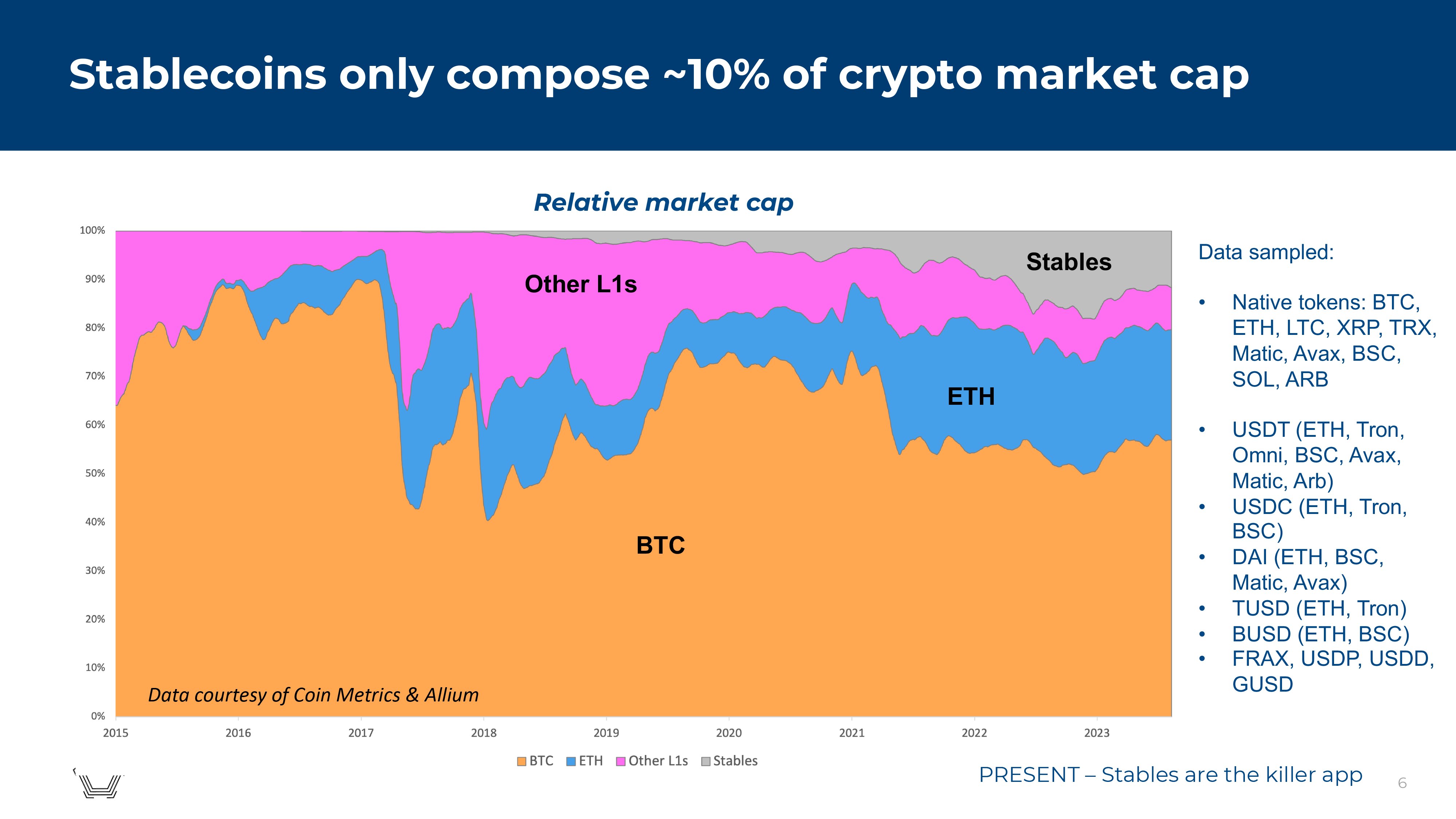
Stablecoin market cap dominance
However, Carter noted that despite such a huge difference in overall value, the utilization differs rather starkly. The five biggest stablecoins, namely USDT, USDC, DAI, TUSD and BUSD alone, account for most of the circulating value of these assets; indeed, their on-chain usage has eclipsed Bitcoin considerably.
Close to 70% of the on-chain transaction volume is dominated by these five stablecoins, along with a few other small-cap stablecoins. The remaining 30% of the transaction volume is split into BTC, ETH and other layer-1 tokens.
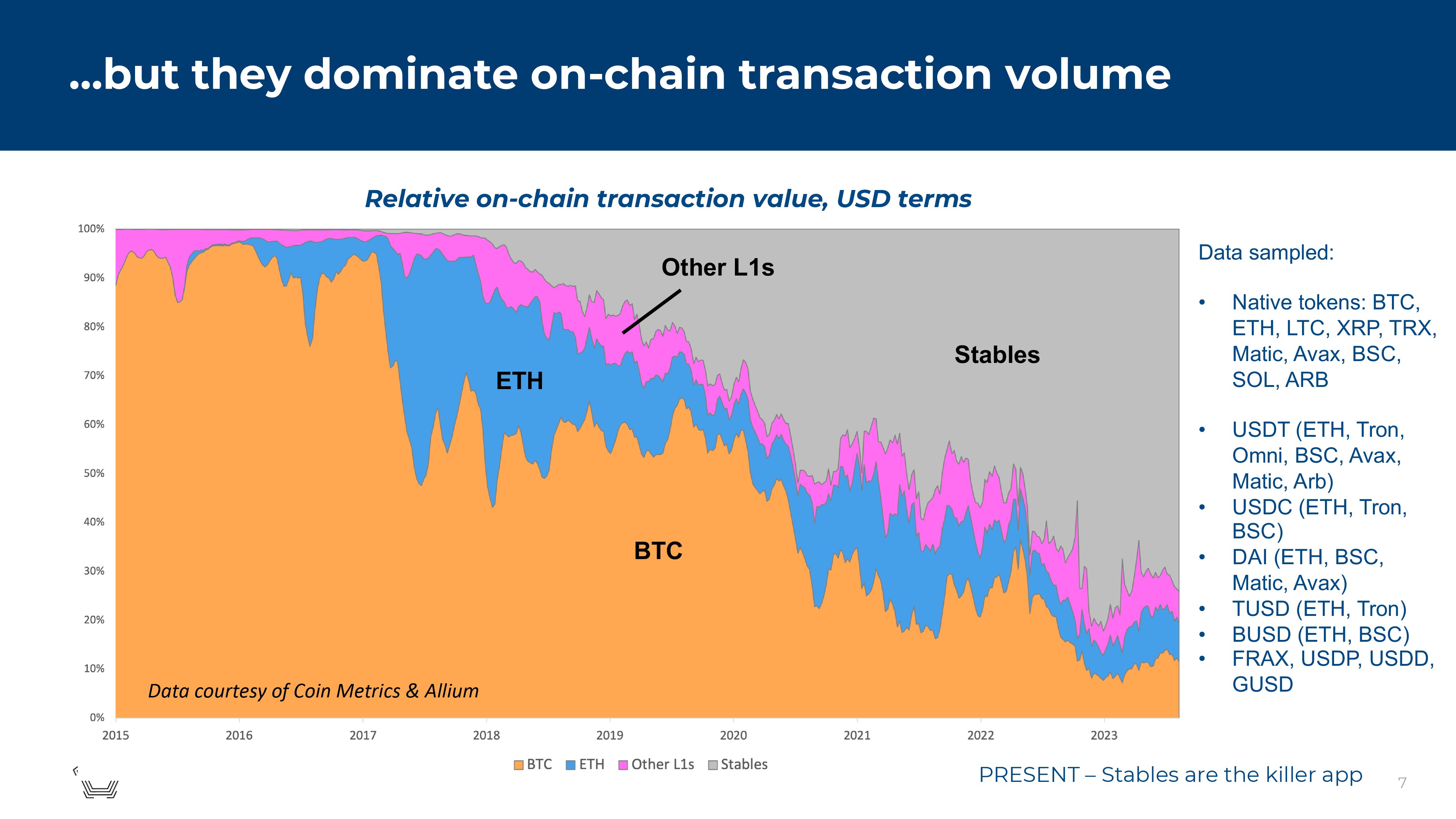
Stablecoins dominance in transaction volume
Despite the decline in crypto volume and activity, these stablecoins have maintained a robust demand, so much so that their annual volume is closing in on that of credit card company Visa. This is in spite of the fact that stablecoins were launched less than six years ago.
Interestingly, Visa also adopted these crypto assets, with the settlement of interbank transactions set to be conducted in USDC beginning this month. However, looking at the larger picture, the broader market conditions have left these assets in a struggle. Demand has seen a drop-off since mid-2022, with the market capitalization of stablecoins falling by 20% from $165 to $131 million over the past year.
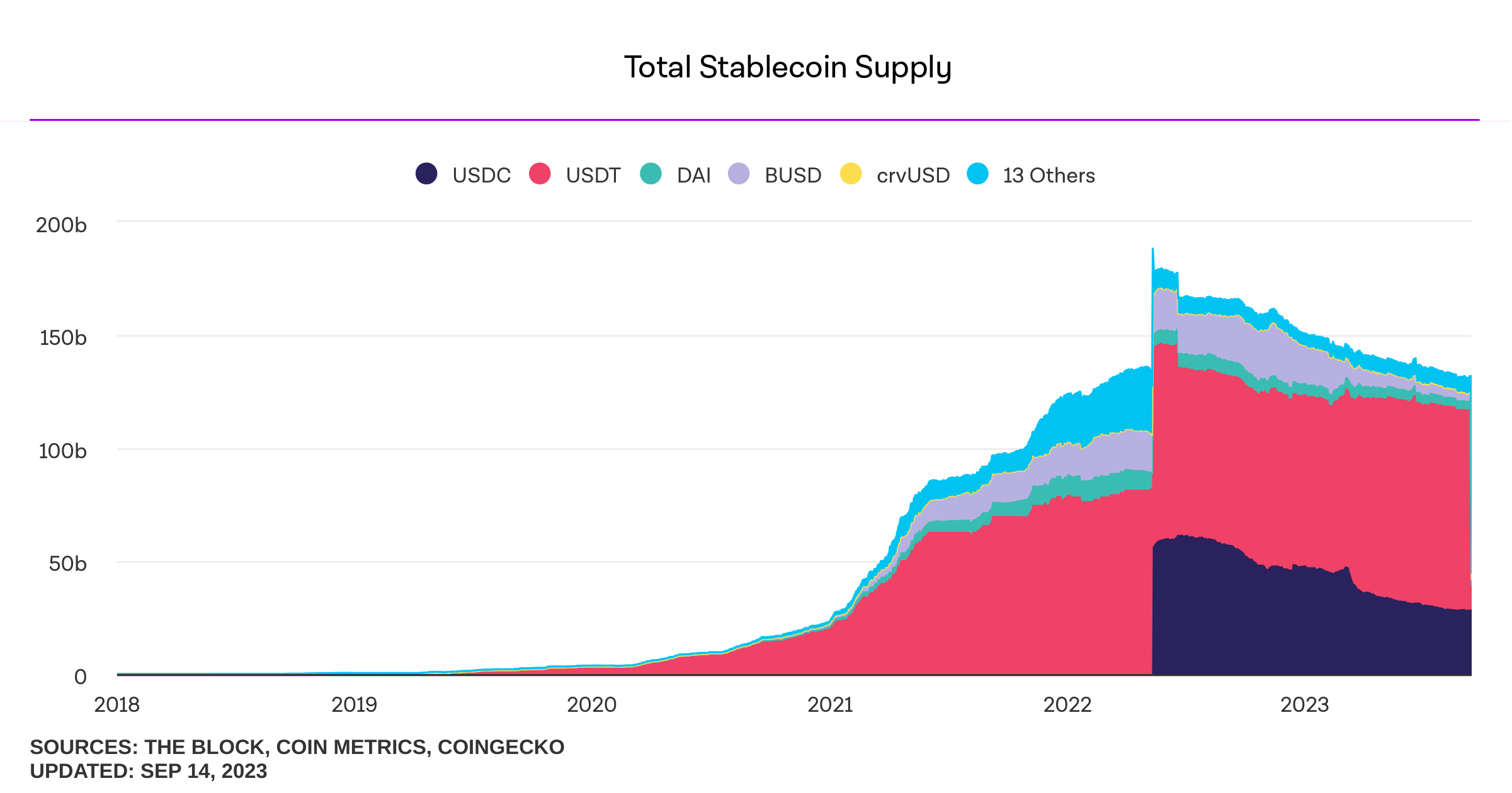
Stablecoin market capitalization
Thus, even though the stablecoins may not share the same use they had when they were first launched, they have found newer use cases and continue to dominate the market no matter how small their own value might be.
Bitcoin, altcoins, stablecoins FAQs
What is Bitcoin?
Bitcoin is the largest cryptocurrency by market capitalization, a virtual currency designed to serve as money. This form of payment cannot be controlled by any one person, group, or entity, which eliminates the need for third-party participation during financial transactions.
What are altcoins?
Altcoins are any cryptocurrency apart from Bitcoin, but some also regard Ethereum as a non-altcoin because it is from these two cryptocurrencies that forking happens. If this is true, then Litecoin is the first altcoin, forked from the Bitcoin protocol and, therefore, an “improved” version of it.
What are stablecoins?
Stablecoins are cryptocurrencies designed to have a stable price, with their value backed by a reserve of the asset it represents. To achieve this, the value of any one stablecoin is pegged to a commodity or financial instrument, such as the US Dollar (USD), with its supply regulated by an algorithm or demand. The main goal of stablecoins is to provide an on/off-ramp for investors willing to trade and invest in cryptocurrencies. Stablecoins also allow investors to store value since cryptocurrencies, in general, are subject to volatility.
What is Bitcoin Dominance?
Bitcoin dominance is the ratio of Bitcoin's market capitalization to the total market capitalization of all cryptocurrencies combined. It provides a clear picture of Bitcoin’s interest among investors. A high BTC dominance typically happens before and during a bull run, in which investors resort to investing in relatively stable and high market capitalization cryptocurrency like Bitcoin. A drop in BTC dominance usually means that investors are moving their capital and/or profits to altcoins in a quest for higher returns, which usually triggers an explosion of altcoin rallies.
Like this article? Help us with some feedback by answering this survey:
Author

Aaryamann Shrivastava
FXStreet
Aaryamann Shrivastava is a Cryptocurrency journalist and market analyst with over 1,000 articles under his name. Graduated with an Honours in Journalism, he has been part of the crypto industry for more than a year now.