Bitcoin's quietest bull note: Governments are accumulating

I swear it is true
The past isn't dead
It's alive, it is happening
In the back of my head
Agnes Obel presciently said it 10 years ago, just before it happened again. At that point, it was already the second time it had happened.
The first was after BTC/USD collapsed from 1,153 in November 2013 to 152 in January 2015. What followed was a period of silence and consolidation that lasted for months.
Then it happened again after December 2017. Bitcoin fell from 19,666 in December 2017 to 3,122 in December 2018. Then came another period of silence and consolidation. The same thing happened after 2021.
And now, it seems to be happening once again.
What does the silence tell us?
The narrative around Bitcoin in 2026 has been surprisingly quiet. That silence may be the most important signal in the market right now.
While retail sentiment has cooled and headlines have moved on to tariffs and AI earnings, a structural shift is underway beneath the surface - one that has historically preceded significant repricing events in any asset class.
Governments are buying Bitcoin. And the market hasn't fully priced it yet.
The structural setup
The United States federal government holds approximately 198,000 BTC consolidated under a Strategic Bitcoin Reserve established by executive order in March 2025.
First, there were the Feds, but the states followed quickly. Arizona has enacted state-level Bitcoin reserve legislation. Texas, Florida, New Hampshire, and Utah have followed with similar proposals.
In addition, Senator Lummis' BITCOIN Act would authorize the US Treasury to purchase up to 1 million Bitcoin over five years - approximately $100 billion in sovereign demand entering a structurally constrained market.
Meanwhile, the April 2024 halving cut the new supply from 6.25 BTC to 3.125 BTC per block. Supply is contracting. Sovereign demand is building. The BlackRock Bitcoin ETF alone has accumulated over $50 billion in assets.
This is not speculation. This is institutional architecture being built in real time.
The Bitcoin technical picture
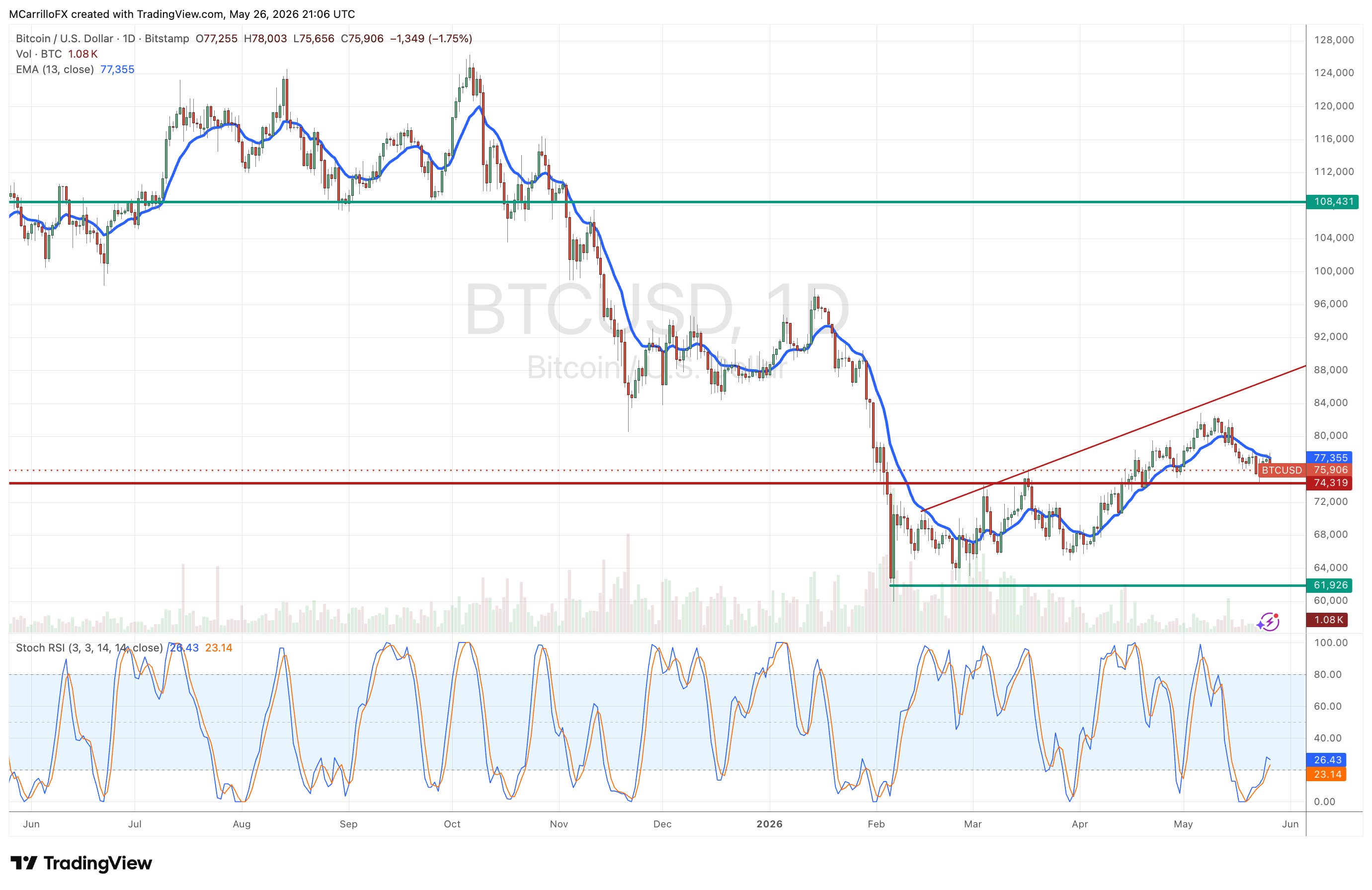
BTC/USD is currently trading around $76,000, down approximately 14% YTD in 2026. The pair is subjugated below the 13 EMA in the daily chart, with volume contracting and RSI resetting from overbought levels - constructive conditions for a trend that has not reversed structurally.
In the medium term, BTC/USD is facing support at the important 74,300 area. Then, the 73,400 and the 71,500 levels. To the upside, the 13-period daily EMA at 77,375 is containing the pair. Above that, the 89,500 area would be exposed, then May highs around 82,500.
A daily close above $79,500 with expanding volume would signal trend resumption toward the $85,000 area. A break below $73,400 reopens the $68,000-$70,000 zone as the next demand area.
Long-term is all about fundamentals
In the bigger picture, the thesis is straightforward. If the BITCOIN Act passes and the U.S. Treasury begins active purchases in Q4 2026, a significant demand shock would enter a market where available float is already tightening because of the halving cycle. Historically, that combination has produced powerful price moves.
If the thesis proves correct, BTC/USD appears positioned to break through the psychological and technical resistance zone between $100,000 and $105,000 before challenging all-time highs.
Beyond that, the $109,000 level comes into focus.
The Bitcoin conclusion
The medium-term structure favors patience. The compression below the 13 EMA with contracting volume is not distribution - it is accumulation. The kind of accumulation that precedes the next leg, not the end of the trend.
The long-term thesis remains intact and is strengthening with each piece of sovereign legislation that passes.
When the quietest buyers in the market - governments - are accumulating, the question is not whether the next move is higher.
The question is whether you'll be positioned when it happens.
Author

Mauricio Carrillo
Witbrew
Mauricio Carrillo is a financial journalist, fintech executive, and inter-markets analyst with fifteen years of experience at the intersection of traditional finance and digital asset infrastructure.