Bitcoin struggles to find a floor near $73,500
- BTC/USD trades near a three-month low, tests key 200-week SMA support.
- Institutional appetite stays weak, outflows extend into November.
- Macro, regulatory and liquidity headwinds continue to weigh on sentiment.

Bitcoin downside pressure persists
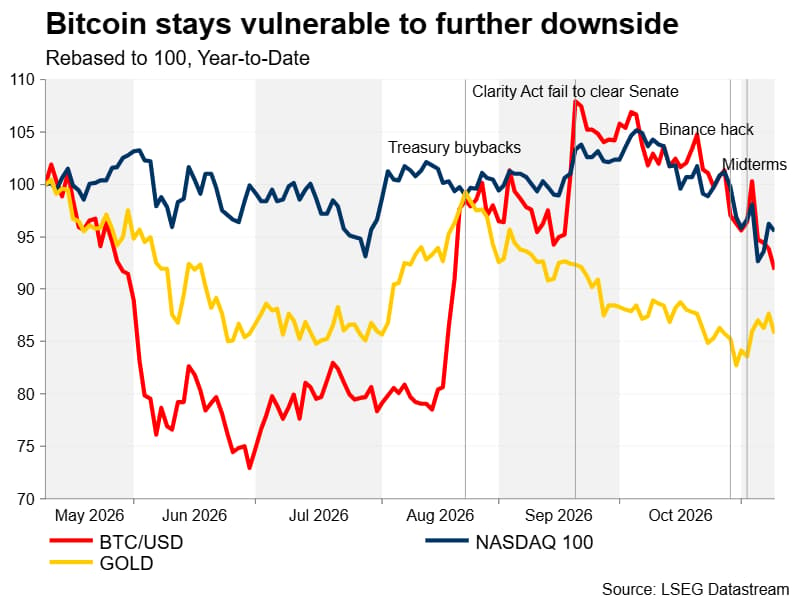
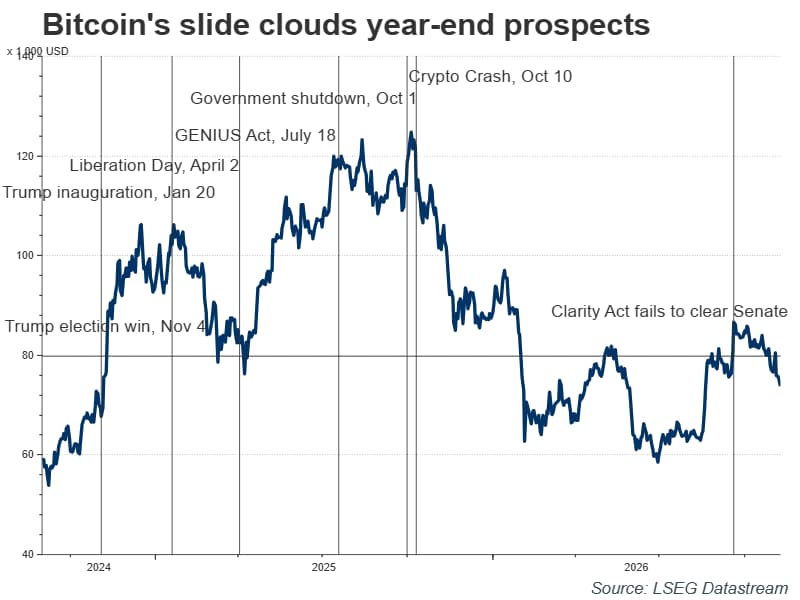
Bitcoin is trading near $73,500, attempting to stabilize around three-month lows after a prolonged selloff that has erased nearly half of the July-September rally. While equity markets are recovering from last week's sharp technology-led selloff, helping to improve broader risk sentiment, bitcoin has so far struggled to participate meaningfully in the rebound. Sentiment remains fragile, and the risk of a weaker year-end performance cannot be ruled out as the macro backdrop becomes increasingly challenging for risk assets.
Bitcoin is trading near $74,000, attempting to stabilize around three-month lows after a prolonged selloff that has erased nearly half of the July-September rally. While global equity markets are recovering from last week's sharp technology-led selloff, helping to improve broader risk sentiment, bitcoin has so far struggled to participate meaningfully in the rebound. Sentiment remains fragile, and the risk of a weaker year-end performance cannot be ruled out as the macro backdrop becomes increasingly challenging for risk assets.
The world's largest cryptocurrency has fallen more than 15% since peaking near $87,000 on September 21. Stronger-than-expected US economic data and hotter inflation readings have reinforced expectations that the Fed may keep interest rates elevated for longer. This keeps Treasury yields higher and the US dollar firmer, which tends to reduce the appeal of non-yielding assets such as bitcoin, adding to downside pressure.
Political developments have also clouded the outlook. The Democratic sweep in the US midterm elections has raised concerns that the crypto industry could face a tougher regulatory environment, potentially slowing progress on crypto-friendly legislation. The sector's policy outlook had already deteriorated following the failure of the Clarity Act to pass the Senate in September, although discussions about a revised version suggest regulation will remain a key theme to watch.
Confidence has also been shaken by last month's $6.3 billion Binance hack, which served as a reminder of the operational and security risks that continue to surround digital assets during periods of heightened market stress.
The total cryptocurrency market capitalization has fallen to around $2.46 trillion, its lowest level since August and well below this year's peak near $3.17 trillion, underscoring the deterioration in risk appetite across digital assets.
ETF outflows extend as institutional demand weakens
Investor appetite remains subdued. US spot Bitcoin exchange-traded funds (ETFs) have recorded $1.57 billion in net outflows during the first 10 days of November, extending October's withdrawals and signalling cautious institutional participation. ETF flows matter because persistent redemptions force funds to sell bitcoin holdings to meet investor withdrawals, creating an additional source of market supply and weighing on prices.
Elevated leverage raises volatility risks
Beyond weak spot demand, derivatives positioning suggests volatility risks remain elevated. Open interest in bitcoin perpetual futures remains near the highest levels seen in the past two years, while funding rates continue to indicate demand for leveraged long positions. Historically, elevated leverage has often coincided with periods of heightened volatility and sharp price reversals. This leaves bitcoin vulnerable to another wave of liquidations should key support levels fail, while any improvement in sentiment could trigger an equally sharp short-covering rebound.
Still, long-term adoption story remains intact
Despite the recent weakness, long-term adoption trends remain constructive. Major financial institutions, including Goldman Sachs, Citigroup, Deutsche Bank and Santander, have recently backed a stablecoin venture aimed at expanding blockchain-based payment infrastructure.
While such developments are unlikely to alter bitcoin's near-term direction, they reinforce the view that institutional interest in digital assets and blockchain technology continues to grow, even as current market conditions remain challenging.
The 200-week SMA is the key benchmark to watch
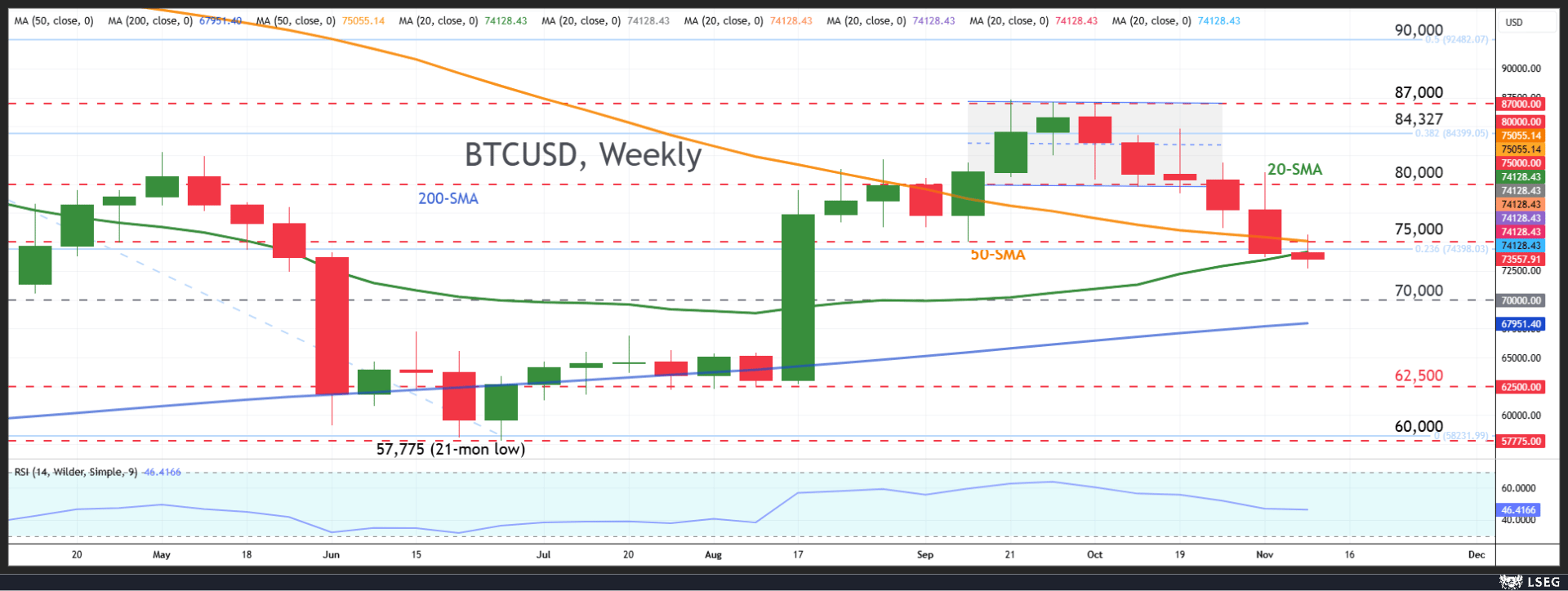
Technically, BTCUSD remains under pressure, extending its six-week pullback after breaking below key moving averages and the $75,000 threshold to trade near $73,600. Further weakness could expose the $70,000 area, while a decisive break below the closely watched 200-day SMA near $73,150 could open the door to the August breakout zone between $67,000 and $65,000. Nevertheless, the RSI is stabilizing around neutral territory, suggesting selling pressure may start to ease if support holds.
Author

Nicole joined Trading Point as a Market Analyst in January 2025. She holds a BA in English Literature from Kingston University, London, and an MA in Applied Linguistics (Research Methodology) from the University of Southampton with distinction.