Bitcoin one year after its record high: Is the downturn over?
- Near-50% rebound revives hopes that Bitcoin has found a bottom
- ETF demand and lower leverage point to a healthier market structure
- $85K-$87K becomes the key test as Treasury yields threaten the recovery

After record crypto crash, Bitcoin revival
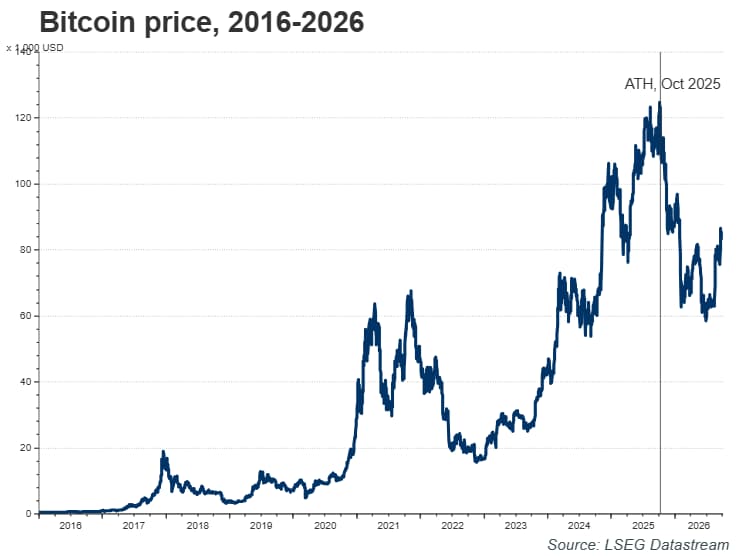
A year after Bitcoin reached its record high, and almost a year since the historic liquidation shock that followed four days later, the world’s largest cryptocurrency is showing increasingly convincing signs of recovery, although declaring the downturn over may still be premature. BTCUSD is consolidating within a $82,500-$87,000 range, roughly 32% below its October 6, 2025 peak above $126,000 but almost 50% above its summer trough near $59,000.
The October 6 peak proved short-lived. Just four days later, escalating US-China trade tensions sparked a risk-off move that collided with heavily leveraged crypto positioning. The announcement of 100% tariffs on Chinese imports was followed by more than $19 billion of forced liquidations within 24 hours, the largest liquidation cascade on record, abruptly ending the 2025 rally.
A shallower bear market
What followed was brutal but notably less severe than Bitcoin’s previous major bear markets. BTC ultimately fell just over 53% from the October peak to the summer trough, compared with declines of roughly 77%-85% in the previous three major cycles.
The contrast is even clearer one year on. Bitcoin is currently around 32% below its record, versus declines of roughly 70%, 82% and 75% one year after the 2013, 2017 and 2021 peaks, respectively. The latest trough also arrived after around nine months, earlier than in previous major cycles.
The shallower and shorter downturn could reflect Bitcoin’s changing investor base. Historically though, sizeable rebounds have sometimes failed after comparatively shallow drawdowns, meaning the near-50% recovery does not yet confirm a durable bottom.
Institutional demand uptick
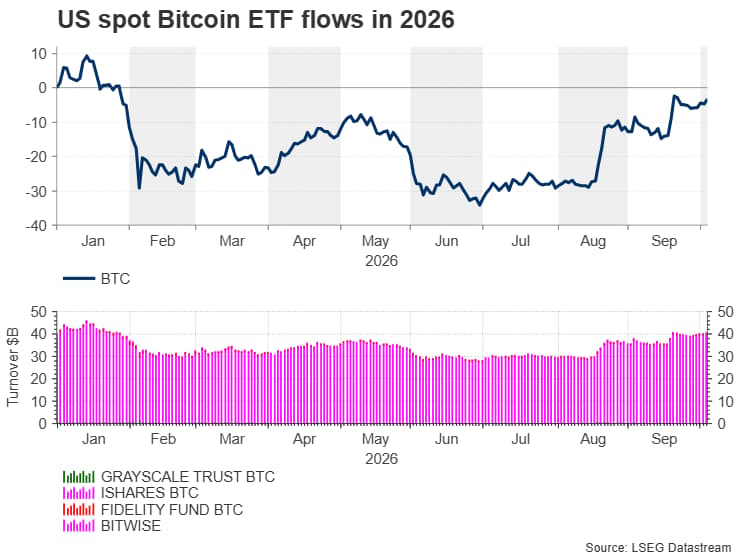
The changing investor base may help explain that resilience. Unlike earlier cycles dominated more heavily by retail speculation and leverage, ETFs and institutional investors now account for a larger share of Bitcoin exposure. Yet, 2026 has been far from one-way. US spot Bitcoin ETFs suffered roughly $5.4 billion of net outflows in the first half, before attracting around $6.3 billion in Q3, leaving year-to-date flows modestly positive by quarter-end. September marked a particularly sharp turnaround. A $2.4 billion weekly inflow through September 25, the strongest in almost a year, pushed 2026 ETF flows back into positive territory after they had been almost $6 billion in the red in July. Early October has turned more mixed, however, with an $89.9 million outflow on October 5 following two positive sessions.
The rally also appears less dependent on leverage. Perpetual-futures funding remained at a relatively moderate annualised 5.4% during the latest advance, according to QCP Capital, pointing to a greater role for spot demand rather than leverage alone. Glassnode has similarly found derivatives positioning easing towards more normal ranges.
Bitcoin has also weathered regulatory disappointment. The US Senate failed to advance the CLARITY Act in September, but subsequent SEC initiatives helped soften the setback. Citigroup has since raised its 12-month Bitcoin forecast to $113,000 from $82,000, citing renewed ETF inflows and stronger crypto activity.
High yields test Bitcoin’s resilience
However, the healthier structure has not removed Bitcoin’s sensitivity to the wider macroeconomic backdrop. Greater institutional participation has strengthened its links with traditional markets, making Fed expectations, Treasury yields and the dollar important price drivers.
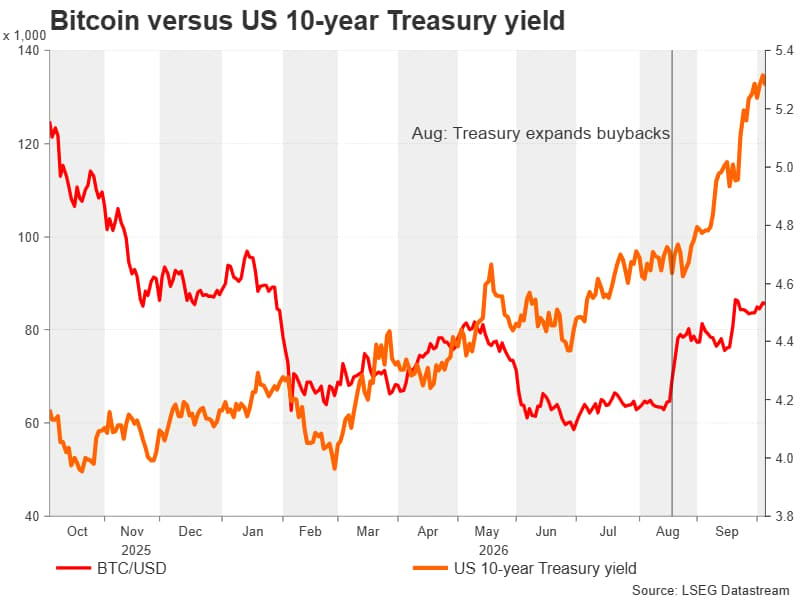
As illustrated in the chart, rising Treasury yields broadly accompanied Bitcoin’s decline from its October 2025 peak, but that relationship has become less straightforward during the recovery. Bitcoin has rebounded sharply since the summer even as the 10-year yield climbed above 5%, showing greater resilience to the difficult rates backdrop. According to Binance Research, Bitcoin’s correlation with US yields was close to zero during the first half of 2026 before turning more negative from mid-year, with its correlation to the 10-year real yield falling to -0.31 in August.
The pressure nevertheless remains significant. The 10-year Treasury yield recently reached 5.35%, while the 30-year hit 5.7%, their highest levels since 2002, tightening financial conditions and increasing competition for capital. The impact may also depend on why yields are rising: Fed-driven tightening presents a clearer liquidity headwind, while fiscal concerns can strengthen the case for scarce alternative assets such as Bitcoin.
Hence, continued spot and ETF demand while yields are climbing provide an important test of the recovery’s durability.
$85K-$87K becomes the battleground
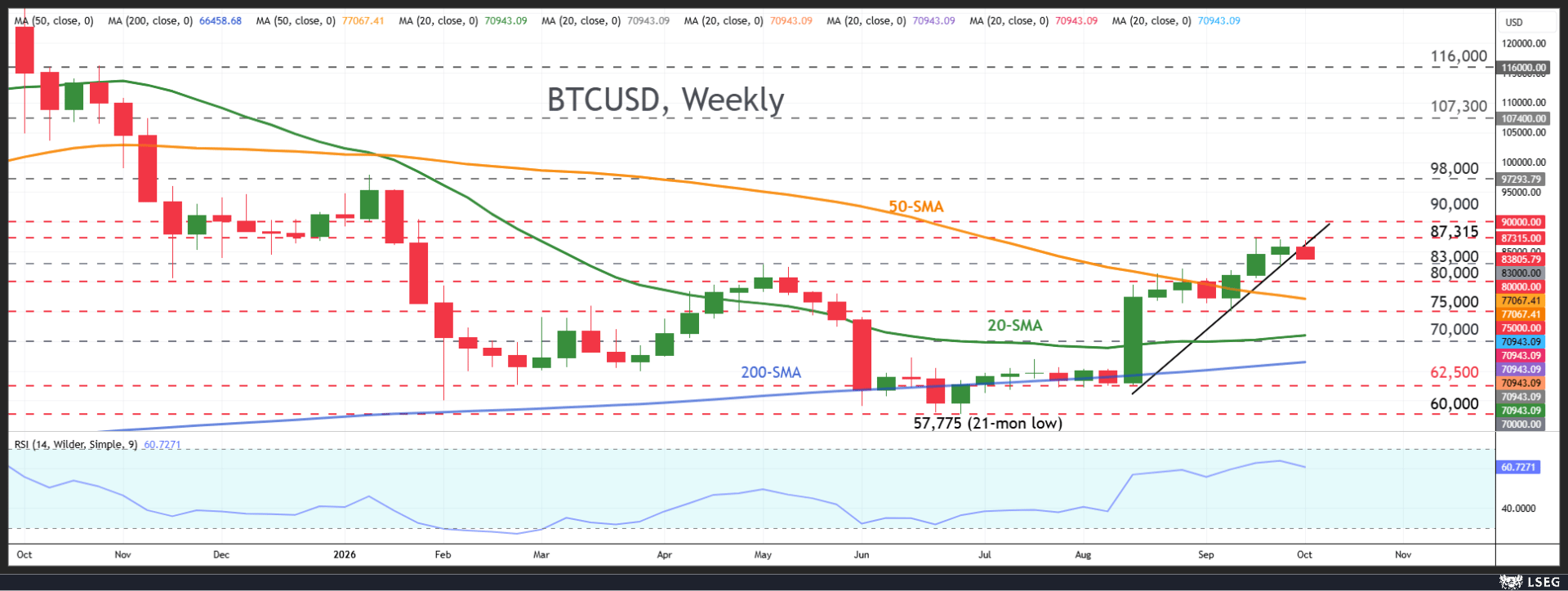
For traders, the immediate test is clear. Bitcoin has repeatedly struggled to sustain moves above the $87,000-$87,400 region, while $85,000 has emerged as an important near-term benchmark within the broader consolidation range.
Holding in the $85,000 zone would suggest buyers continue to absorb pullbacks. A decisive break above $87,000 could bring the upper-$80,000 region into focus, while losing $85,000, particularly alongside weaker ETF flows or another rise in yields, would increase the risk of deeper consolidation.
So, is the downturn over?
Even though there is compelling evidence explaining why this downturn has been shallower, it may not be enough to prove that the longer-term bear market is over. A broader institutional investor base, recovering ETF demand and more moderate leverage have nevertheless produced a more resilient market structure.
The stronger confirmation would require sustained spot and ETF demand alongside a decisive break above $87,000, particularly if Bitcoin can achieve that while Treasury yields remain elevated.
For now, the October 2025 crash increasingly looks like a major deleveraging event rather than the start of another crypto winter. A year on, the question is whether genuine demand can turn Bitcoin’s recovery into a sustained bullish breakout.
Author

Nicole joined Trading Point as a Market Analyst in January 2025. She holds a BA in English Literature from Kingston University, London, and an MA in Applied Linguistics (Research Methodology) from the University of Southampton with distinction.