Bitcoin can be made quantum-safe without a protocol upgrade: Researcher

A Bitcoin researcher has come up with a way that could immediately make Bitcoin transactions quantum-safe without the need for a soft fork.
In a proposal published Thursday, StarkWare chief product officer Avihu Levy proposed a Quantum Safe Bitcoin (QSB) transaction scheme that he said would remain secure “even against an adversary with a large-scale quantum computer running Shor’s algorithm.”
He added that the scheme requires no changes to the Bitcoin protocol and operates entirely within the existing legacy script constraints. The downside is that it is costly and likely is not useful for everyday transactions, he said.
The Bitcoin community has been split on how to tackle the quantum problem. QSB presents a temporary solution while a long-term approach is ironed out.
The scheme’s main feature is replacing the proof-of-work signature-size puzzle with a hash-to-sig puzzle.
Instead of relying on elliptic curve math that quantum computers can break, the spender must find an input whose hash output randomly happens to resemble a valid ECDSA (elliptic curve digital signature algorithm) signature, requiring brute-force work that even a quantum computer cannot shortcut.
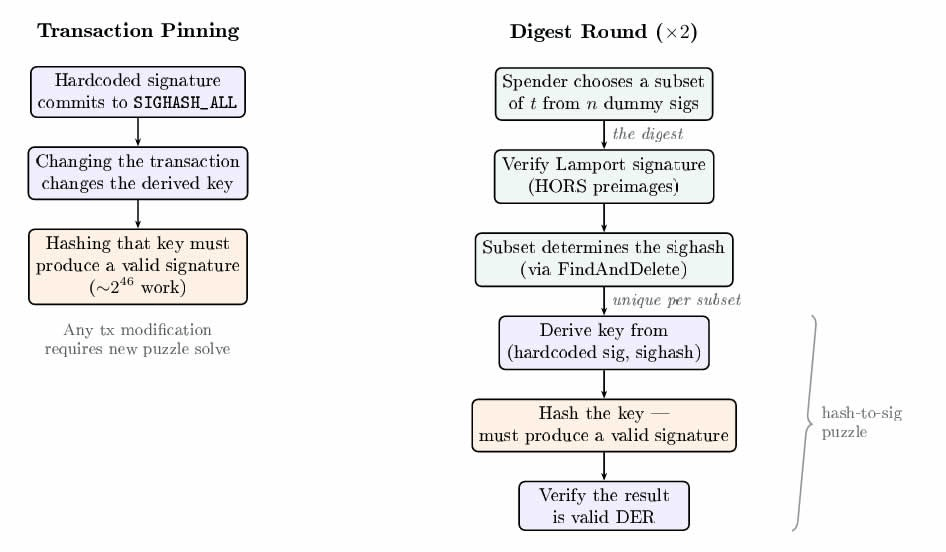
Far more computing power is required for QSB. Source: GitHub
Quantum safe Bitcoin not practical for everyday use
The proposal comes with caveats, however. It costs the sender between $75 and $150 per transaction in GPU compute and is more complex than a typical Bitcoin transaction, and thus would only make sense for securing large BTC transactions.
“This is huge,” said StarkWare CEO Eli Ben-Sasson, claiming that it essentially makes Bitcoin quantum-safe today.
However, Bitcoin ESG specialist Daniel Batten said it was “an overstatement” because exposed public keys and dormant wallets are “not addressed in the paper.”
Batten was referring to an estimated 1.7 million BTC locked in early P2PK addresses that could be cracked by a quantum computer.
Its existence has led to fierce debate about what to do with the dormant coins, with the community split between leaving Bitcoin as-is to preserve its core ethos, freezing or burning the vulnerable coins entirely or upgrading the protocol to support quantum-safe signatures.
Protocol changes are the preferred solution
The researchers acknowledged that this is a last-resort measure as transactions are non-standard, costs don’t scale to all users and use cases like Lightning Network are not covered.
They concluded that protocol-level changes remain the preferred long-term path.
“While this article describes a solution that works today for quantum-safe Bitcoin transactions, it should be treated as a last-resort measure.”
Google published a paper in March that unsettled the Bitcoin community as it suggested that a quantum computer could potentially crack Bitcoin’s cryptography using far fewer resources than previously thought.
Meanwhile, Lightning Labs chief technology officer Olaoluwa Osuntokun on Wednesday published a quantum “escape hatch” prototype that enables users to prove Bitcoin wallet ownership from the original seed phrase without revealing it, which could serve as an alternative Bitcoin authorization method.
Author

Cointelegraph Team
Cointelegraph
We are privileged enough to work with the best and brightest in Bitcoin.