BIS partners with Israel, Norway and Sweden for CBDC payments after completing a $22 million pilot
- The Bank for International Settlements (BIS) launched Project Icebreaker to explore cross-border CBDC payments with Israel, Norway and Sweden.
- The project will result in the creation of a “hub” that will connect the central bank CBDC systems of these countries.
- Earlier this week, the BIS announced the successful completion of its pilot run conducting $22 million worth of transactions.

The rising adoption of cryptocurrencies is only countered by the central bank digital currencies (CBDC), which some countries consider an alternative to crypto, albeit one they can control.
While the notion may not hold the principles of crypto, it is still being considered by many governments, resulting in rapid development across the world.
CBDC transfer to become easy
The BIS announced that it would be launching Project Icebreaker along with the central banks of Israel, Norway and Sweden. This will be a joint exploration among the four entities to figure out the best way of implementing CBDCs for international retail and remittance payments.
BIS Innovation Hub Nordic Centre will be developing a “hub” to reduce the time and cost of cross-border payments. This hub will be linked to the domestic CBDC systems of the Bank of Israel, Central Bank of Norway and Sveriges Riksbank.
The project’s target will be to test certain functions and technological feasibility of interlinking different CBDC systems.
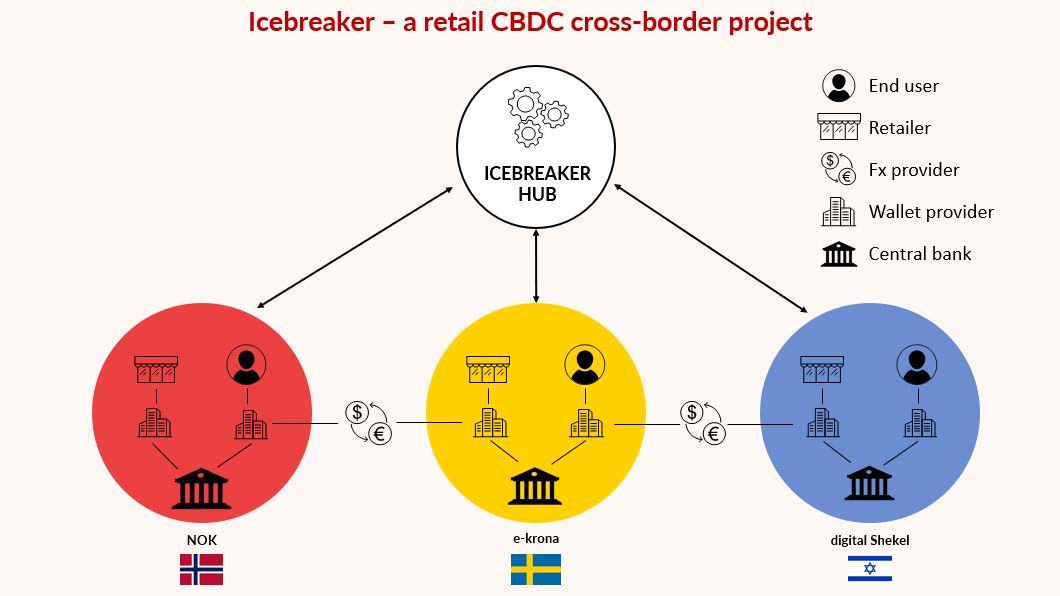
Project Icebreaker architecture
Explaining the process, BIS reported,
“The architecture is designed to enable immediate retail CBDC payments across borders, at a significantly lower cost than with existing systems, which are typically based on payments being sent via several different banks to the final recipient (the so-called correspondent banking system).”
Set to be tested until the beginning of 2023, the final report is expected to be ready by next year’s Q1.
BIS has already done this before
While the project was announced on September 28, the BIS had already conducted a major pilot, with the result being published a day before the announcement.
With the participation of about 20 central banks, BIS successfully completed the CBDC pilot following month-long testing. In this duration, more than $22 million worth of cross-border transactions were conducted through over 160 transfers and FX Exchanges.
The central banks of Hong Kong, China and the United Arab Emirates were among the participating banks. Going forward, Israel, Norway and Sweden are also going to join this list.
Author

Aaryamann Shrivastava
FXStreet
Aaryamann Shrivastava is a Cryptocurrency journalist and market analyst with over 1,000 articles under his name. Graduated with an Honours in Journalism, he has been part of the crypto industry for more than a year now.