Aave Price Forecast: AAVE eyes $100 after Stable Vaults launch
- Aave rises above $90.00 after defending $80.00 support amid renewed geopolitical tensions in the Middle East.
- Aave unveils Stable Vaults, an all-in-one solution to embed fixed-rate stablecoin yield into DeFi products.
- Businesses can now integrate Aave-powered yield via Stable Vaults without building yield infrastructure from the ground up.

Aave (AAVE) edges higher above $90.00 at the time of writing on Thursday, amid broader price stabilization in the crypto market. The company has announced Stable Vaults, a platform that allows businesses to integrate fixed-rate stablecoin yield, mildly lifting sentiment in the ecosystem.
Stability above the reclaimed $90.00 would boost the short-term outlook, paving the way for gains toward the psychological $100 level.
Aave unveils Stable Vaults targeting DeFi
Aave stated in its Thursday announcement that “Stable Vaults are the smart contract vaults that already power the Aave mobile savings app.” The service is now available to businesses struggling to integrate decentralized finance (DeFi) yield into consumer products.
Stable Vaults eliminates the tedious process of managing volatile rates and multi-chain liquidity on heavily layered infrastructure. The smart contracts transform fluctuating on-chain lending rates into predictable fixed yields for businesses to offer their users, while streamlining rebalancing, cross-chain processes, and user payouts.
Businesses that integrate Stable Vaults will have access to out-of-the-box infrastructure for delivering on-chain stablecoin yields. Companies have the freedom to select supported stablecoins, tailor yield strategies, and set competitive fixed rates for their users.
“Businesses can also reward target user groups, such as premium subscribers, with higher rates, or run temporary promotions that boost a user's rate,” Aave outlined in the press release.
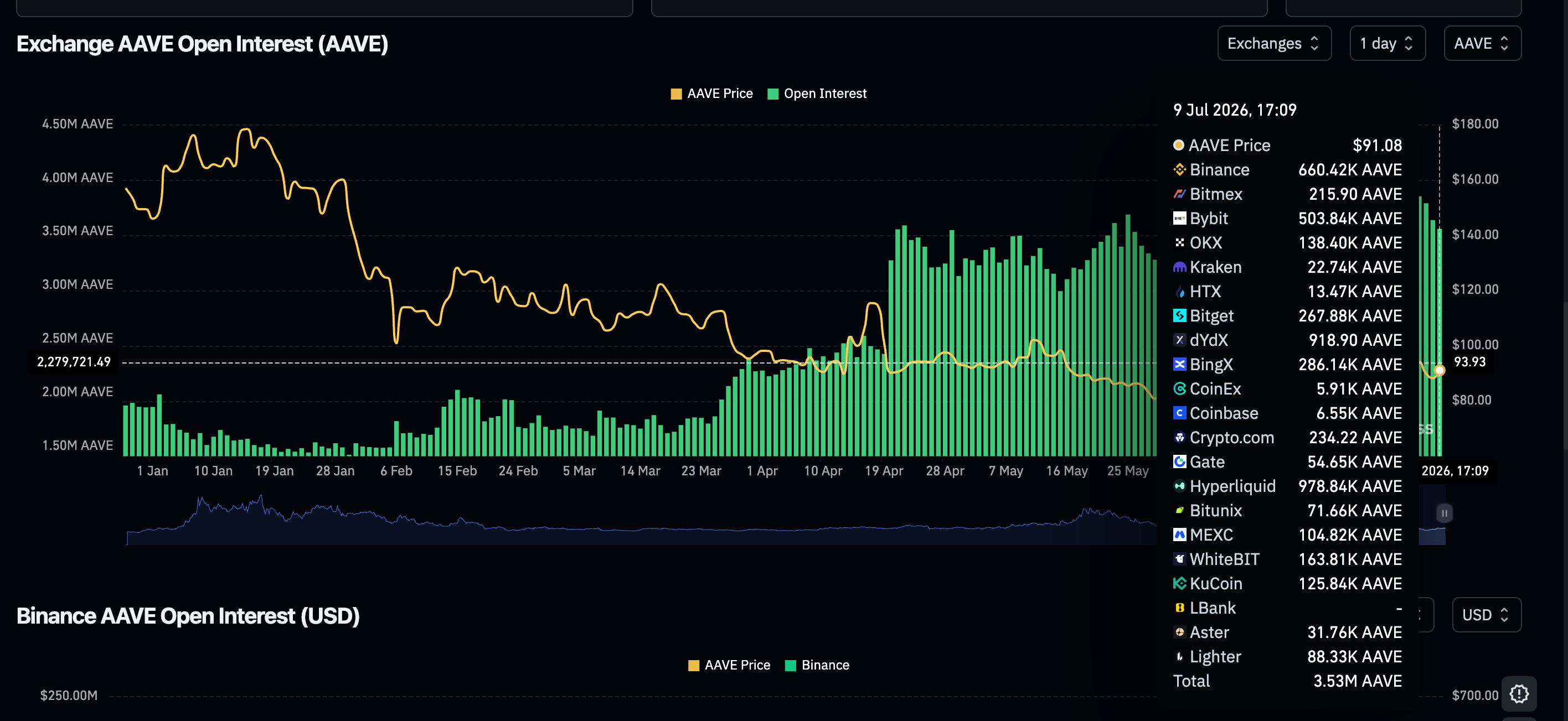
In the meantime, appetite for AAVE derivatives continues to fade, as evidenced by the futures Open Interest (OI), which averages 3.53 million AAVE on Thursday, down from 3.61 million AAVE the day before. A broader scope reinforces the narrowing demand, given that OI on June 24 was 4.24 million AAVE.
Price analysis: AAVE reclaims key support
AAVE trades above $90.00 as of writing after extending gains from support tested at $80.00 on Wednesday. The token upholds a short-term bullish outlook despite its upside still below both the 100-day and 200-day Exponential Moving Averages (EMAs) at $90.95 and $115.21.
The Moving Average Convergence Divergence (MACD) indicator hovers slightly in positive territory on the daily chart and the Relative Strength Index (RSI) around 59 suggests moderate bullish momentum that has yet to overcome the prevailing overhead structure.
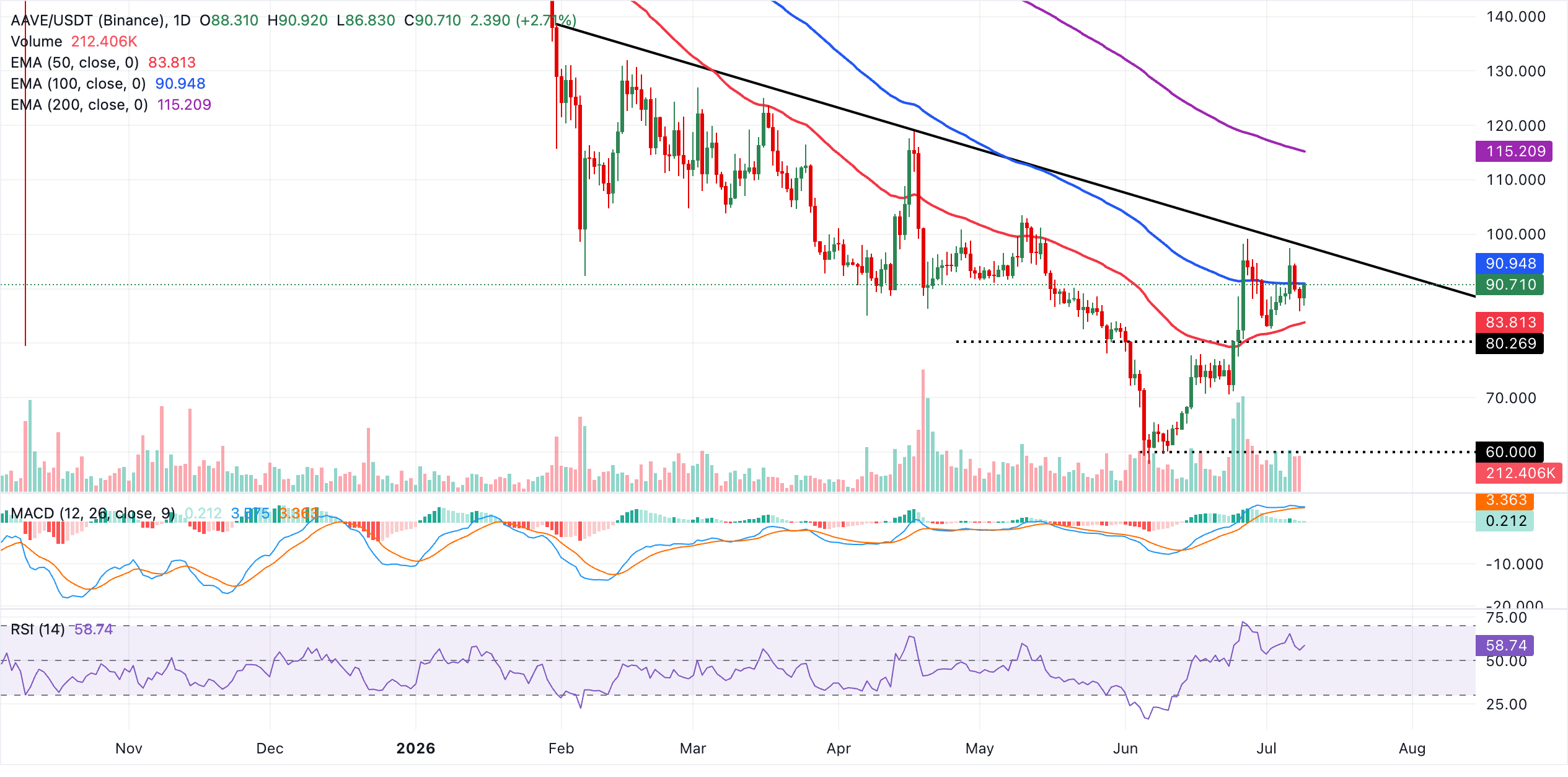
Immediate resistance is defined by the 100-day EMA at $90.95, with a subsequent barrier near the falling trendline break price at $97.74, ahead of the more meaningful 200-day EMA at $115.21. On the downside, initial support is seen at the 50-day EMA around $83.81, and a daily close below this level would likely expose AAVE to deeper corrective risk despite the currently constructive momentum profile.
(The technical analysis of this story was written with the help of an AI tool. Know more.)
Open Interest, funding rate FAQs
Higher Open Interest is associated with higher liquidity and new capital inflow to the market. This is considered the equivalent of increase in efficiency and the ongoing trend continues. When Open Interest decreases, it is considered a sign of liquidation in the market, investors are leaving and the overall demand for an asset is on a decline, fueling a bearish sentiment among investors.
Funding fees bridge the difference between spot prices and prices of futures contracts of an asset by increasing liquidation risks faced by traders. A consistently high and positive funding rate implies there is a bullish sentiment among market participants and there is an expectation of a price hike. A consistently negative funding rate for an asset implies a bearish sentiment, indicating that traders expect the cryptocurrency’s price to fall and a bearish trend reversal is likely to occur.
Author

John Isige
FXStreet
John Isige is a seasoned cryptocurrency journalist and markets analyst committed to delivering high-quality, actionable insights tailored to traders, investors, and crypto enthusiasts. He enjoys deep dives into emerging Web3 tren