$1 trillion gift card market: New global onramp for cryptocurrencies

Gift cards that were initially perceived as a consumer product are gradually evolving into an alternative financial channel linking the retail economy and the crypto market. The reasons for this phenomenon become clear when considering the scale of the market itself. The global gift card market has already exceeded $1 trillion in annual turnover, according to Precedence Research. The sector continues to grow thanks to the digitalization of commerce, mobile payments, and the development of e-commerce.
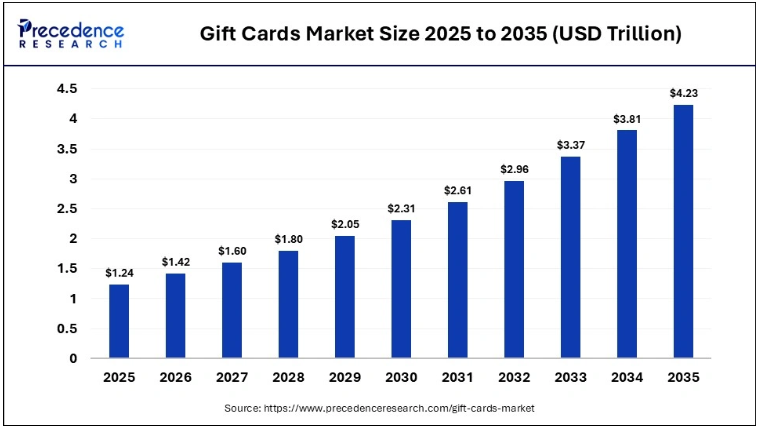
Over the past three years, the role of gift cards has begun to change. In countries with limited access to banking systems or international payment services, gift cards are gradually becoming a bridge between the local economy and cryptocurrencies.
How gift cards became a gateway to the crypto economy
The connection between gift cards and cryptocurrencies first emerged in developing markets. In many countries in Africa, Latin America, and Southeast Asia, users faced a simple problem: they wanted to buy cryptocurrency, but traditional banking payment channels either didn't support such transactions or made them extremely complex.
Gift cards proved to be an unexpectedly convenient solution: unlike bank transfers or cards, they don't require a bank account and can be purchased in retail stores, online marketplaces, or received digitally. These vouchers can then be easily exchanged for cryptocurrency through P2P platforms.
Such simplicity and functionality created a rapidly growing demand, forming a full-fledged market with traders specializing in exchanging gift cards for cryptocurrency. The trend has expanded beyond developing countries, where people started using digital gift cards as an alternative entry point into the crypto market, even in developed regions.
NoOnes: Crypto gift cards are used by two million people
P2P platform NoOnes estimates that around 2 million crypto users regularly use gift cards. The platform offers over 300 brands and 783 gift card types, and its ecosystem is used in more than 180 countries.
Seeing a rapidly growing demand for gift card-crypto transactions, the company has recently announced plans for a major expansion of its gift card trading division. The company intends to create one of the largest global marketplaces for exchanging gift cards for cryptocurrency.
According to the platform's announcement, the ecosystem is expected to unite over 10,000 brands and dozens of regional markets, where users will be able to exchange retail vouchers for digital assets through P2P transactions.
A key part of the new infrastructure will be a dynamic pricing mechanism that will aggregate supply and demand data from different regions and generate estimated market prices for popular gift card categories. The platform also plans to launch tools for large traders and liquidity providers, enabling them to trade gift cards in large volumes and maintain market stability.
A new layer of liquidity between retail and the crypto market
In terms of market structure, the development of crypto gift card marketplaces may create a new layer of liquidity between the traditional retail economy and digital assets. Gift cards have long represented a form of prepaid value for thousands of global brands — from digital services and games to travel and e-commerce. When these vouchers are freely exchangeable for cryptocurrency, they begin to function as a liquid asset, bridging two distinct financial worlds. In essence, this resembles a decentralized currency market, using retail vouchers instead of national currencies.
Author

Julia Magas
Independent Analyst
Julia Magas is an analyst and writer specializing in cryptocurrency and fintech market trends. Her work has been featured in leading financial publications such as Nasdaq, InvestorPlace, Cointelegraph, and Investing.