Why Hyperliquid is losing RWA market share to centralized exchanges
- Hyperliquid’s RWA perpetual futures market share fell from 80% in July to 26% as centralized exchanges captured 64% of trading volume.
- Binance’s RWA market share climbed from 3% to 30% in two weeks, while OKX reached 14% amid expanding competition.
- HYPE bounced off the 100-day EMA, just above the $75.6 support.

Hyperliquid (HYPE) is losing market share in real-world asset (RWA) perpetual futures to centralized exchanges (CEXs) even as the overall financial market faces pressure.
Hyperliquid’s trade.xyz accounted for roughly 80% of RWA perpetual trading volume in July, according to Artemis data shared by Ark Invest Digital Asset Head of Research Lorenzo Valente.. Its share has since fallen to 26%, while centralized exchanges collectively control 64% of the market. Weekly trading volume has doubled to tripled from around $20 billion to between $40 billion and $60 billion.
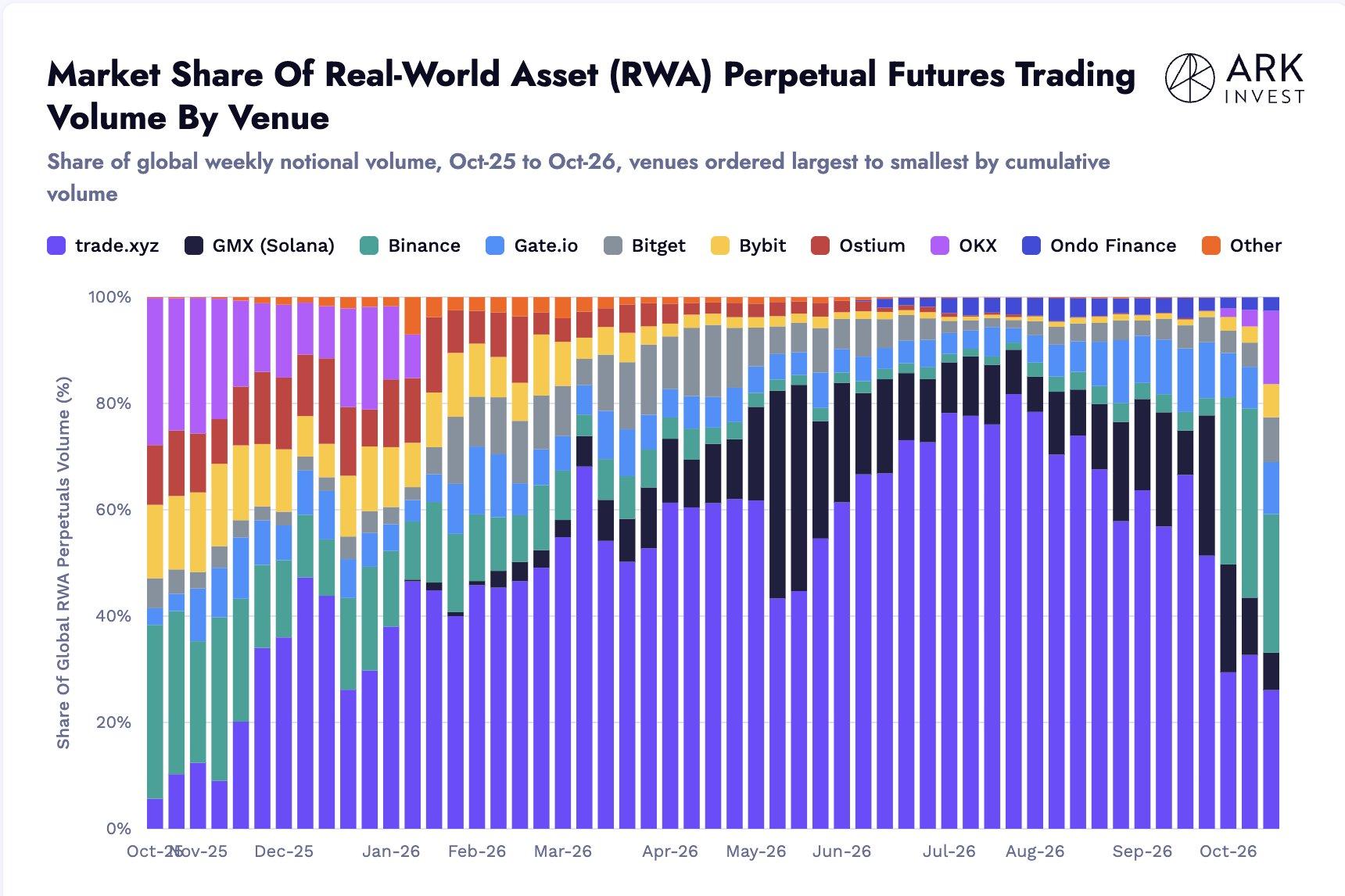
The figures suggest that centralized exchanges are capturing most of the market's additional trading activity rather than simply benefiting from a shift in existing volume.
CEXs expand perpetual RWA offerings at Hyperliquid’s expense
Binance's share reportedly increased from 3% to 30% within two weeks, while OKX climbed to 14% over the same period. Gate and Bitget are also expanding their presence.
The growth reflects centralized exchanges' ability to offer traditional asset exposure alongside existing crypto trading products.
Hyperliquid initially benefited from offering round-the-clock exposure to assets that traditional markets trade during limited hours.
Oil perpetual futures became particularly attractive during geopolitical tensions at the start of the year, when traders sought to respond to developments outside conventional market hours. Hyperliquid was among the few venues offering continuous oil trading, helping attract activity from traders beyond its usual crypto-native audience.
However, centralized exchanges are now offering similar access to traditional assets, reducing that early advantage.
Binance launched TradFi perpetual contracts in March, covering commodities such as gold and silver, selected stocks including Tesla and Intel, and exchange-traded funds (ETFs). The contracts settle in USDT and allow around-the-clock trading.
OKX launched more than 40 tokenized US stocks and ETFs in July, offering 24/7 trading against USDT in supported regions. Its unified markets allow users to trade assets such as Apple, Nvidia and Tesla through their existing exchange accounts.\
The competitive shift comes as traditional financial institutions are also moving toward tokenized securities. The NYSE announced plans in January to develop a platform supporting 24/7 trading and blockchain-based settlement of tokenized securities, subject to regulatory approval.
Following that, OKX and NYSE parent Intercontinental Exchange (ICE) announced plans through their joint venture, OKXICE, to launch an on-chain tokenized securities venue.
Meanwhile, the US Securities and Exchange Commission (SEC) introduced its Innovation Exemption in September, granting conditional, temporary regulatory relief to qualifying venues trading certain tokenized US-listed stocks.
Despite losing RWA market share, Hyperliquid remains a major perpetual futures venue. Its 30-day total perpetual futures volume stood at $208.07 billion.
Hyperliquid technical outlook: HYPE holds 100-day EMA and $75.6 support
On the daily chart, HYPE trades at $77.8, down 3.8% in the past 24 hours at the time of writing. The token retains a bearish near-term bias as price holds below the 20-day and 50-day Exponential Moving Averages (EMAs), clustered just above $82.00, after bouncing off the 100-day EMA near $76.
The 14-day Relative Strength Index (RSI) at 41 and the Stochastic Oscillator (Stoch) near 17 both sit in weak territory, suggesting downside pressure persists despite a modest rebound from recent lows.
On the downside, immediate support is seen at the 100-day EMA, just above the $75.69 horizontal level, before a deeper floor emerges at $67.64 and then $61.16.
On the topside, initial resistance aligns with the short-term EMAs' convergence at $82.10, ahead of a more significant barrier at $85.04. A sustained break above that zone would open the way toward the major resistance highlighted at $97.84.
(The technical analysis of this story was written with the help of an AI tool. Know more.)
Author

Michael Ebiekutan
FXStreet
With a deep passion for web3 technology, he's collaborated with industry-leading brands like Mara, ITAK, and FXStreet in delivering groundbreaking reports on web3's transformative potential across diverse sectors. In addition to