|

XAU/USD - Rebound off 0.786 resistance arc, medium term remains bearish towards 3720

XAU/USD - Rebound off 0.786 resistance arc, medium term remains bearish towards 3720

Gold spot/US Dollar (XAU/USD): Arc cycle analysis™
Chart

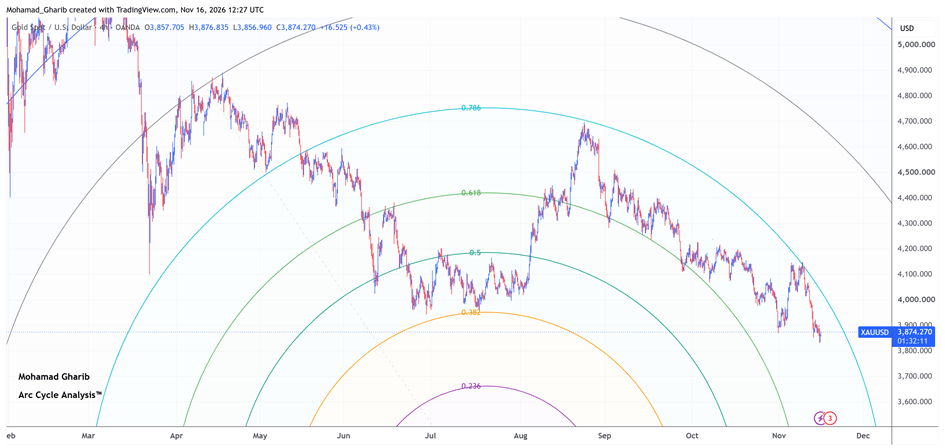
Figure 1: XAUUSD 4h chart with Arc Cycle levels. Gold Spot / U.S. Dollar (XAUUSD) on the 4h chart with the Arc Cycle levels used in this analysis. Source: TradingView chart; Arc Cycle Analysis™ by Mohamad Gharib.

Overview

Based on Arc Cycle Analysis™ applied to the 4h chart, Gold is still rebounding off the 0.786 Resistance Arc, with the medium-term view remaining bearish toward 3,720. In the short term, a further limited downside toward 3,805 is expected before any upside rebound. No signal has been confirmed yet, and the preferred approach is to await a clear reaction at the Arc before anticipating the next move.

Table 1: XAU/USD arc cycle analysis summary

Metric

Reading

Market Bias

Bearish

Preferred Scenario

Rejection at the 0.786 Resistance Arc

Medium-Term Target

3,720

Short-Term View

Limited further downside toward 3,805 before any upside rebound

Current Arc Level

0.786 Resistance Arc

Cycle Status

Rejection at Resistance Arc

Table 1: Key Arc Cycle readings for XAUUSD. Source: Arc Cycle Analysis™ by Mohamad Gharib.

Market outlook

Gold is still rebounding off the 0.786 Resistance Arc, which continues to cap the market within the current arc cycle. The medium-term view remains bearish with eyes on 3,720. In the short term, a further limited downside toward 3,805 is expected before any upside rebound takes shape. No signal has been confirmed yet, and the preferred approach is to await a clear reaction at the Arc before anticipating the next move.

Author

Mohamad Gharib

Mohamad Gharib

Independent Analyst

Mohamad Gharib is a Financial Markets Analyst and Quantitative Researcher with more than 18 years of experience in financial markets, including 15 years as an FX Quant Trader.


More from Mohamad Gharib
Share:

Editor's Picks

AUD/USD stays vulnerable below 0.6800 after weak China data

AUD/USD kicks off the week subdued, consolidating recent heavy losses to its lowest level since January. The pair stays defensive below 0.6800 after China’s October Retail Sales and Industrial Production disappointed, keeping the Chinese proxy, the Australian Dollar, undermined amid a broadly bullish US Dollar and fresh US-Iran tensions.

USD/JPY drifts toward 159.50 despite dismal Japan Q3 GDP

USD/JPY faces headwinds and drifts lower toward 159.50 at the start of the new week on Monday, shrugging off dismal data showing that Japan’s economy unexpectedly shrank by 0.1% in Q3. Japanese Yen draws support from looming intervention risks. Meanwhile, the US Dollar sits near a 19-month high amid certainty of a Fed rate hike and geopolitical risks, supporting the pair.


Gold steadies after hitting lowest since October 2025, hawkish Fed caps gains

Gold (XAU/USD) attracts some dip buyers on Monday after falling to $3,832 in early Asian trade, its lowest level since October 2025. At the time of writing, the metal trades flat around $3,872, below its intraday high of $3,901.

Crypto Today: Bitcoin, Ethereum, XRP face increasing selling pressure, ETF outflows

Bitcoin trades lower below $65,000 on Monday, as selling pressure expands in the broader cryptocurrency market, accentuated by growing risk-off sentiment. Ethereum paints a similar grim picture, with the price sliding near $1,800 while Ripple remains below $0.95.

Nvidia earnings preview: The first big test after Jensen Huang’s exit

Nvidia reports on 17 November after the US close, with consensus pointing to roughly US$109 billion in revenue and adjusted earnings of US$2.47 per share. Strong earnings could support sentiment, but uncertainty remains: Leadership clarity may ease some concerns.

Gold hit its lowest level of 2026 near $3,850
Gold (XAU/USD) attempts to stabilize around $3,890 on Friday after falling to $3,852 on Thursday, its lowest level since October 2025. The precious metal has lost more than 4% this week, as investors increasingly anticipate further monetary tightening from the Federal Reserve (Fed). The latest decline reflects a sharp change in market expectations.