|

Rage, rage against the dying of the light

Rage, rage against the dying of the light

Summary

United States: Do not go quietly into that good night

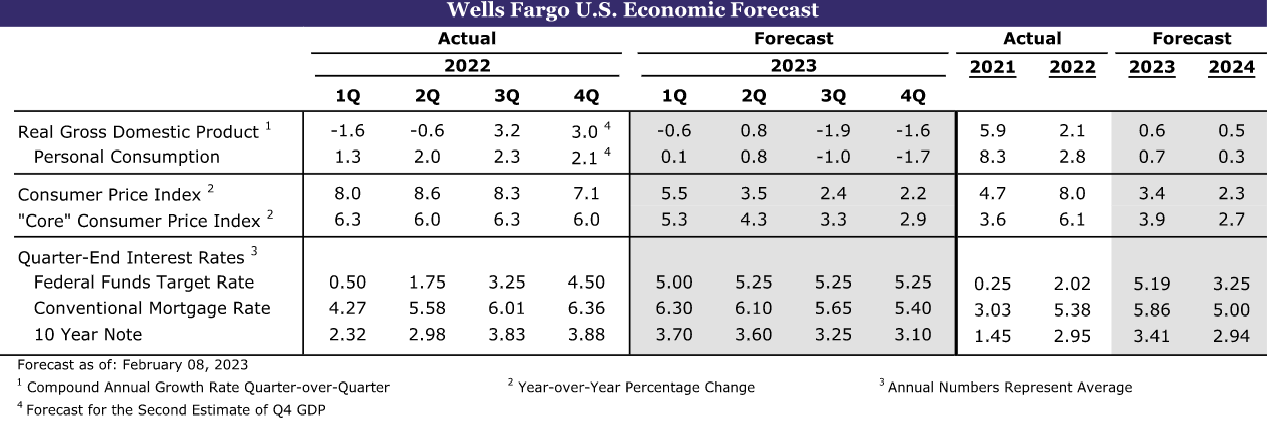
  • Resilience was on full display in this week's economic indicators and market-based rate expectations moved closer in line to the forecast we have maintained for months: that the Federal Reserve will guide its main borrowing rate higher still to 5.25% and hold it there through year-end.

  • Next week: Existing Home Sales (Tue), Personal Income & Spending (Fri), New Home Sales (Fri)

International: Inflation is hot and growth is not. What's new?

  • In good news, inflation in the U.K. receded for the third straight month in January, with the headline rate coming in at 10.1% year-over-year. In bad news, this is still five times the Bank of England's 2% target. Elsewhere, Japan's economy rebounded 0.2% quarter-over-quarter in Q4 after a negative print in Q3, and we expect these mixed growth trends to continue this year. Down under in Australia, the job market failed to regain its footing last month, with employment declining for the second month in a row. Notably in contrast to the December jobs report, this drop in employment was completely due to a decline in full-time employment.

  • Next week: Eurozone PMIs (Tue), U.K. PMIs (Tue), Canada CPI (Tue)

Interest rate watch: Rates market reset

  • Treasury yields have climbed higher in recent weeks amid a string of especially hot economic data. The yield on a 10-year Treasury note is nearly back to where it started the year, and the two-year note yield is above its 2023 starting point.

Topic of the week: The bottom line: Margin's getting squeezed

  • S&P 500 profit data show that even as sales continued to grow in the fourth quarter, margins compressed. We won't get economy-wide margins until the end of March, but we look for a similar squeeze. Declining profitability can motivate firms to keep prices high or force cost-cutting to protect the bottom line; neither is good for the economy.
Chart

Read the full report

Author

More from Wells Fargo Research Team
Share:

Editor's Picks

AUD/USD remains depressed below 0.6750 after RBA minutes

AUD/USD treads water below 0.6750 in Asia on Tuesday, struggling near ten-month lows. The pair fails to find any inspiration from RBA Governor Bullock’s hawkish remarks. Moreover, Minutes from the November RBA meeting also had little impact on the Australian Dollar amid a bullish US Dollar undertone, bolstered by firming Fed hike bets and geopolitical uncertainties.

USD/JPY holds steady around 156.50 as 'Yentervention' risks loom

USD/JPY is consolidating around mid-156.00s in the Asian session on Tuesday as traders stay on high alert amid speculation that authorities will step in to support the Japanese Yen. Meanwhile, the US Dollar holds its recent gains at a 19-month high, amid firming Fed rate-hike bets and geopolitical uncertainty. This, along with the wide US-Japan rate differential, acts as a tailwind for the pair.


Gold remains offered below $3,850 on firmer US Dollar

Gold recedes below the $3,850 zone per troy ounce on Tuesday, still navigating the area of multi-month lows. The continuation of the upside momentum in the US Dollar, investors’ repricing of further Fed tightening and a decent bounce in US Treasury yields across the curve keep the precious metal under scrutiny for the second day in a row.

Ripple bulls struggle as Binance whale withdrawals surge

XRP trades marginally above $0.95 as bulls push to gain ground, but upside remains strongly capped. XRP whales withdrew $21 million from Binance on Monday, extending broader $127 million outflows since November 10.

Make or break tonight: Nvidia reports Q3 earnings
The Nasdaq lost 2.5% yesterday following an interim final rule by the US Commerce Department on US export restrictions on AI chips (to China). The rule targets a loophole where Chinese firms rent computing power from data centers in unrestricted countries. Data center operators in Singapore, Malaysia, Thailand, Indonesia and Brazil must now request a US license to buy advanced AI chips.
Gold isn't being sold for thew reason most people think
Gold (XAU/USD) remains under heavy selling pressure on Monday, hitting its lowest level in 13 months. The precious metal is struggling to recover despite escalating geopolitical tensions in the Middle East, a backdrop that would normally encourage investors to seek protection in safe-haven assets. However, the main driver behind Gold's decline is not the geopolitical uncertainty itself.
Rage, rage against the dying of the light

















