The New Zealand Dollar is now weaker than at any point since the 2009 crisis


NZD/USD extends its decline on Monday, falling to its lowest level since 2009. The New Zealand Dollar (NZD) has now fallen below the March 2020 pandemic low near 0.5470 against the US Dollar (USD), reaching levels last seen during the aftermath of the global financial crisis.
The latest decline marks a significant deterioration in the Kiwi's long-term outlook. Despite signs of improving domestic consumption, investors remain reluctant to buy the New Zealand currency, as expectations of further monetary tightening by the Federal Reserve (Fed) continue to support the Greenback.
The contrast is particularly striking: New Zealand has just reported its strongest quarterly retail sales growth in nearly five years, yet its currency remains at levels not seen in almost two decades.
Strong retail sales fail to rescue the New Zealand Dollar
New Zealand's latest economic data offer some encouraging signs for the domestic economy, but they have done little to reverse the Kiwi's bearish momentum. Statistics New Zealand reported on Monday that Retail Sales increased 2.2% QoQ in the third quarter, significantly exceeding market expectations of a 0.5% rise. The result also marks a sharp recovery from the revised 0.4% contraction recorded in the previous quarter. This represents the strongest quarterly expansion in retail consumption in nearly five years, suggesting that household spending is recovering despite a challenging economic environment.
Normally, such a positive surprise could support the New Zealand Dollar by improving growth expectations. However, NZD/USD has failed to establish a meaningful recovery, highlighting the extent to which broader monetary policy expectations are overshadowing domestic economic improvements.
The Reserve Bank of New Zealand (RBNZ) remains another source of uncertainty. Its decision to leave interest rates unchanged in late October, despite expectations of a hike, disappointed investors and contributed to a buildup of speculative short positions against the Kiwi.
Although markets anticipate a 25-basis-point rate increase at the RBNZ's December 9 meeting, this prospect has so far failed to generate sustained demand for the currency.
The Federal Reserve continues to dominate the currency market
The New Zealand Dollar's weakness is also closely linked to the resilience of the US Dollar, supported by expectations of further monetary tightening in the United States (US). According to the CME FedWatch Tool, investors assign a 96% chance to a 25-basis-point interest rate increase at the Fed's December meeting, followed by a 62% chance of another hike in January. However, expectations for a third consecutive increase in March have moderated, with the odds declining to 35% from more than 50% in the previous week.
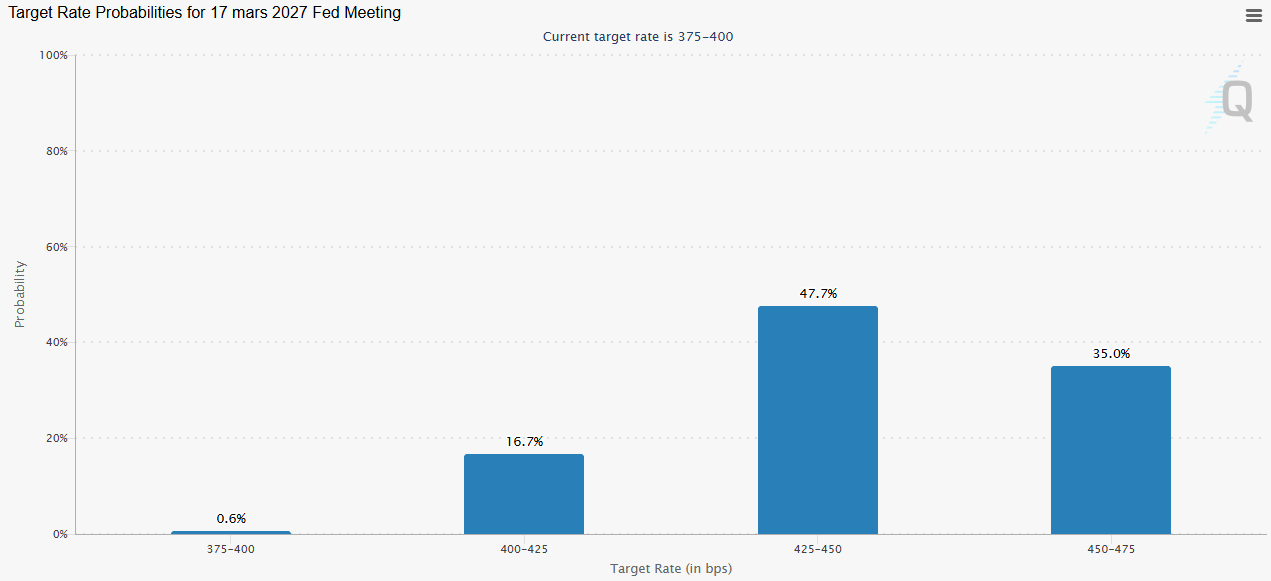
Despite this adjustment, the overall monetary policy outlook remains supportive of the Greenback. The US Dollar Index (DXY), which measures the US Dollar's performance against six major currencies, climbs above 104.00, reaching a fresh 19-month high after briefly retreating to 103.59 earlier in the day.
ING considers that it is “probably a little too early to expect much downside for the Dollar yet.” The bank expects the upcoming US inflation data to “come in hot again and maintain solid support for a tightening cycle into 2027,” reinforcing the view that US interest rates could remain an important source of support for the currency.
Investors now await Wednesday's release of the US Personal Consumption Expenditures (PCE) Price Index for October, the Fed's preferred inflation gauge, for further clues about the trajectory of monetary policy. Meanwhile, renewed geopolitical tensions in the Middle East are contributing to demand for the safe-haven US Dollar, adding another obstacle to a potential recovery in NZD/USD.
NZD/USD breaks a historical floor: How much further can the Kiwi fall?
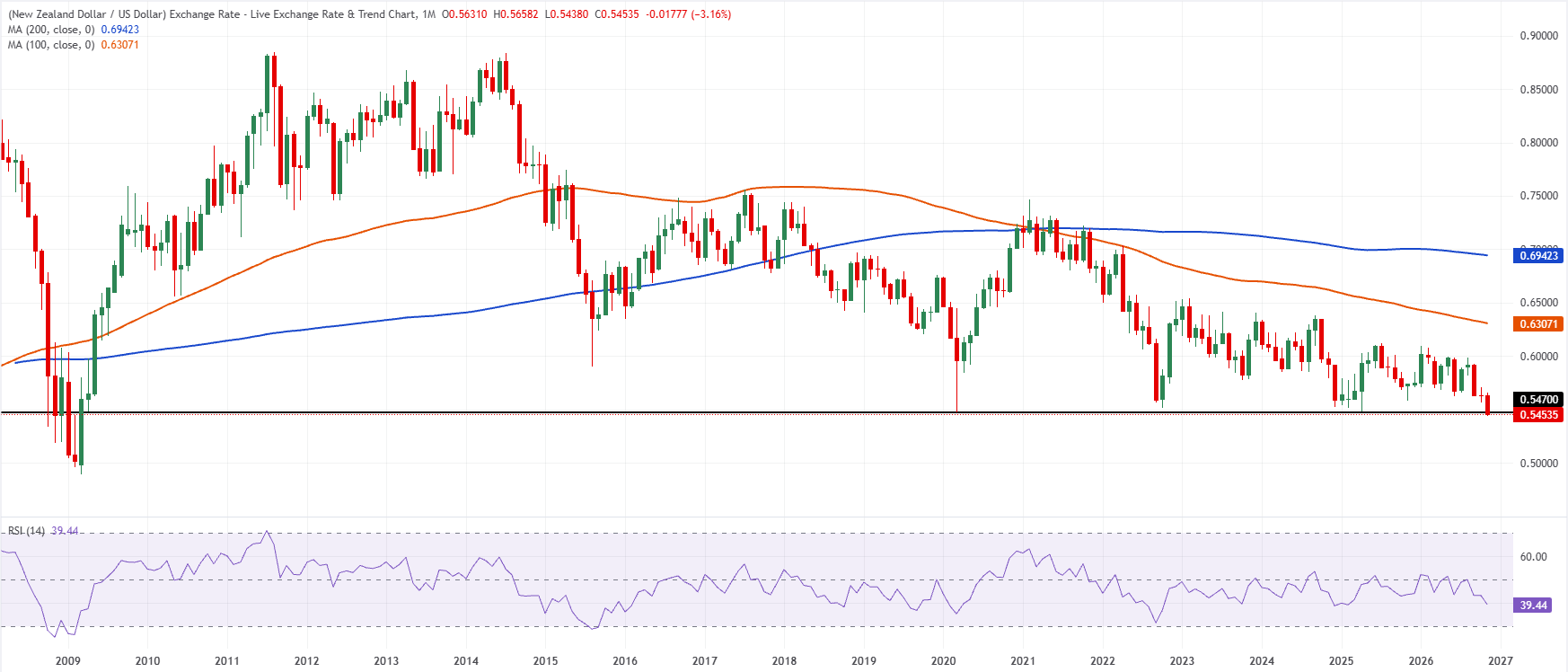
The monthly NZD/USD chart illustrates the significance of the latest decline, with the currency pair breaking below the 0.5470 level, which marked the low reached during the Covid-19 market turmoil in March 2020. This breakdown is particularly important because the 0.5470-0.5600 region has repeatedly acted as a major support area over recent years, notably in 2022 and 2025.
With NZD/USD now trading around 0.5450, this historical floor is under serious threat, although a monthly close below the zone would provide stronger confirmation of a sustained bearish breakout.
The next significant support emerges around 0.5342, a level associated with the extreme market volatility of the 2008-2009 financial crisis. Below this threshold, the 0.5200 region represents another potential downside target.
On the upside, a recovery above 0.5470 would be the first step toward stabilizing the currency pair. However, NZD/USD would still face resistance around 0.5600 and 0.5750, two levels that have repeatedly limited price movements.
The broader technical picture remains unfavorable, with the pair trading well below its 100-month and 200-month Simple Moving Averages (SMAs), currently around 0.6307 and 0.6942, respectively. The monthly Relative Strength Index (RSI) stands near 39, indicating persistent bearish momentum without suggesting that the currency has reached oversold conditions.
For the New Zealand Dollar, the challenge is therefore twofold: recovering from its weakest levels since 2009 while facing a US Dollar supported by expectations of further interest rate increases.
Unless the Fed's monetary policy outlook changes significantly or New Zealand's economic recovery gains enough momentum to restore investor confidence, the Kiwi could remain vulnerable to further losses.
Author
Ghiles Guezout
FXStreet
Ghiles Guezout is a Market Analyst with a strong background in stock market investments, trading, and cryptocurrencies. He combines fundamental and technical analysis skills to identify market opportunities.

















