The Euro is at its weakest since spring 2025 and the ECB is about to hike

EUR/USD remains under selling pressure on Tuesday, reaching a fresh 19-month low near 1.0985. The Euro (EUR) has fallen below the psychological 1.1000 level for the first time since May 2025, extending a decline that has accelerated considerably in recent weeks.
The weakness of the single currency appears paradoxical. The European Central Bank (ECB) is widely expected to raise interest rates in December, a development that would normally support the Euro. However, investors remain more attracted to the US Dollar (USD), as expectations of further monetary tightening by the Federal Reserve (Fed) continue to dominate currency markets.
Why is the Euro falling when the ECB is preparing to raise rates?
The ECB is approaching another monetary tightening decision. According to a Reuters survey conducted between November 10 and 12, all 71 economists expect the central bank to raise its deposit rate by 25 basis points, from 2.50% to 2.75%, at its December 17 meeting. According to the ECB Watch tool, markets price a 93% chance of a 25-basis-point (bps) hike for the upcoming meeting.
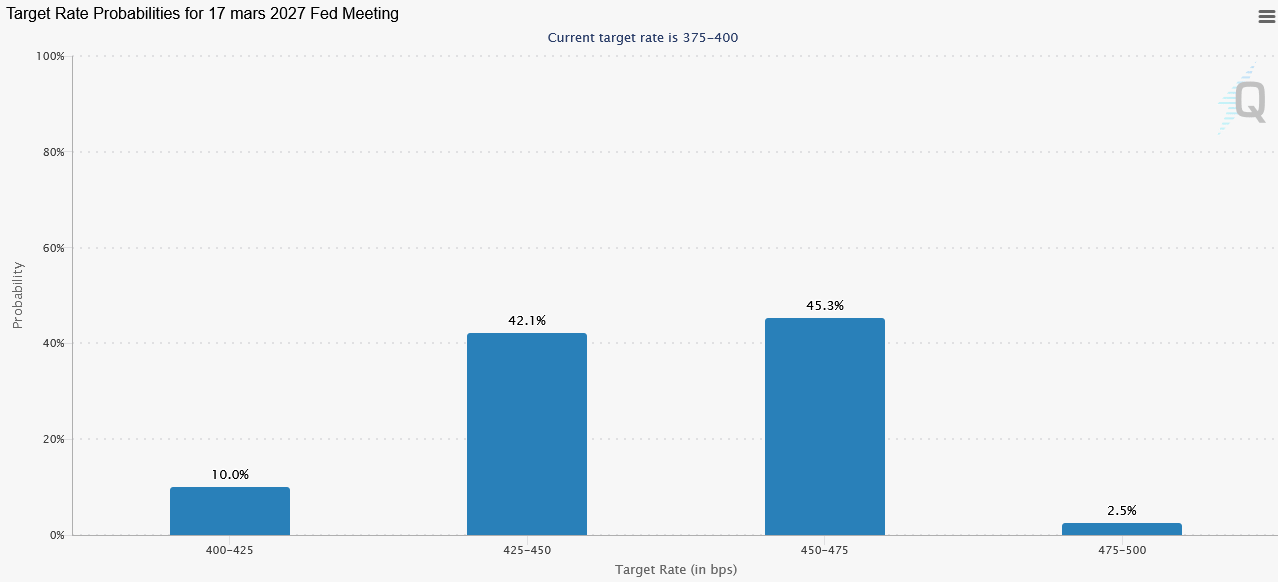
However, the Fed is also widely expected to raise rates at its December 8-9 meeting, potentially maintaining the interest rate advantage of the United States (US). According to the CME FedWatch tool, markets assign a 93% chance to a 25 bps hike in December.
The difference lies in expectations for what happens afterward. Investors increasingly believe that the Fed could sustain a more aggressive tightening cycle than the ECB, particularly following stronger-than-expected US inflation figures and hawkish comments from policymakers. Traders are also pricing in additional interest rate hikes in January and March, further increasing the upward pressure on the US Dollar.
ING analysts highlight this imbalance, explaining that "the market sees the potential for a prolonged tightening cycle as more credible in the US than in the Eurozone."
The divergence is reflected in interest rate markets. According to ING, the two-year EUR/USD swap rate differential has widened by nearly 35 basis points, while the inflation-adjusted differential has reached its widest level since December 2022.
Stronger German economic sentiment fails to rescue the Euro
Tuesday's economic figures provide another illustration of the Euro's difficulties. Germany's ZEW Economic Sentiment Index rose to 35.6 in November from 28.1 in October, significantly exceeding market expectations of 29. The Current Situation Index also improved to -33.2 from -35.9. Across the Eurozone, the ZEW Economic Sentiment Index climbed to 26.5 from 18.5, beating the consensus forecast of 19.1. These figures suggest improving confidence in the European economic outlook, but they have failed to reverse the Euro's downward trajectory.
The weakness reflects broader concerns about economic growth, particularly after Eurozone Industrial Production increased only 0.2% MoM in September, below expectations of 0.6%. Meanwhile, political uncertainty and public debt concerns in France continue to undermine investor confidence. HSBC analysts warn that "France’s fiscal pressures have attracted less FX-market attention than in early October, but remain unresolved."
These fiscal vulnerabilities are limiting the Euro's ability to benefit from higher interest rate expectations, particularly as investors question the ECB's room for maneuver if economic conditions deteriorate.
The US Dollar benefits from Fed expectations and market uncertainty
The US Dollar continues to benefit from expectations of higher interest rates and renewed demand for safe-haven assets. Recent US inflation figures have reinforced speculation that the Fed will raise rates by at least 25 basis points in December, while policymakers continue to warn that inflation remains uncomfortably elevated.
The correction in US technology stocks is also contributing to market uncertainty, supporting defensive demand for the Greenback. However, this relationship could eventually reverse if declining equity prices trigger expectations of a less restrictive Fed policy.
Commerzbank notes that "falling US equity prices also have the potential to weigh on the US dollar."
EUR/USD bears target 1.0950 as 1.1000 gives way
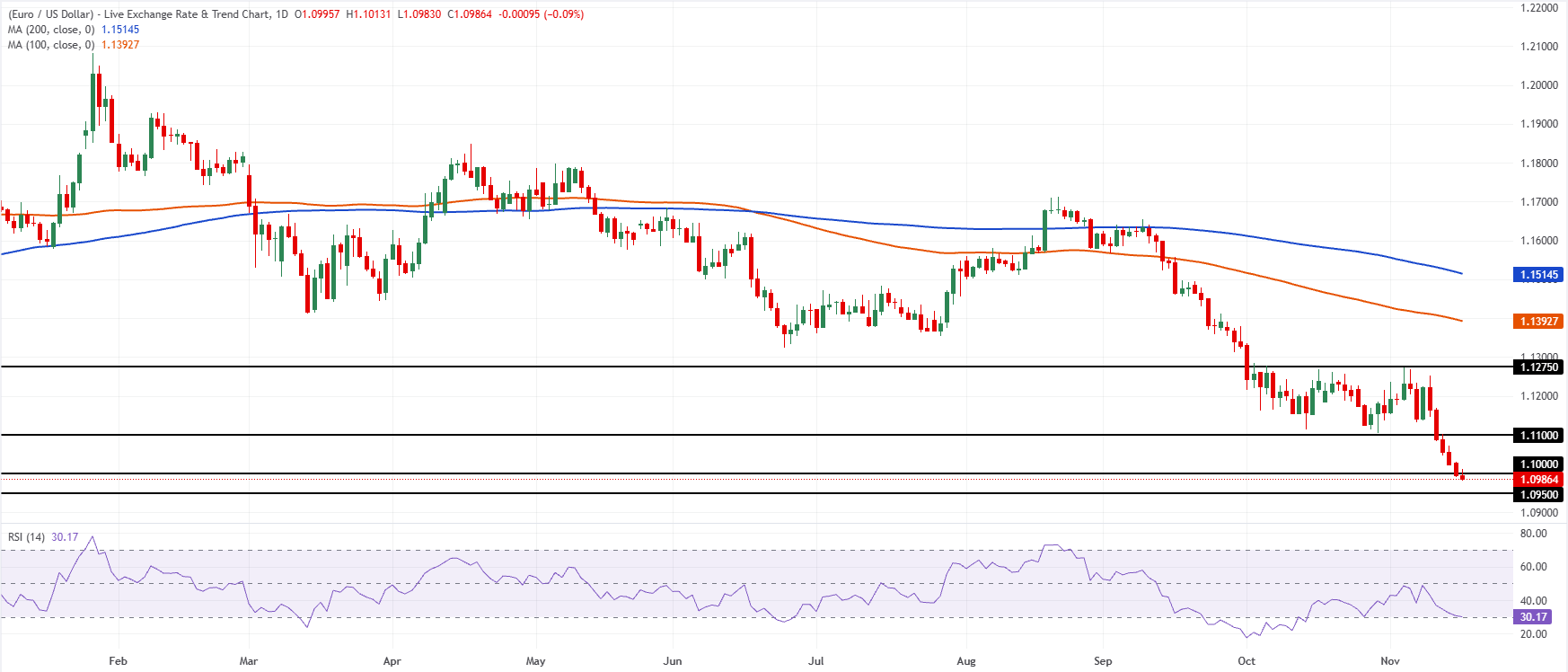
EUR/USD's daily chart shows a firmly established downtrend, characterized by successive lower highs and lower lows since the January peak near 1.2100. The latest decline has pushed the pair below the former support levels at 1.1275 and 1.1100, followed by the psychological 1.1000 level.
The 100-day Simple Moving Average (SMA) at 1.1393 and the 200-day SMA at 1.1515 are both declining, confirming the broader bearish structure. Meanwhile, the Relative Strength Index (RSI) stands near 30, approaching oversold territory. This suggests that selling pressure remains strong, although the possibility of a temporary technical rebound is increasing.
The immediate downside target is located at 1.0950, the next visible support on the daily chart. A decisive break below this level would reinforce the bearish outlook and expose EUR/USD to further losses.
Conversely, a recovery above 1.1000 could provide initial relief, but the former support at 1.1100 represents a more significant obstacle. Beyond that, the 1.1275 resistance level would need to be reclaimed to challenge the current bearish structure.
Can the ECB's December rate hike stop the decline?
The Euro's weakness highlights an important distinction in currency markets: interest rate increases don't automatically translate into currency appreciation. What matters is how monetary policy expectations compare between economies, and whether investors believe a central bank can sustain higher rates.
For now, the Fed enjoys greater credibility in sustaining a prolonged tightening cycle, while concerns about European growth and fiscal uncertainty continue to weigh on the single currency.
A stabilization of EUR/USD remains possible if US economic data disappoint or interest rate differentials move further in the Euro's favor. However, without a meaningful change in the relative monetary policy outlook, the ECB's anticipated December rate hike may prove insufficient to reverse the Euro's persistent downtrend.
Author
Ghiles Guezout
FXStreet
Ghiles Guezout is a Market Analyst with a strong background in stock market investments, trading, and cryptocurrencies. He combines fundamental and technical analysis skills to identify market opportunities.

















