Reserve Bank of Australia Preview: A hawkish surprise from Lowe & Co?
- The RBA is expected to end its pandemic-related bond-buying program.
- Market participants speculate policymakers will bring forward rate hikes’ guidance.
- AUD/USD corrective advance could continue only once above 0.7100.

The Reserve Bank of Australia has a monetary policy meeting on Tuesday, February 1st. The central bank has anticipated that it would put an end to its A$350 billion bond-buying programs in this meeting while maintaining the view that rate hikes will remain low at least until 2024. However, market players are anticipating that policymakers will bring forward rate hikes’ guidance to early 2023.
Inflation up, wage growth lagging
At the same time, there’s mounting speculation the RBA will have to respond faster to mounting inflationary pressures. Some market analysts believe the central bank will have no choice but to kick-start lifting rates as soon as this year.
Australian policymakers have conditioned rate hikes to wage growth surging to at around 3%. They estimate that with wages advancing at such a pace, inflation will be sustainably in the 2-3% target band. The next quarterly wage report will be out on February 23rd, with the latest figure at 2.2% YoY.
Meanwhile, employment figures have been upbeat ever since the economic reopening mid-October. The country added 64.8K new jobs in December after creating 366K positions in the previous month, while the Unemployment Rate contracted to 4.2%.
Inflation, on the other hand, has risen to an annual rate of 3.5% in December, while the core Trimmed Mean Consumer Price Index rose to 2.6% in the same month, up from the previous 2.1%. Consumer Inflation Expectations shank to 4.4% in January from 4.8% previously.
So, while wage growth is still far from the RBA’s target, inflation is not. The trimmed mean aforementioned figure is between the central bank’s target for the first time since 2014, which means that the RBA has high chances of changing its forward guidance to even a closer date than 2023.
Overall, market players anticipate a hawkish stance from Governor Philip Lowe & Co.
AUD/USD possible scenarios
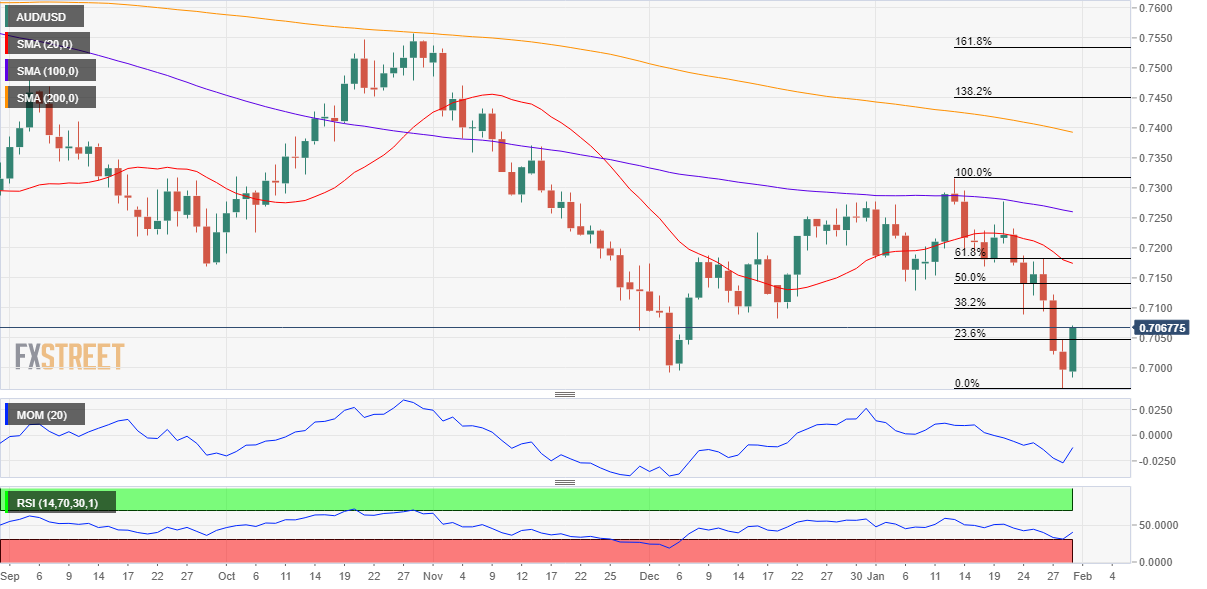
Heading into the event, the AUD/USD pair is recovering some ground, trading at around 0.7060. The pair bottomed at 0.6966 on Friday, the lowest since July 2020. The greenback is responsible for the latest AUD/USD decline, as an aggressive US Federal Reserve has boosted demand for the American currency while putting equities in a selling spiral. Wall Street has closed in the red for the previous four weeks, and much of the upcoming direction will continue to depend on US equities’ behaviour.
From a technical point of view, the daily chart shows that the corrective movement could extend, as the pair has surpassed the 23.6% retracement of its January decline, as technical indicators bounce from their recent lows. Nevertheless, they remain far below their midlines, while the pair is developing below moving averages, indicating the advance could be temporal.
The 4-hour chart shows that the price is currently advancing above a bearish 20 SMA, but also that technical indicators lost momentum near their midlines, hinting at limited buying interest. The 38.2% retracement of the mentioned slide stands at 0.7098, the level to break to confirm further gains in the upcoming sessions. Below 0.7045, on the other hand, the risk will turn back south.
Author

Valeria Bednarik
FXStreet
Valeria Bednarik was born and lives in Buenos Aires, Argentina. Her passion for math and numbers pushed her into studying economics in her younger years.