Private payroll losses and US shutdown fuel market volatility

Last week’s ADP report landed with a real shock: the US private sector shed jobs for the second straight month. September payrolls fell by 32,000, and August was revised down to -3,000 from the originally reported +54,000. For traders, this wasn’t just another data release, it was the kind of miss that forces a wholesale repricing of Federal Reserve expectations.
The timing couldn’t have been worse. With the government shutdown halting many official statistics, markets have been forced to lean heavily on private surveys like ADP and high-frequency data to take the pulse of the economy. In that kind of vacuum, every single print carries extra weight, and the debate around the Fed’s next move only gets louder.
The impact was immediate. Fed Funds futures quickly shifted to price in a higher chance of another cut in October, and chatter about a possible 50-basis-point move has started to creep in. Treasury yields slid across the curve, the dollar weakened, and commodities caught a fresh bid. Inside the Fed, the gap between hawks and doves is widening, leaving Chair Jerome Powell struggling to keep the balance.
The shock of two consecutive job losses
The ADP release showed:
-
September: -32,000 private payrolls (vs. expectations of +50,000).
-
August revision: down to -3,000 from an initial +54,000.
This marks the first time since the pandemic that ADP has reported two consecutive months of net job losses in the private sector. For a labor market long considered the backbone of US economic resilience, this is a striking shift.
Markets reacted instantly. Fed Funds futures repriced sharply: the probability of a cut at the October meeting jumped above 70%, while a non-negligible minority of contracts began pricing a 50-bp cut. Treasury yields dropped, especially at the front end, reflecting expectations that policy rates will come down faster.
For the dollar, the impact was clear: USD weakened broadly, with EUR/USD lifting above 1,12 and USD/JPY sliding toward the 147,50 area. Commodities such as silver and oil benefitted from the weaker greenback and the perception of a faster easing cycle.
Shutdown leaves the Fed blindfolded
The backdrop to these developments is the US government shutdown, which has forced agencies like the Bureau of Labor Statistics (BLS) and the Bureau of Economic Analysis (BEA) to suspend publication of official data. That means no nonfarm payrolls, no updated GDP estimates, and no reliable inflation surveys.
In this environment, private data becomes the only compass. ADP payrolls, PMI surveys, ISM indices, and high-frequency indicators such as weekly claims take on disproportionate importance. Marketsm and the Fed itself, are forced to lean on numbers that are inherently more volatile and less comprehensive.
This is problematic for policymakers. Hawks and doves inside the Fed are already pulling in opposite directions. Without the anchor of official data, each camp seizes on whatever figures support their case. Hawks argue inflation remains sticky and that cutting too fast would undermine credibility. Doves point to the ADP data as evidence that the labor market is cracking and demand immediate easing.
The result is a data vacuum filled by noise and volatility. Every private survey is treated like gospel, even though revisions are frequent and reliability is mixed. Traders must therefore navigate an environment where policy signals are blurred and risk of overshoot, both in markets and in Fed decision, makin is high.
Hawks vs Doves: Divisions widen
The ADP shock has deepened the existing fault lines inside the Fed.
-
Hawks insist that inflationary pressures, particularly in services, remain too strong to allow aggressive easing. They argue that shelter costs, healthcare, and labor expenses still pose upside risks. In their view, the Fed must protect its credibility and move cautiously.
-
Doves, on the other hand, highlight rising jobless claims, declining wage momentum, and now two consecutive months of ADP losses. For them, the risk of recession is greater than the risk of inflation, and the Fed must act decisively to prevent a hard landing.
-
Powell continues to straddle the middle ground. His post-decision remarks after the last cut emphasized a “modestly restrictive” stance and a commitment to data dependence. But with official data offline, the Chair’s pragmatism risks frustrating both sides, and unsettling markets further.
Market reactions: Dollar, Bonds, commodities
The ADP miss triggered a broad repricing across asset classes.
-
US Dollar (DXY): Dropped toward 102 before finding support. EUR/USD reclaimed 1,12, while USD/JPY fell to 147,50, its lowest in weeks. The greenback remains vulnerable as long as labor data disappoint.
-
Treasuries: Yields fell across the curve, with the 2-year yield dropping nearly 15 bps in a single session. The curve steepened modestly, reflecting expectations of faster cuts ahead.
-
Silver: Extended its consolidation near 43,00 $, benefitting from lower real yields and a softer dollar. Key resistance remains at 43,50 $, with support at 42,50 $.
-
Oil (WTI): Crude oil extended its decline last week, falling from the mid-60s and now testing support levels below 62,00 $. The Renko chart shows a clean break under WS61 (61,71), with the next support near WS78 (60,30). Momentum remains weak, as indicated by a bearish stochastic pattern. Resistance is now distant around 64,50–65,00 $, suggesting rallies will face heavy selling pressure.
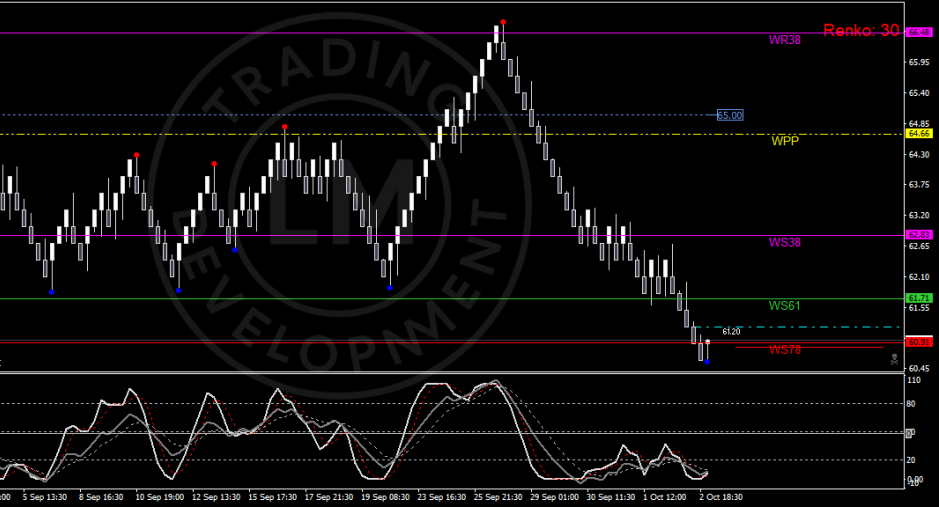
WTI Renko chart highlights the breakdown below 61,70 with support at 60,90 (WS78) and resistance near 64,66 (WPP).
Why the shutdown matters for traders
The absence of official data creates three key risks:
-
Overreaction to Private Data: Traders and policymakers alike may overweight ADP, ISM, or PMI figures, leading to exaggerated market moves.
-
Increased Volatility: With less information, uncertainty spikes. Every Fed speech or private release can swing markets sharply.
-
Policy Missteps: The Fed risks making decisions on incomplete data. A premature cut could reignite inflation; too much caution could deepen a slowdown.
For traders, this environment demands flexibility and risk management. Wide ranges, sudden reversals, and data-driven whipsaws are likely until the shutdown ends and official statistics return.
Trading implications
-
EUR/USD: Support at 1,1150, resistance at 1,1250. A dovish Fed bias keeps the pair bid, but a hawkish pushback could cap gains.
-
USD/JPY: Key level at 147,50. A break lower opens 146,00, while hawkish commentary could fuel a rebound toward 149,00.
-
Silver (XAGUSD): Watch 43,50 $. A breakout would target 44,50 $, while consolidation keeps the range intact.
-
WTI Crude: Support 71,50 $, resistance 73,50 $. A shutdown-driven slowdown narrative may weigh on demand, but supply-side risks offer a floor.
Looking ahead
The coming weeks will test the Fed’s ability to steer without reliable instruments. Every speech, every private survey, and every market reaction will be scrutinized for clues. For traders, that means opportunity, but also heightened risk.
If shutdown conditions persist, ADP and similar releases will remain disproportionately influential. That amplifies the stakes of each print and the volatility that follows.
Personal take
In my view, the ADP surprise is less about the number itself and more about the context. A negative print of 32,000 would usually get dismissed as survey noise. But with the shutdown muting official releases, it suddenly becomes a stand-in for the entire labor market.
That’s the real risk. Policy shouldn’t pivot on a single dataset, and markets know that. Yet until Washington resolves its budget standoff, both traders and the Fed are flying half-blind.
For me, the key takeaway is that uncertainty isn’t a tail risk anymore, it’s the base case.
The Fed is split, the data is incomplete, and markets are hypersensitive. That mix almost guarantees volatility. And for disciplined traders, volatility is opportunity.
Author

Luca Mattei
LM Trading & Development
Luca Mattei is a market analyst focusing on FX, metals, and macroeconomic trends. He develops trading tools for retail and professional traders, coding indicators and EAs for MT4/MT5 and strategies in Pine Script for TradingView.