Non-human resources: Commodity traders are adopting algorithms

Apparently catching up with the rest of the world in the field of automated “algorithmic” trading, commodity traders are rapidly adopting Artificial Intelligence as a new tool to determine market price direction.
For many years, commodity traders relied on fundamental data, market rumors, and pure trader instinct to navigate their markets. However, with computerization, and in particular, the Internet, the world is a much smaller and faster moving place. Traders who could move trends on rumor and run markets to take out buy and sell stops have seen their profit margins dwindling. Now, rather than looking for gutsy traders willing to “have a go”, commodity companies are now more inclined to hire mathematical and computer whiz kids to sit around their trading desks. Market flow is now taking a backroom position to pattern recognition and artificial intelligence.
Automated trading is on the rise in the commodities markets, with increases extending to 25% in some financial futures sectors, like grains and oilseeds, in the years 2014-2016. This is a direct result of shrinking margins, following the immediate dissemination of news, weather reports, and online cargo tracking. In the past, commodity traders easily saw profits in excess of 50%.Those profits have been halved, forcing them to look for other methods to make gains.
Algo-trading is increasing in the commodity markets
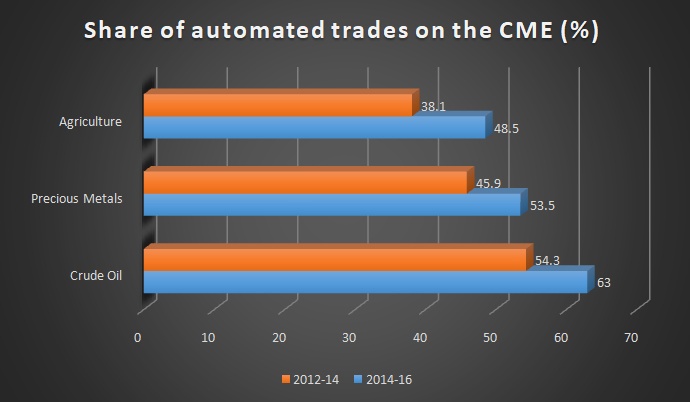
Trading is now driven by computer geeks, with dealing rooms looking for young people with PhDs in physics and mathematics. These young men and women are hired to sift through banks of historical prices in an attempt to find patterns within the charts. The data is then fed back into the computer, and forecasts are made for future price movements, which are then assessed for profitability.
Many traditional commodity firms have declared that the “new trading” is producing results, and that profits are back on the rise. On the downside, such algorithmic trading also has an effect on futures prices, making hedging a more difficult task. In spite of that, automated commodity contract trading is growing rapidly. Indeed, some traders are forming partnerships with algorithmic funds that specialize in “quant”, or quantitative trading.
But the road to full automation is not an easy one. There is still great resistance to fully handing over trading decisions to robots. Many old traders are wary of taking trading decisions out of the hands of humans, and they’re probably right. However, these computerized tools do have intrinsic value, and in the hands of experienced traders who can follow the old adages of cutting losses short and running profits, the overall trading strategy can only be enhanced.
Merrill Lynch, who performed extensive computer optimization programs back in the 1970s, found that patterns could be identified in specific markets. However, when those patterns were applied to future market movement, invariably those programs lost money. This was possibly due to the error of assuming that any financial market is like a giant human brain that can learn from its successes and failures. Any person who has traded in the market will know that markets can change direction in an instant for reasons that only become apparent weeks or months later. This type of behavior is difficult to program. Merrill Lynch’s conclusion was that computer technical analysis is particularly helpful when tracking market price movement and for giving buy and sell signals, but this trading activity must be conducted in parallel with solid money management.
Author

Amram Margalit
Leverate
Amram Margalit is a professional writer who has worked in a wide range of settings, including technology companies, nonprofits, and the entertainment industry.

















