Japanese Yen's weakness pushes Tokyo core inflation to a 16-month high for households

Tokyo's core inflation rose to 2.9% in November because energy bills jumped, and a weak Yen makes that imported energy cost more. Household bills will ease only if the Yen recovers or the government returns to paying part of them.
Prices in Tokyo are rising at their fastest in 16 months, and the Japanese Yen (JPY) is getting the blame. Core inflation, which excludes fresh food but includes energy, reached 2.9% in November from 2.6% in October. Over the same period, the currency has been close to 160.00 to the US Dollar (USD), where it has traded since late September. A weak Yen makes imports cost more, so the connection is real.
It is also the smallest of the three things behind the number. Energy bills account for the whole rise, about half of that is a government subsidy running out, and most of the rest is the world price of Oil and gasoline products. The Yen comes third, but it is the only one of the three that the Bank of Japan (BoJ) can do anything about. Whether it recovers decides who ends up paying for the other two.
Energy bills did all of it
The November figures for Tokyo, which come out about three weeks before the national ones, show where the rise came from. Energy prices were up 9.5% from a year earlier, against 2.2% in October, with electricity up 9.5% and piped gas up 13.7%. Energy added 0.43 of a point to the inflation rate in November and 0.09 in October, and the difference of 0.34 is slightly more than the 0.3-point rise in core inflation.
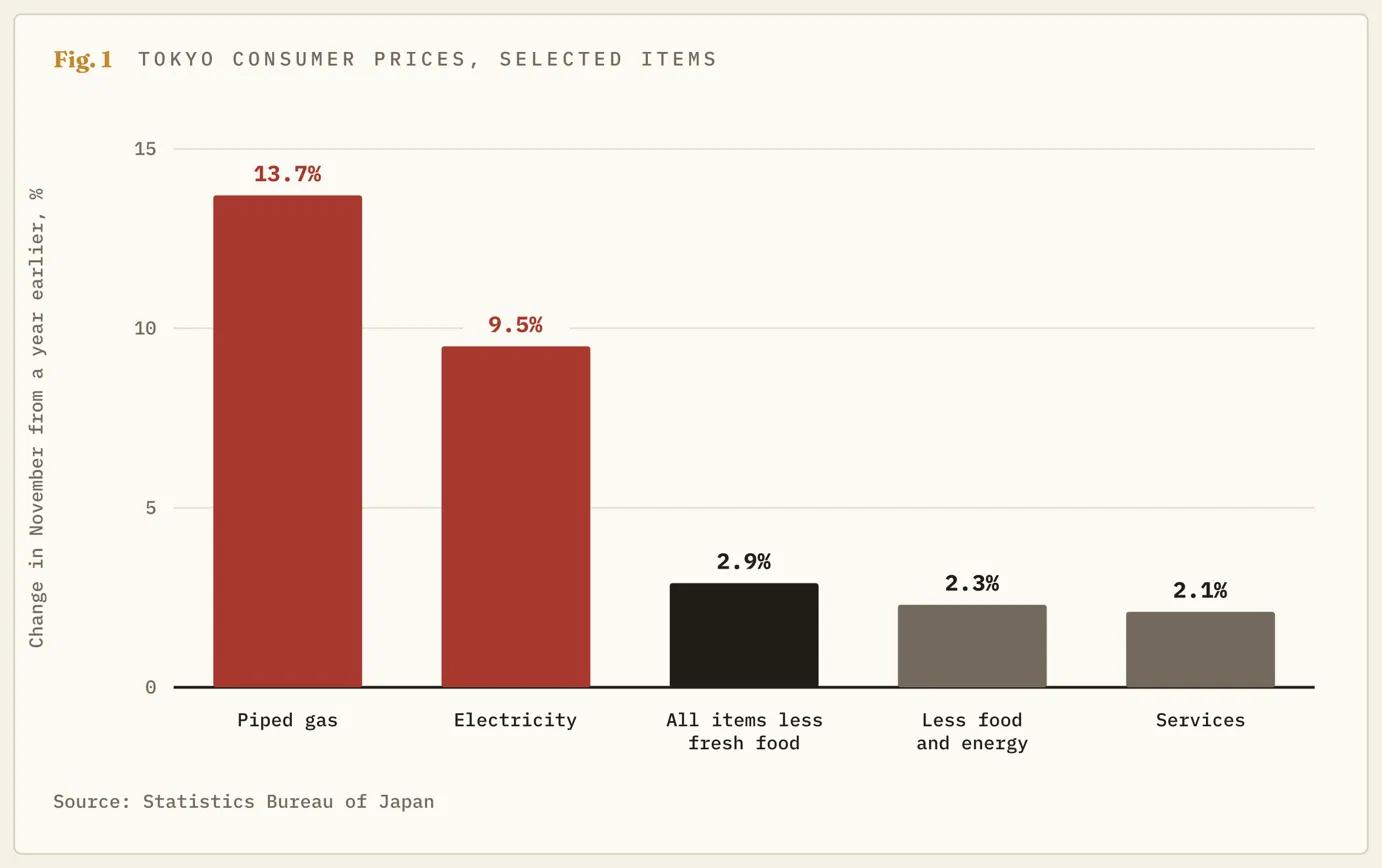
Outside energy, Tokyo's prices slowed. The measure without food and energy came in at 2.3%, down from 2.4% and well short of the 3% forecasters expected, and prices for services rose 2.1% after 2.2%. Core inflation was a tenth of a point below its forecast, so the 16-month high was still smaller than forecasters had expected.
Even within energy, about half of the jump has nothing to do with fuel markets. Tokyo households had been getting government help with their electricity and gas bills, and that help ended after the October billing period. The government estimates that the subsidies took 0.16 of a point off October's inflation rate, so removing them would be expected to put about the same amount back in November.
What a weak Yen adds to the fuel bill
The other half of the energy jump is fuel that costs more, and this is where the Yen comes in. Japan imports nearly all of its Oil and gas and pays for most of it in US Dollars. The price a Tokyo household ends up paying therefore depends on the Dollar price of the fuel and on how many Yen it takes to buy a Dollar, and both have gone up.
On that point, the BoJ's import price figures separate the two. In October, the prices Japan paid for its imports were 24.8% higher than a year earlier when measured in Yen. They were 19.2% higher when measured in the currencies the contracts were written in, which are mostly Dollars. The 19.2% is largely the war involving Iran and what it has done to Oil and gas prices, and the 5.6 points on top are the weaker Yen.
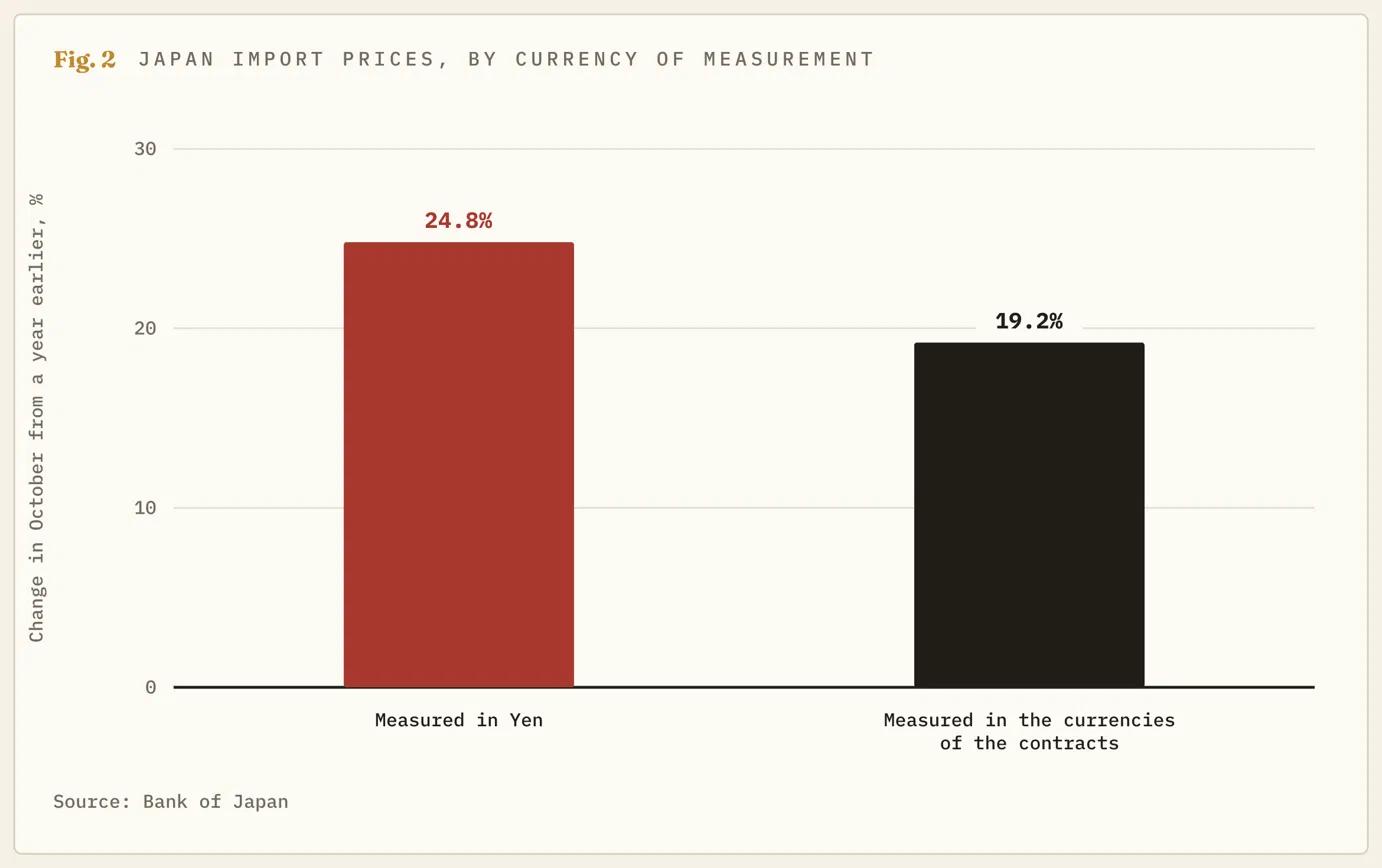
By that measure, the Yen is a bit more than a fifth of the increase in Japan's import bill, which is still far from all of it. It still matters more than its share suggests, because nobody in Tokyo sets the Dollar price of Oil, and the exchange rate is something Japanese policy is supposed to influence. A Yen back near 153.00, where it traded in early September, would take about 4% off the Yen price of every imported barrel without the Oil market changing at all.
Pay is rising and households are spending less
Japanese workers are, on paper, keeping up. Pay adjusted for inflation rose 2.2% in September from a year earlier, the ninth monthly gain in a row, and pay before inflation rose 4.6%, the most since 1997. Numbers like those would show up in shops if prices were rising because the economy was running hot.
Instead, household spending adjusted for inflation fell 6.8% in September from a year earlier, the tenth fall in a row and the largest since September 2020. Bad weather took some of the blame that month, but spending also shrank across the whole third quarter, for the second quarter running. In a BoJ survey published in October, 54.4% of people said their household finances had got worse over the past year.
Part of the explanation is who the pay figures leave out, since pensioners get no pay rise and they are a growing share of Japanese households. The rest is what is going up. Electricity, gas and food are bills that can't be put off, so a household facing a 9.5% rise in its electricity bill pays it and cuts something else. That is how fuel bought in Dollars with a weak Yen ends up as weaker spending in Tokyo's shops.
The BoJ has its own reasons to raise rates
The best argument on the other side is that inflation in Japan is broader than one month of Tokyo energy bills. The BoJ publishes its own measure that removes the effect of temporary government measures such as fuel subsidies, and it rose 3.5% in October from a year earlier, the fastest since September 2023. The published national figure for the same month was 2.2%.
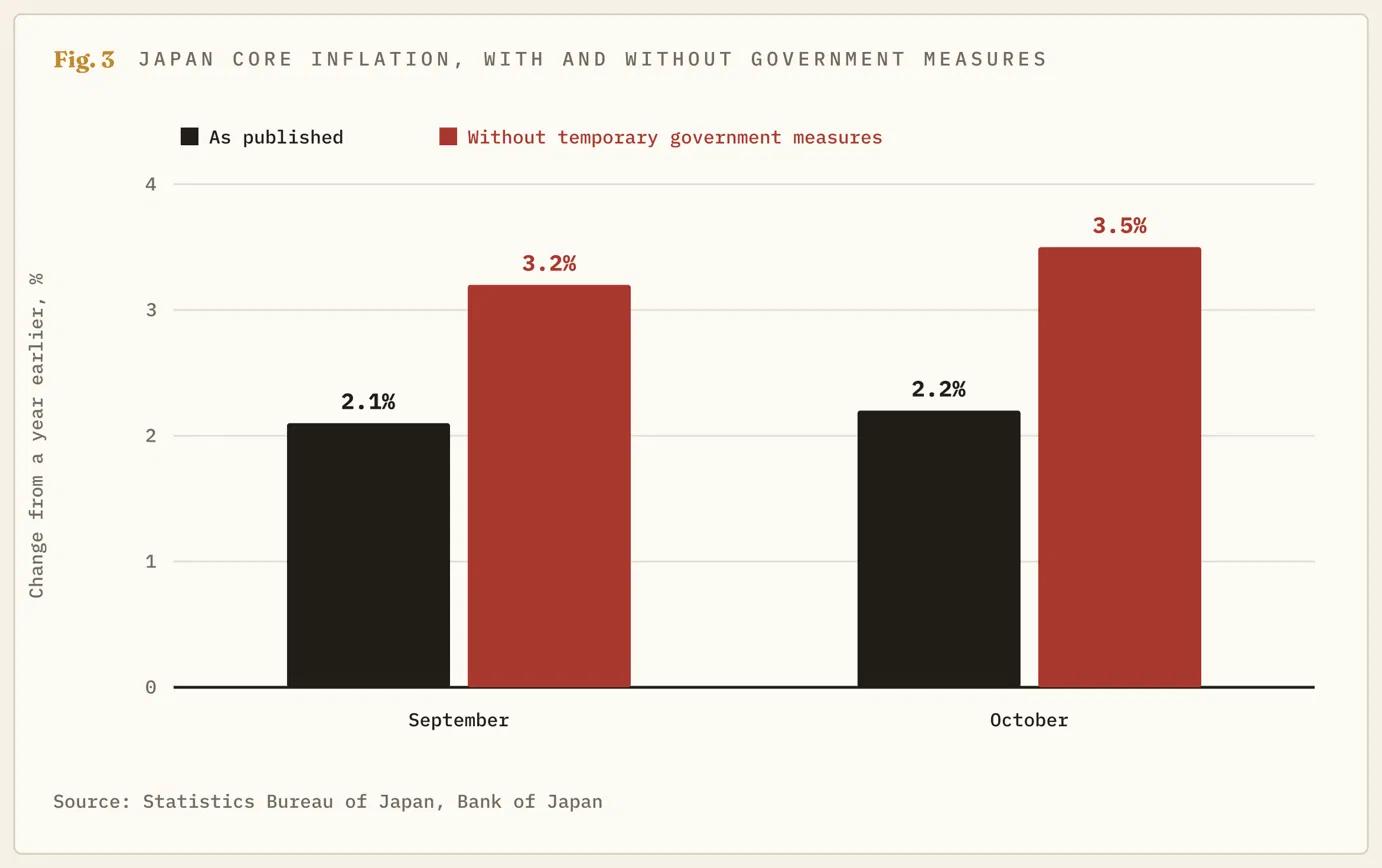
On that view, households have been protected from more than a point of inflation, and Tokyo's November figure shows what happens when part of that protection is removed. Firms are also still passing their costs on. Food and drink makers planned price rises on nearly ten times as many products in November as a year earlier, according to the research firm Teikoku Databank. Traders put the chance of a BoJ increase at the December 17-18 meeting to 1.50% from 1.25%, at 76.4%.
Even so, a rate increase works on that kind of inflation slowly, by cooling demand, and Japanese households are already spending less. The quick route from a BoJ decision to a Tokyo electricity bill runs through the exchange rate, since a stronger Yen would lower the cost of imported fuel within months. BoJ Governor Kazuo Ueda told parliament on November 19 that the weak Yen adds to inflation. On the BoJ's own reasoning, then, the benefit to households depends on what the Yen does after the decision.
The Yen, the budget or the household
Someone has to pay for expensive imported energy, and there are three candidates. If the Yen strengthens, the cost shrinks before it reaches Japan and nobody there has to cover it. If it doesn't, the government can cover it, and it has just decided to: electricity and gas subsidies return for use from December through February at a cost of about ¥520 billion. Prime Minister Sanae Takaichi also plans to cut the sales tax on food to 1% from 8% for two years, starting in April.
If neither happens, households pay, as they did in November. With the subsidies back, the next few Tokyo readings would be expected to come down again, and that would say more about the budget than about prices. The Yen is unlikely to help soon, because the Federal Reserve (Fed) is expected to raise its own rate on December 9, nine days before the BoJ decides. A BoJ increase would then leave the gap between US and Japanese interest rates about where it is, and that gap is the main reason the Yen is weak.
For now, the likeliest outcome is that the government pays through the winter and the Yen stays close to 160.00, which would put the bill back on households when the subsidies run out after February. December 18 is the first test, because the BoJ's decision and the national inflation figures for November arrive on the same day. A Yen that strengthens after the decision and holds its gains into the new year would prove that wrong. A stronger currency is the only one of the three that lowers the cost instead of moving it to someone else.
Author
Joshua Gibson
FXStreet
Joshua joins the FXStreet team as an Economics and Finance double major from Vancouver Island University with twelve years' experience as an independent trader focusing on technical analysis.
















