Gold remains under pressure as inflation keeps Fed rate hikes in focus

Gold (XAU/USD) remains under pressure after a steep decline. Persistent US inflation has kept further Fed rate increases in focus ahead of the December meeting. Higher yields and a stronger dollar could limit a recovery. Tensions involving Iran may support demand for gold, but energy supply risks could also add to inflation pressure. Support near $3,800 is now in focus as gold moves toward the lower boundary of its descending channel.
Gold faces continued pressure as markets await December Fed decision
Gold is consolidating near its recent lows after a steep decline. Persistent US inflation has kept further Federal Reserve tightening in focus ahead of the December meeting. Susan Collins supports gradual rate increases but has also warned that higher borrowing costs could restrain demand more than expected. Collins acknowledged that economic uncertainty could affect the pace of tightening. Jeff Schmid stressed that inflation remains too high and that the Fed has a responsibility to address it. Schmid linked price pressure to strong demand and argued that monetary policy can still bring inflation under control. These comments suggest that policy pressure on gold could persist.
Market pricing strongly favors a December increase of 25 basis points, with a smaller chance of a larger move. Pricing reflects expectations rather than a confirmed policy decision, so fresh comments could change the outlook. These expectations can support Treasury yields and the US dollar. Higher yields raise the appeal of assets that pay interest because gold provides no income. A stronger dollar also makes gold more expensive in other currencies. Any comments from Fed Chair Kevin Warsh that suggest further tightening could extend these pressures. A more cautious tone could help ease them.
Renewed attacks involving Iran and US bases in Bahrain add another source of uncertainty. Such tensions can support demand for gold as a store of value. They can also strengthen demand for the dollar, which may limit gold gains. Any disruption to energy supplies could keep inflation pressure high and complicate the Fed outlook. The effect on gold therefore depends on how the dollar and yields respond. Geopolitical tension alone does not guarantee a price recovery.
Gold technical analysis: Descending channel keeps downside risks in focus
The gold chart below shows price moving within a descending channel. Gold recovered in early November and approached the upper boundary of the descending channel. That advance failed to hold. Gold then fell below the dashed midpoint. This sequence keeps the downward trend in focus.
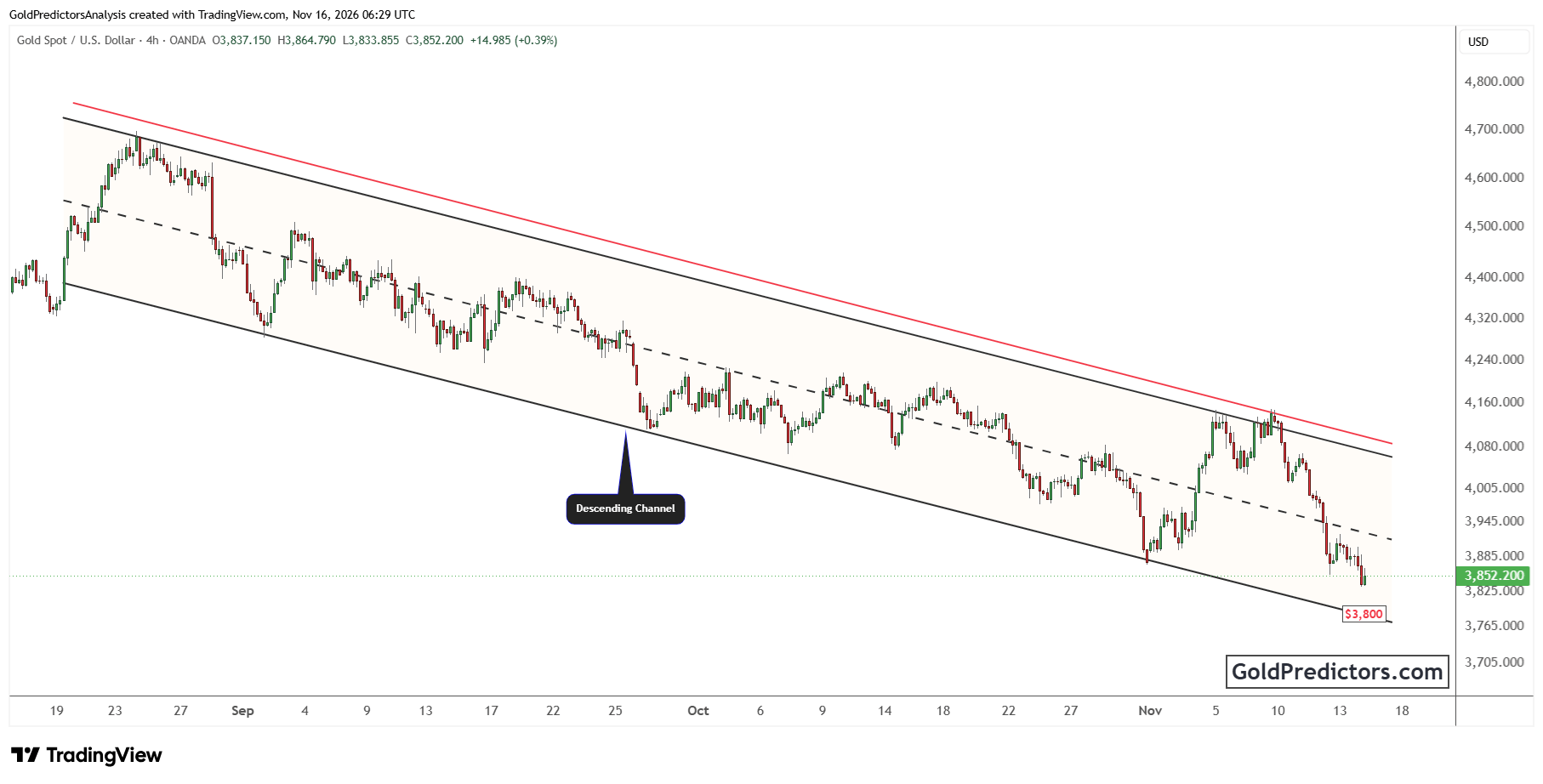
The price is trading around $3,850. Further weakness could bring support near $3,800 into focus. This area lies close to the lower boundary of the descending channel. A sustained break below the boundary would increase the risk of a deeper decline. The outlook remains weak while gold stays below the dashed channel midpoint.
A recovery first needs to clear $3,900 and the channel midpoint near $3,950. A sustained move above that midpoint could bring $4,000 into focus. The upper channel boundary and red descending trendline form a stronger resistance area around $4,080 to $4,100. A move above both lines would provide stronger evidence that downward pressure is easing.
Gold outlook: Strong Dollar and Treasury yields limit gains
Gold may regain stability if support near $3,800 holds and expectations for further Fed rate increases ease. Lower yields and a weaker dollar could help the recovery. Higher energy costs could keep inflation high and limit those gains. A sustained rise above the channel midpoint near $3,950 would bring $4,000 into focus. A break below the lower channel boundary would leave gold exposed to further losses.
Unlock exclusive gold and silver trading signals and updates that most investors don’t see. Join our free newsletter now!
Author

Muhammad Umair, PhD
Gold Predictors
Muhammad Umair is a financial markets analyst and investor who focuses on the forex and precious metals markets.