|

DXY – Holds at strong 100% resistance Arc, awaiting directional confirmation

DXY – Holds at strong 100% resistance Arc, awaiting directional confirmation

US Dollar Index (DXY): Arc cycle analysis™
DXY
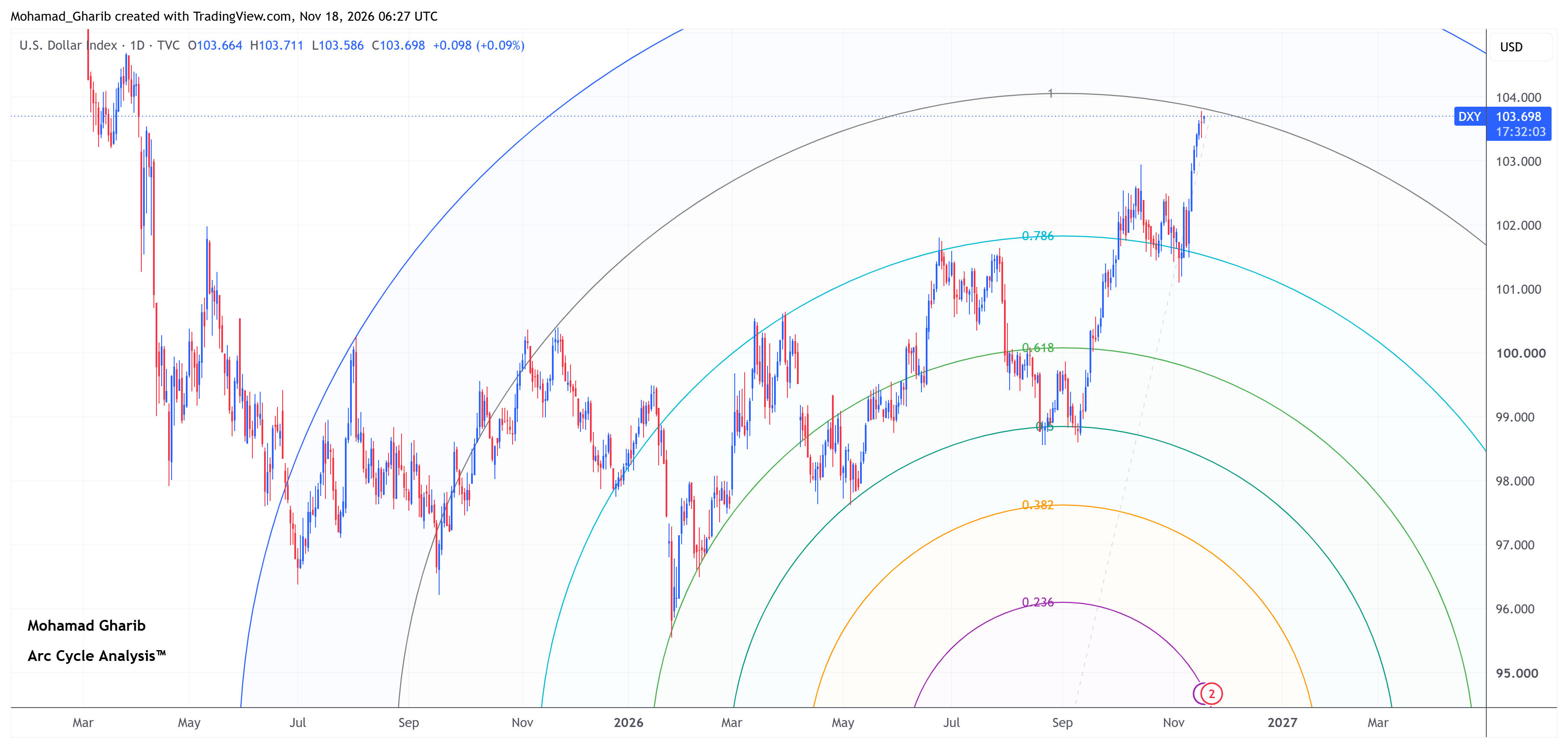
Figure 1: DXY 1D chart with Arc Cycle levels. U.S. Dollar Index (DXY) on the 1D chart with the Arc Cycle levels used in this analysis. Source: TradingView chart; Arc Cycle Analysis™ by Mohamad Gharib.

Overview

Based on Arc Cycle Analysis™ applied to the 1D chart, the U.S. Dollar Index is holding before the 1 (100%) Resistance Arc, which is acting as strong resistance and may absorb the current strong upside momentum. The preferred approach is to await a rebound or a breakout confirmation at the Arc before determining the next market direction.

Table 1: DXY Arc cycle analysis summary

Metric

Reading

Market Bias

Bullish

Preferred Scenario

Awaiting Directional Confirmation

Short-Term Momentum

Strong upside momentum, may be absorbed at the Arc

Current Arc Level

1 (100%) Resistance Arc

Cycle Status

Testing Resistance Arc

Arc Behavior

Strong Resistance

Table 1: Key Arc Cycle readings for DXY. Source: Arc Cycle Analysis™ by Mohamad Gharib.

Market outlook

The U.S. Dollar Index is holding before the 1 (100%) Resistance Arc, which continues to act as strong resistance within the current arc cycle. This Arc may absorb the strong upside momentum that carried the index into the level. No signal has been confirmed yet, and the preferred approach is to await either a rebound or a breakout confirmation at the Arc before determining the next market direction.

Author

Mohamad Gharib

Mohamad Gharib

Independent Analyst

Mohamad Gharib is a Financial Markets Analyst and Quantitative Researcher with more than 18 years of experience in financial markets, including 15 years as an FX Quant Trader.


More from Mohamad Gharib
Share:

Editor's Picks

AUD/USD sits at fresh 10-month lows, nears 0.6700

AUD/USD refreshes ten-month lows below 0.6750 and approaches 0.6700 in Wednesday’s Asian session. Fed rate-hike bets, along with fresh exchange of fire between the US and Iran, underpin the safe-haven US Dollar. Furthermore, the RBA’s dovish tilt weighs on the Aussie and the pair.

USD/JPY defends bids near 159.50 on hawkish BoJ Ueda

USD/JPY is defending bids near 159.50 in the Asian session on Wednesday, holding a three-day losing streak after hawkish commentary from BoJ Governor Ueda supports the Japanese Yen amid looming intervention risks. Meanwhile, escalating Middle East tensions revive US Dollar demand amid hawkish Fed bets, which could limit the pair's downside.


Gold stays week below $3,800 as traders look to FOMC Minutes for Fed rate cues

Gold sticks to intraday losses below the $3,800 mark through the early European session, trading near its lowest level since September 2025, which it touched this Wednesday. Following last week’s hot US inflation reports, several Federal Reserve officials adopted a more hawkish tone and signaled further interest-rate hikes. Adding to this, Tuesday’s upbeat US data cemented market bets, which continue to act as a tailwind for the US Dollar, and drive flows away from non-yielding bullion.

Dogecoin stuck in bearish trend after new lows

Dogecoin remains under pressure, trading around $0.059 on Wednesday, struggling to recover from last week’s sharp sell-off that pushed the meme coin to a new yearly low of $0.055. Weakening derivatives activity and bearish on-chain metrics continue to weigh on market sentiment.

Nvidia offers up double beat in third quarter

Nvidia (NVDA) shares jumped 3% afterhours as the leading AI chipmaker easily surpassed Wall Street's projections for the third quarter. The semiconductor powerhouse posted adjusted earnings per share of $2.68, 8.5% or $0.21 better than the consensus. Revenue of $115.85 billion clobbered the consensus by $7.1 billion or 6.6%.

Gold isn't being sold for thew reason most people think
Gold (XAU/USD) remains under heavy selling pressure on Monday, hitting its lowest level in 13 months. The precious metal is struggling to recover despite escalating geopolitical tensions in the Middle East, a backdrop that would normally encourage investors to seek protection in safe-haven assets. However, the main driver behind Gold's decline is not the geopolitical uncertainty itself.