A Bank of England rate hike in July can’t be ruled out

A June rate rise now looks unlikely amid a fall in oil prices and weaker economic data. Yet a hike in July is possible if energy flows through the Strait of Hormuz don’t materially – and durably – improve over the next 10 weeks.
A June rate hike no longer looks likely
Our view on the Bank of England has shifted over recent weeks.
Six weeks ago, at the Bank’s April meeting, it felt as though officials were edging closer to a rate hike. While policymakers looked notably more reluctant to tighten policy than their counterparts at the European Central Bank, most were also working off a more benign energy scenario than our own base case at a time when sentiment around the Middle East crisis remained fragile. Back then, we thought a June hike had become marginally more likely than not.
That’s no longer the case. Markets are right that the odds of a hike this month have faded.
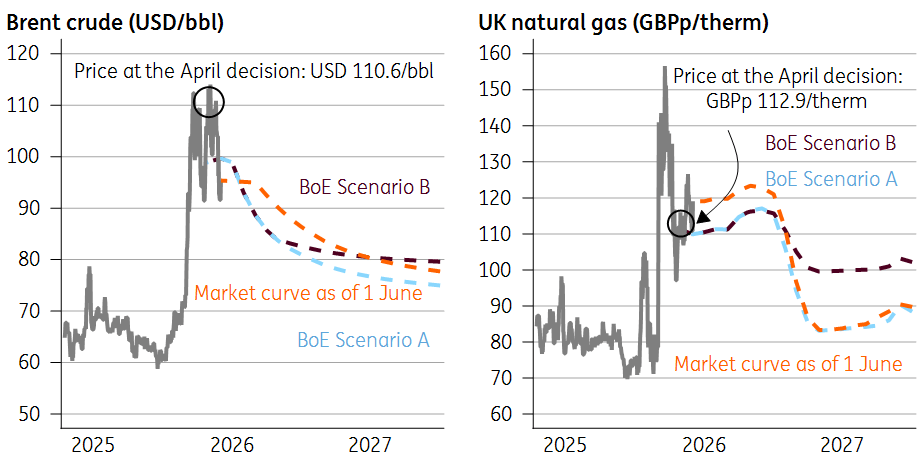
Yes, oil futures covering late 2026 and 2027 have indeed drifted higher. But that’s been offset by a $15/bbl fall in spot prices. Even more remarkably, natural gas prices have remained subdued. That matters for Britain, given how heavily it still relies on gas and LNG.
Energy markets now sit somewhere between the Bank’s April “scenario A” and “scenario B”. Crucially, most officials judged at the time that neither scenario automatically warranted rate rises. In their view, simply not cutting rates – as likely would have happened absent the Iran war – already amounts to de facto tightening.
Energy prices are somewhere between the BoE's "scenario A" and "B"
We think it’s particularly significant that futures prices for natural gas delivery in 6-12 months have fallen back close to pre-war levels. If that holds, July’s 12% jump in household energy bills could be followed by an 8% fall in October.
That would leave inflation peaking at around 3.7% in September before hovering near 3.5% into next spring – bearing in mind lower household energy bills into the winter will be offset by rising food inflation.
And that matters because the Bank has effectively drawn a line in the sand at 4%. Last summer, officials argued that inflation is more likely to persist if headline CPI breaches that level for any sustained period. Right now, it’s not obvious that it will.
Household energy bills set to fall 8% in October on current futures prices
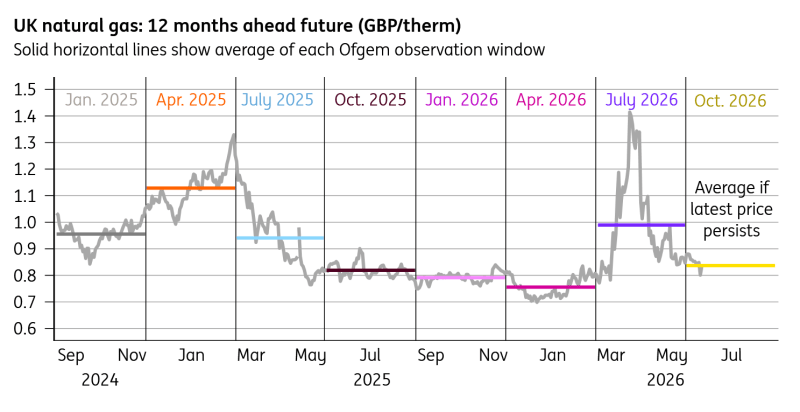
If gas futures don't spike again, inflation peaks below 4%
In fact, the inflation profile increasingly resembles the second half of last year, when CPI topped out at 3.8%. The catalysts are slightly different, though that period also involved a spike in food inflation, egged on by payroll tax and national insurance hikes.
Back then, hawks feared price pressures could become more entrenched. Inflation expectations had jumped sharply.
Yet that risk has not materialised – quite the opposite. Inflation data for April, which captures annual price resets at the start of the financial year, was well-behaved.
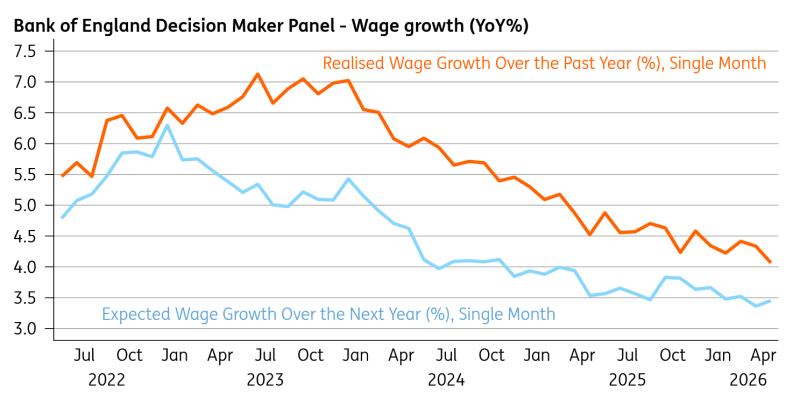
Meanwhile, the recent jobs data has been dismal. Payrolled employment fell sharply, though is liable to be revised up fairly heavily. Wage growth is dropping like a stone; private pay rose by just 0.6% annualised over the past three months, a far cry from the 8% recorded in 2023. Pay expectations among CFOs responding to the BoE’s “decision maker” survey haven’t budged since the crisis began, even if output price forecasts are a little higher.
Wage growth looks much more benign than four years ago
A July hike is possible if the Strait of Hormuz stays blocked
It all serves as a reminder that the UK economy is much less susceptible to second round effects than it was during the last energy shock four years ago. The economy is more fragile – and we put very little weight on the eye-popping 0.6% growth figure in the first quarter, which we think was amplified by seasonal adjustment issues.
So where does this leave rates?
Much still depends on whether a deal is reached in the coming weeks and whether that leads to a sustained recovery in energy flows. The longer the crisis drags on, the greater the risk of second-round inflation effects. For instance, our commodities team warns that natural gas prices are biased to the upside, as Europe increasingly competes with Asia for LNG cargoes.
Ultimately, central banks must weigh not just the supply chain disruption seen so far, but the risk that disruption persists through the summer and beyond.
That’s why we’re not ruling out a July hike if the Strait of Hormuz remains heavily disrupted. And it’s why we’re likely to see a greater number of officials vote for a rate hike later this month. BoE members Megan Greene and potentially Catherine Mann look likely to join Huw Pill in advocating for higher interest rates, even if Governor Andrew Bailey appears much less convinced.
We’ll be taking a fresh look at our global house view on the Middle East and energy prices over the next week or so. But on our existing base case, which factors in a significant recovery in energy flows by July – and based on the current level of spot prices – the more likely scenario is a prolonged pause from the Bank of England.
Author
ING Global Economics Team
ING Economic and Financial Analysis
From Trump to trade, FX to Brexit, ING’s global economists have it covered. Go to ING.com/THINK to stay a step ahead.
















