Gold rebounds after sharp correction, eyes $5,000 resistance
- Gold recovers as dip buyers return after last week’s violent sell-off from record highs.
- A firmer US Dollar and easing US-Iran tensions may limit near-term upside.
- Technically, price remains supported above the rising 20-day SMA, while Bollinger Bands continue to widen.

Gold (XAU/USD) climbs more than 5% on Tuesday as dip buyers step back into the market following last week’s violent correction from record highs near $5,600. At the time of writing, XAU/USD is hovering near $4,980, recovering after slipping to near four-week lows around $4,402 on Monday.
The sharp sell-off was largely technical in nature, driven by position unwinding and margin-related liquidation rather than clear deterioration in fundamentals. The broader backdrop for Bullion remains supportive, while Tuesday’s rebound highlights still-elevated volatility across the precious-metals space, with Silver up nearly 10% on the day.
That said, Gold may consolidate in the near term in the absence of fresh catalysts, while tentative signs of easing tensions between the US and Iran could temper safe-haven demand. At the same time, renewed strength in the US Dollar (USD) may cap the upside in XAU/USD.
Market movers: US-Iran tensions ease, US-India trade deal announced, DXY rebounds
- Signs of easing US-Iran tensions emerge after Iranian President Masoud Pezeshkian said on Tuesday that he had instructed his foreign minister to “pursue fair and equitable negotiations” with the United States, with the two sides reportedly preparing to send senior envoys to Istanbul later this week for talks on Iran’s nuclear programme. The comments follow remarks from US President Donald Trump that Iran is “seriously talking”.
- US President Trump announced on Monday that the United States and India have agreed on a trade deal under which US tariffs on Indian goods will be reduced from around 50% to about 18%, while India will step up purchases of US products, with commitments that could reach up to $500 billion.
- US economic data flow has thinned after the Bureau of Labor Statistics said on Monday that the January Employment Situation report due on Friday will be delayed because of the partial government shutdown, with the JOLTS report also postponed.
- The US Dollar Index (DXY), which tracks the Greenback’s value against a basket of six major currencies, is trading near one-week highs around 97.40, recovering after slipping to four-year lows last week.
- The rebound in the Greenback comes after markets welcomed US President Donald Trump’s nomination of former Federal Reserve Governor Kevin Warsh as the next Fed Chair. Warsh, who is widely viewed as an inflation hawk, has helped ease market concerns about the risk of aggressive rate cuts under political pressure.
- Upbeat US manufacturing data has reinforced the view that the Fed can afford to remain patient before resuming monetary policy easing. The Institute for Supply Management (ISM) Manufacturing Purchasing Managers Index (PMI) jumped to 52.6 in January from 47.9 in December, comfortably beating market expectations of 48.5, while the S&P Global Manufacturing PMI edged higher to 52.4 from 51.9.
Technical analysis: Uptrend intact despite elevated volatility
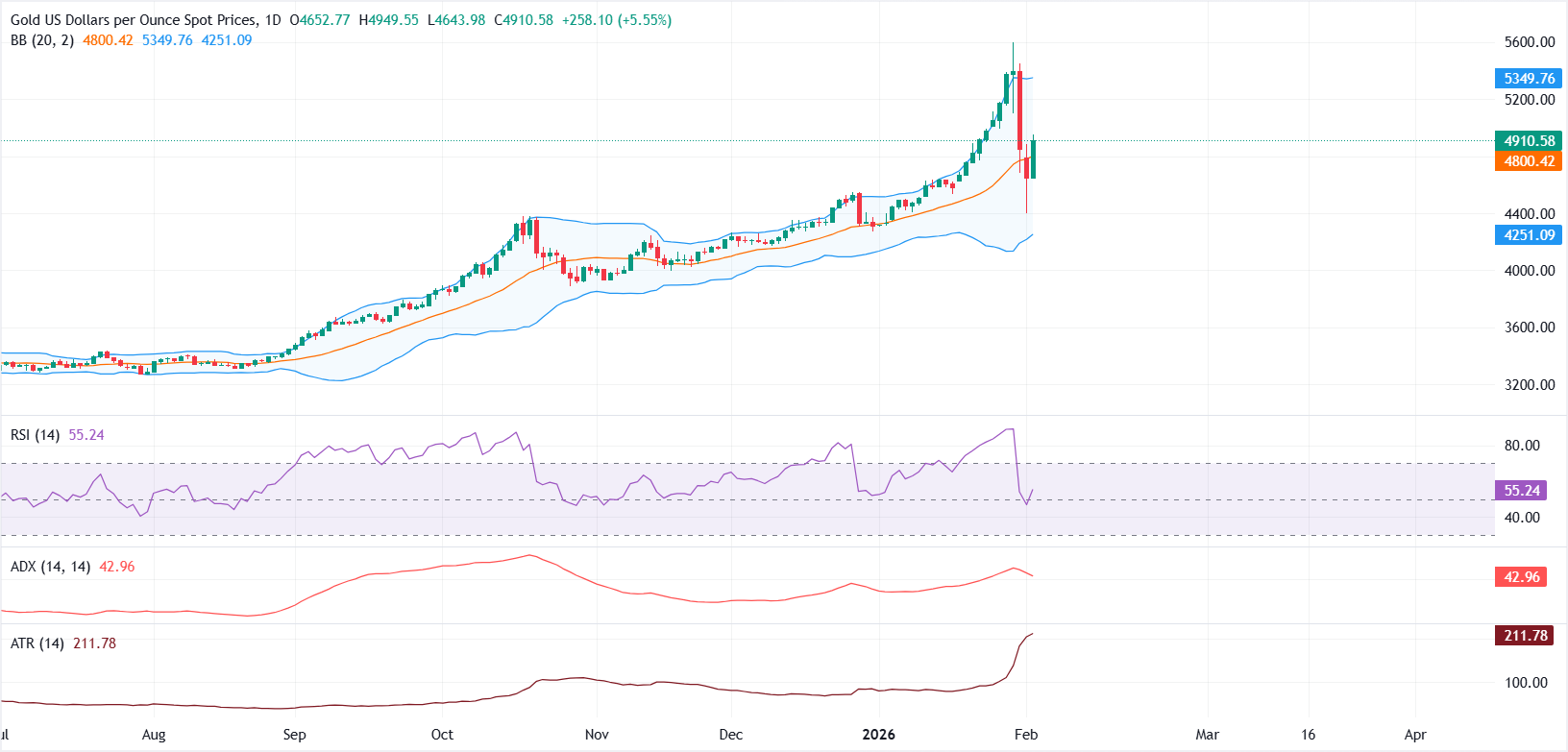
From a technical perspective, the broader uptrend on the daily chart remains intact. Price is holding above the 20-day Simple Moving Average (SMA), which also represents the middle Bollinger Band, near $4,800, keeping the short-term trend structure constructive despite the sharp and volatile correction from last week’s peak.
Bollinger Bands are widening and the Average True Range (ATR) has surged to around 212, signalling elevated volatility. Momentum indicators have also started to recover. The Relative Strength Index (RSI) stands near 55, rebounding from sub-50 territory and pointing to improving bullish momentum.
At the same time, the trend remains strong, with the Average Directional Index (ADX) elevated around 43, although the indicator is beginning to roll over from recent highs, suggesting the strength of the trend is easing rather than accelerating.
On the upside, the $5,000 psychological level marks the immediate resistance, followed by the upper Bollinger Band near $5,350. On the downside, a break below the middle Bollinger Band would expose initial support around $4,500, followed by Monday’s low near $4,402. A deeper cushion is located at the lower Bollinger Band around $4,250.
Gold FAQs
Gold has played a key role in human’s history as it has been widely used as a store of value and medium of exchange. Currently, apart from its shine and usage for jewelry, the precious metal is widely seen as a safe-haven asset, meaning that it is considered a good investment during turbulent times. Gold is also widely seen as a hedge against inflation and against depreciating currencies as it doesn’t rely on any specific issuer or government.
Central banks are the biggest Gold holders. In their aim to support their currencies in turbulent times, central banks tend to diversify their reserves and buy Gold to improve the perceived strength of the economy and the currency. High Gold reserves can be a source of trust for a country’s solvency. Central banks added 1,136 tonnes of Gold worth around $70 billion to their reserves in 2022, according to data from the World Gold Council. This is the highest yearly purchase since records began. Central banks from emerging economies such as China, India and Turkey are quickly increasing their Gold reserves.
Gold has an inverse correlation with the US Dollar and US Treasuries, which are both major reserve and safe-haven assets. When the Dollar depreciates, Gold tends to rise, enabling investors and central banks to diversify their assets in turbulent times. Gold is also inversely correlated with risk assets. A rally in the stock market tends to weaken Gold price, while sell-offs in riskier markets tend to favor the precious metal.
The price can move due to a wide range of factors. Geopolitical instability or fears of a deep recession can quickly make Gold price escalate due to its safe-haven status. As a yield-less asset, Gold tends to rise with lower interest rates, while higher cost of money usually weighs down on the yellow metal. Still, most moves depend on how the US Dollar (USD) behaves as the asset is priced in dollars (XAU/USD). A strong Dollar tends to keep the price of Gold controlled, whereas a weaker Dollar is likely to push Gold prices up.
Author

Vishal Chaturvedi
FXStreet
I am a macro-focused research analyst with over four years of experience covering forex and commodities market. I enjoy breaking down complex economic trends and turning them into clear, actionable insights that help traders stay ahead of the curve.














