Gold ticks higher as US-Iran deal hopes weigh on USD, upside remains limited
- Gold edges higher on Tuesday as the US Dollar Index slips to six-week lows.
- Elevated Oil prices and uncertainty over the Fed outlook keep Gold’s upside in check.
- Technically, XAU/USD trades in a tight range between the 50-day and 100-day SMAs.

Gold (XAU/USD) trades with a positive bias on Tuesday, supported by a softer US Dollar (USD) as investors react to renewed optimism surrounding potential US-Iran negotiations. At the time of writing, XAU/USD is trading around $4,795, up 1.11% onnthe day but lacks strong upside momentum as price action remains confined within a two-week range.
Speaking at the Oval Office on Monday, US President Donald Trump said the United States (US) had been contacted by “the right people” in Iran, noting that “they’d like to make a deal very badly.” The remarks came after Washington implemented a naval blockade targeting Iranian ports, as weekend talks between the US and Iran failed to produce a breakthrough.
Meanwhile, diplomatic efforts appear to be ongoing. Reports suggest a second round of negotiations could take place in Islamabad later this week before the current two-week ceasefire expires. According to Axios, Pakistan, Turkey, and Egypt are actively engaged in mediation efforts to bring both sides back to the negotiating table.
However, uncertainty remains elevated as key disagreements, particularly over Iran’s nuclear program, continue to divide both sides, limiting the scope for a quick resolution. Still, the prospect of renewed diplomacy has lifted risk appetite and reduced demand for the US Dollar, with the US Dollar Index (DXY) slipping to six-week lows.
At the same time, Crude Oil prices have eased slightly from recent highs, helping temper immediate inflation concerns and cooling expectations that the Federal Reserve (Fed) will need to maintain a more aggressive policy stance. That said, Oil prices remain elevated overall, as disruptions in the Strait of Hormuz continue to limit supply, keeping inflation risks alive.
Chicago Fed President Austan Goolsbee said on Tuesday that inflation expectations remain broadly anchored, but warned that prospects for rate cuts in 2026 could diminish if inflation does not show clear signs of easing.
Against this backdrop, Gold may continue to trade within its recent range in the near term. A sustained breakout will likely depend on clearer progress in negotiations and a more meaningful decline in Oil prices, which could revive expectations for Fed easing. A lower interest rate environment tends to support non-yielding assets like Gold, as it reduces the opportunity cost of holding them.
On the data front, the US Producer Price Index (PPI) data for March came in softer than expected. The headline PPI rose by 0.5% MoM, below market expectations of 1.2% and unchanged from the previous reading of 0.5%, which was revised down from 0.7%. On an annual basis, PPI increased by 4.0%, missing forecasts of 4.6% and easing from the prior 3.4%.
Technical analysis: XAU/USD trapped between 50-day and 100-day SMAs
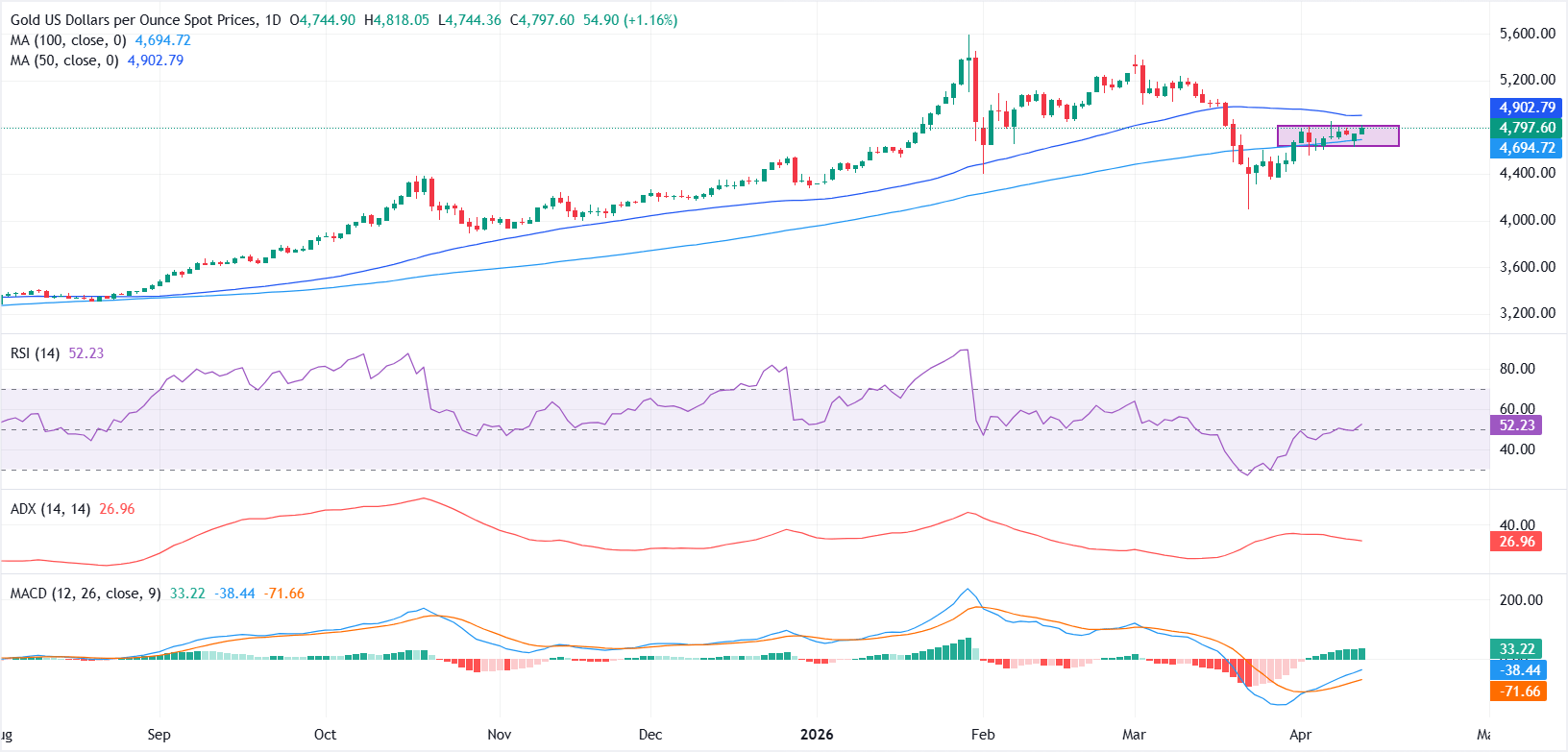
From a technical perspective, the daily chart shows XAU/USD moving in a consolidation pattern. The metal remains under a bearish near-term bias, with spot holding below the 50-day Simple Moving Average (SMA) at $4,902 while still trading above the 100-day SMA at $4,694. The Relative Strength Index (RSI) at 50 is neutral, while the Average Directional Index (ADX) near 27 suggests a trend losing intensity rather than accelerating.
On the topside, initial resistance is reinforced by the 50-day SMA at $4,902; a daily close above this barrier would be needed to soften the current downside bias. On the downside, immediate support is at the 100-day SMA at $4,694; a break below would open the door to a more pronounced bearish extension.
(The technical analysis of this story was written with the help of an AI tool.)
Author

Vishal Chaturvedi
FXStreet
I am a macro-focused research analyst with over four years of experience covering forex and commodities market. I enjoy breaking down complex economic trends and turning them into clear, actionable insights that help traders stay ahead of the curve.














