GBP/JPY Price Forecast: Remains under selling pressure below 194.00, bullish bias prevails
- GBP/JPY attracts some sellers to near 193.85 in Thursday's early European session.
- The positive view of the cross prevails above the key 100-day EMA with the bullish RSI indicator.
- The immediate resistance level emerges at the 196.00-196.10 region; the initial support level to watch is 193.43.


The GBP/JPY cross remains under some selling pressure around 193.85 during the early European session on Thursday. The Japanese Yen (JPY) edges higher against the Pound Sterling (GBP) amid the prospect that the Bank of Japan (BoJ) will hike rates again. Investors will closely watch the preliminary reading of UK Gross Domestic Product (GDP) data for the first quarter (Q1), which will be released later on Thursday.
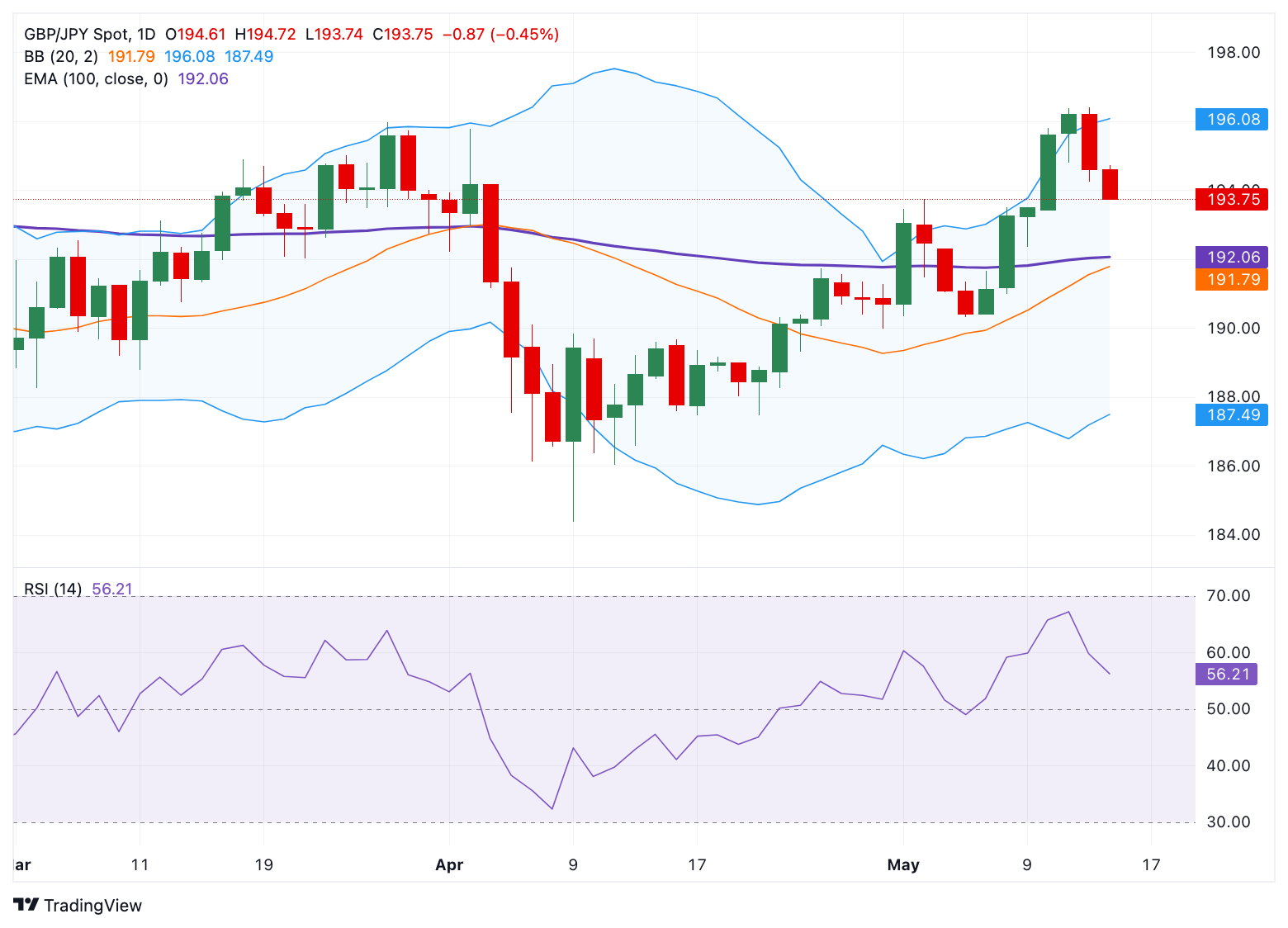
Technically, the positive outlook of the GBP/JPY cross remains in play as the price is well-supported above the key 100-day Exponential Moving Average (EMA) on the daily chart. The upward momentum is reinforced by the 14-day Relative Strength Index (RSI), which stands above the midline near 56.45, suggesting that further upside looks favorable.
The first upside barrier for GBP/JPY emerges in the 196.00-196.10 zone, representing the psychological level and the upper boundary of the Bollinger Band. Further north, the next hurdle is seen at 196.41, the high of May 14. Extended gains could see a rally to 197.41, the high of January 6.
On the flip side, the first support level to watch is 193.43, the low of May 12. The additional downside filter is located at 192.06, the 100-day EMA. A breach of this level could expose 190.42, the low of May 7.
GBP/JPY daily chart
Japanese Yen FAQs
The Japanese Yen (JPY) is one of the world’s most traded currencies. Its value is broadly determined by the performance of the Japanese economy, but more specifically by the Bank of Japan’s policy, the differential between Japanese and US bond yields, or risk sentiment among traders, among other factors.
One of the Bank of Japan’s mandates is currency control, so its moves are key for the Yen. The BoJ has directly intervened in currency markets sometimes, generally to lower the value of the Yen, although it refrains from doing it often due to political concerns of its main trading partners. The BoJ ultra-loose monetary policy between 2013 and 2024 caused the Yen to depreciate against its main currency peers due to an increasing policy divergence between the Bank of Japan and other main central banks. More recently, the gradually unwinding of this ultra-loose policy has given some support to the Yen.
Over the last decade, the BoJ’s stance of sticking to ultra-loose monetary policy has led to a widening policy divergence with other central banks, particularly with the US Federal Reserve. This supported a widening of the differential between the 10-year US and Japanese bonds, which favored the US Dollar against the Japanese Yen. The BoJ decision in 2024 to gradually abandon the ultra-loose policy, coupled with interest-rate cuts in other major central banks, is narrowing this differential.
The Japanese Yen is often seen as a safe-haven investment. This means that in times of market stress, investors are more likely to put their money in the Japanese currency due to its supposed reliability and stability. Turbulent times are likely to strengthen the Yen’s value against other currencies seen as more risky to invest in.
Author
Lallalit Srijandorn
FXStreet
Lallalit Srijandorn is a Parisian at heart. She has lived in France since 2019 and now becomes a digital entrepreneur based in Paris and Bangkok.