GBP/JPY Price Forecast: Crucial upside barrier emerges near 200.00
- GBP/JPY trades with mild gains around 199.45 in Wednesday’s early European session.
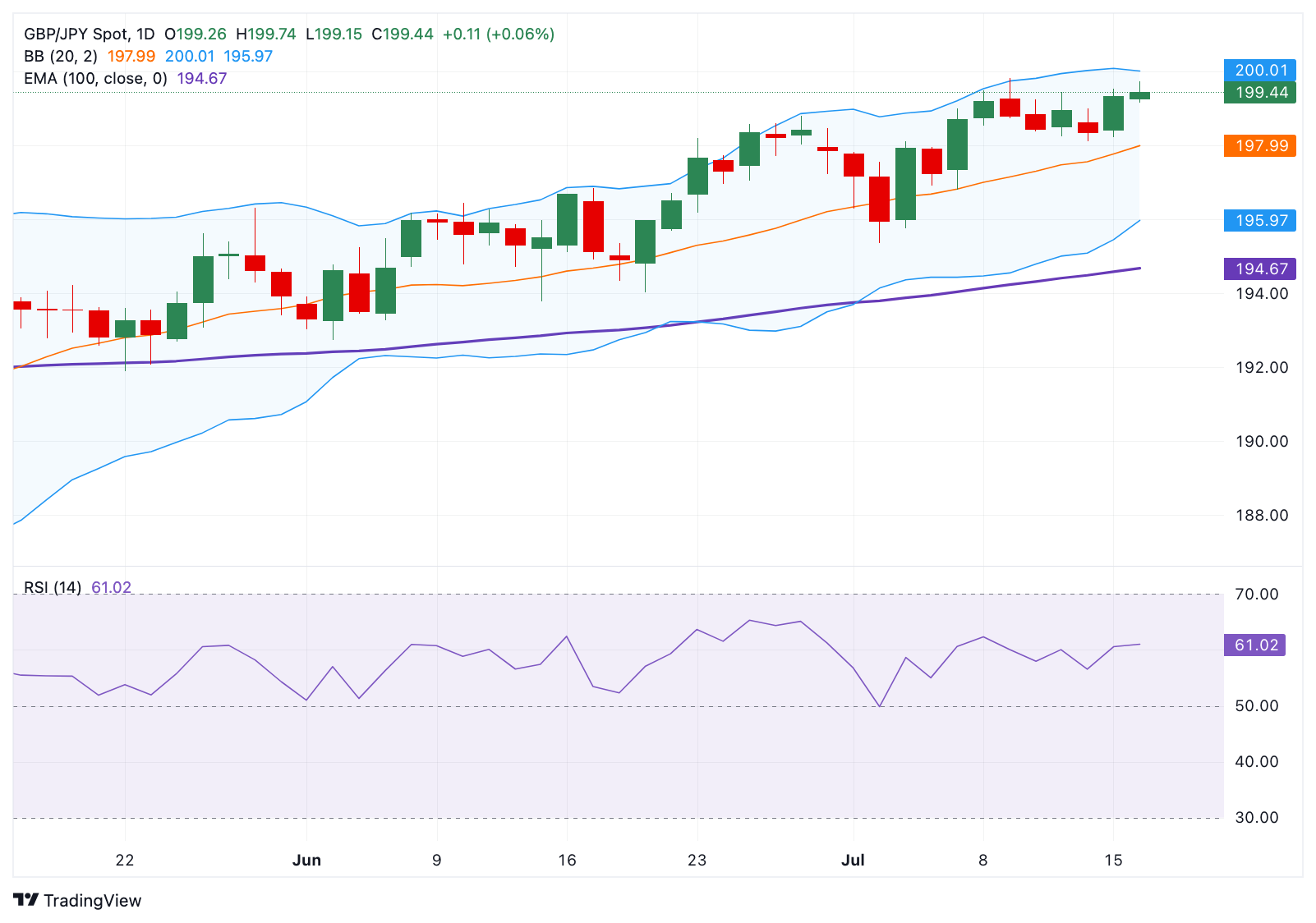
- The constructive outlook of the cross remains intact above the key 100-day EMA, with the bullish RSI indicator.
- The key resistance level emerges at 200.00; the first support level to watch is 198.11.


The GBP/JPY cross trades with mild gains around 199.45 during the early European session on Wednesday. The hotter-than-expected UK June CPI inflation report provides some support to the Pound Sterling (GBP) against the Japanese Yen (JPY). The attention will shift to the UK employment data, which will be released on Thursday.
Technically, the constructive outlook of GBP/JPY remains in place as the cross is well-supported above the key 100-day Exponential Moving Average (EMA) on the daily chart. The upward momentum is reinforced by the Relative Strength Index (RSI), which stands above the midline near 60.80, suggesting that further upside looks favorable.
On the bright side, the key upside barrier for the cross emerges at 200.00, representing the psychological level and the upper boundary of the Bollinger Band. A decisive break above this level could pick up more momentum and aim for the crucial resistance level at 200.75, the high of May 28, 2024. Further north, the additional upside filter to watch is 204.23, the high of July 19, 2024.
In the bearish case, the initial support level for the GBP/JPY is seen at 198.11, the low of July 14. A breach of this level could drag the cross toward 196.00, the lower limit of the Bollinger Band. The crucial contention level is located at 194.65, the 100-day EMA.
GBP/JPY daily chart
Pound Sterling FAQs
The Pound Sterling (GBP) is the oldest currency in the world (886 AD) and the official currency of the United Kingdom. It is the fourth most traded unit for foreign exchange (FX) in the world, accounting for 12% of all transactions, averaging $630 billion a day, according to 2022 data. Its key trading pairs are GBP/USD, also known as ‘Cable’, which accounts for 11% of FX, GBP/JPY, or the ‘Dragon’ as it is known by traders (3%), and EUR/GBP (2%). The Pound Sterling is issued by the Bank of England (BoE).
The single most important factor influencing the value of the Pound Sterling is monetary policy decided by the Bank of England. The BoE bases its decisions on whether it has achieved its primary goal of “price stability” – a steady inflation rate of around 2%. Its primary tool for achieving this is the adjustment of interest rates. When inflation is too high, the BoE will try to rein it in by raising interest rates, making it more expensive for people and businesses to access credit. This is generally positive for GBP, as higher interest rates make the UK a more attractive place for global investors to park their money. When inflation falls too low it is a sign economic growth is slowing. In this scenario, the BoE will consider lowering interest rates to cheapen credit so businesses will borrow more to invest in growth-generating projects.
Data releases gauge the health of the economy and can impact the value of the Pound Sterling. Indicators such as GDP, Manufacturing and Services PMIs, and employment can all influence the direction of the GBP. A strong economy is good for Sterling. Not only does it attract more foreign investment but it may encourage the BoE to put up interest rates, which will directly strengthen GBP. Otherwise, if economic data is weak, the Pound Sterling is likely to fall.
Another significant data release for the Pound Sterling is the Trade Balance. This indicator measures the difference between what a country earns from its exports and what it spends on imports over a given period. If a country produces highly sought-after exports, its currency will benefit purely from the extra demand created from foreign buyers seeking to purchase these goods. Therefore, a positive net Trade Balance strengthens a currency and vice versa for a negative balance.
Author
Lallalit Srijandorn
FXStreet
Lallalit Srijandorn is a Parisian at heart. She has lived in France since 2019 and now becomes a digital entrepreneur based in Paris and Bangkok.