GBP/JPY Price Forecast: Bulls hold 217.00 after trendline break
- GBP/JPY reclaims 217.00 after breaking downtrend resistance line.
- RSI shows buyers gaining momentum, but upside remains gradual.
- Break above 218.00 exposes 218.69 and 219.00 next.

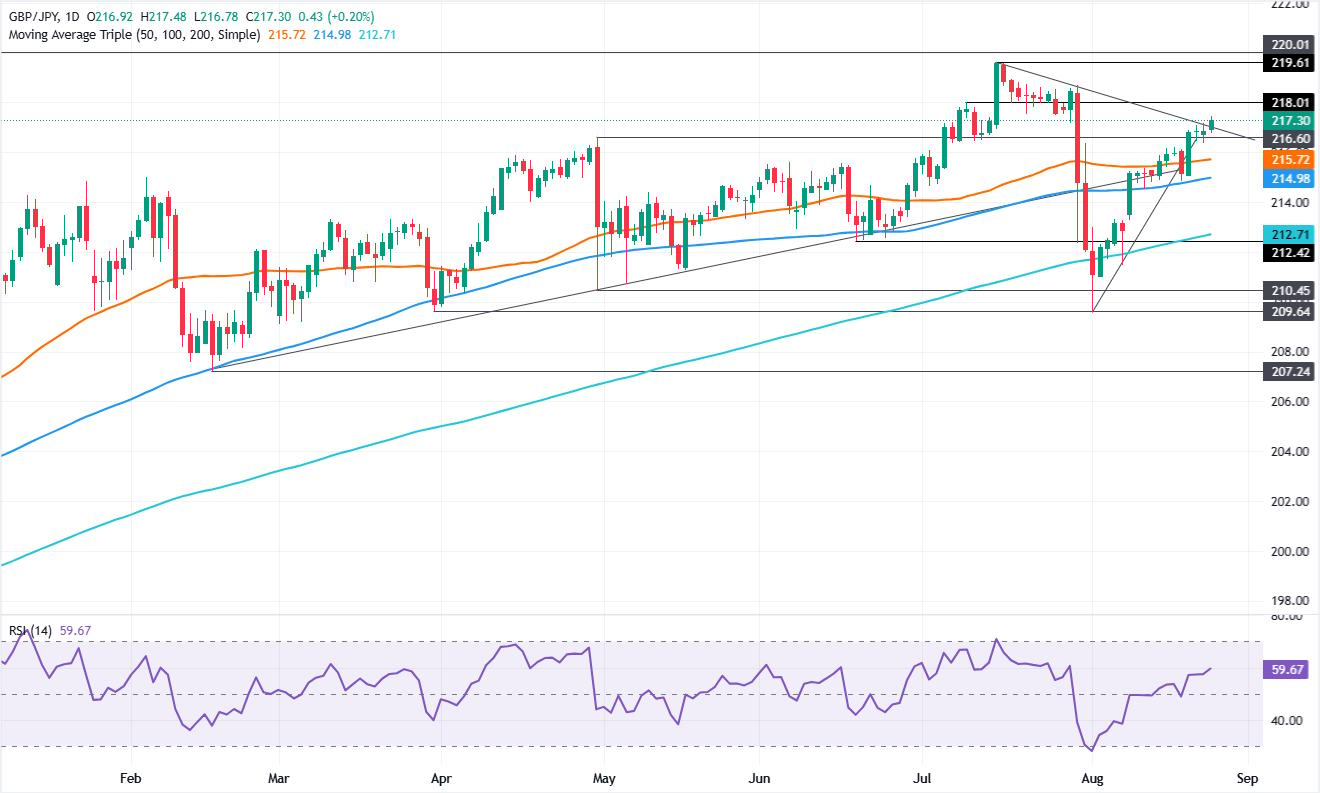
The GBP/JPY surpassed a downtrend resistance line and reclaimed the 217.00 level on Tuesday, as the Japanese Yen weakened while Sterling pushed to a new three-week high at 217.48. At the time of writing, the cross-pair trades at 217.31, up 0.20%.
GBP/JPY Price Forecast: Technical Outlook
GBP/JPY price action seems poised to extend its consolidation despite conquering 217.00, but now the new floor level is the latter. The Relative Strength Index (RSI) shows that buyers are gaining momentum, but the cross-pair is drifting higher at a slow pace, which increases the likelihood for a sudden reversal.
For a bullish continuation, the GBP/JPY must clear 217.20. A breakout above, and the next stop is the 218.00 mark and the July 30 high at 218.69. Above the next stop would be 219.00.
On the downside, the first support for GBP/JPY would be 217.00. Below, the next areas of interest are the 216.50 and 216.00 psychological levels. Downwards, the demand area is the 50-day Simple Moving Average (SMA) at 215.72, followed by 215.00. A decisive push by the bears, opens the door to challenge the 100-day SMA at 214.98.
GBP/JPY Price Chart – Daily
Japanese Yen Price Today
The table below shows the percentage change of Japanese Yen (JPY) against listed major currencies today. Japanese Yen was the strongest against the US Dollar.
| USD | EUR | GBP | JPY | CAD | AUD | NZD | CHF | |
|---|---|---|---|---|---|---|---|---|
| USD | -0.09% | -0.11% | 0.10% | -0.04% | -0.18% | -0.26% | -0.14% | |
| EUR | 0.09% | -0.02% | 0.17% | 0.06% | -0.09% | -0.20% | -0.06% | |
| GBP | 0.11% | 0.02% | 0.20% | 0.10% | -0.06% | -0.18% | -0.03% | |
| JPY | -0.10% | -0.17% | -0.20% | -0.13% | -0.26% | -0.36% | -0.22% | |
| CAD | 0.04% | -0.06% | -0.10% | 0.13% | -0.13% | -0.23% | -0.10% | |
| AUD | 0.18% | 0.09% | 0.06% | 0.26% | 0.13% | -0.09% | 0.01% | |
| NZD | 0.26% | 0.20% | 0.18% | 0.36% | 0.23% | 0.09% | 0.13% | |
| CHF | 0.14% | 0.06% | 0.03% | 0.22% | 0.10% | -0.01% | -0.13% |
The heat map shows percentage changes of major currencies against each other. The base currency is picked from the left column, while the quote currency is picked from the top row. For example, if you pick the Japanese Yen from the left column and move along the horizontal line to the US Dollar, the percentage change displayed in the box will represent JPY (base)/USD (quote).
Author

Christian Borjon Valencia
FXStreet
Markets analyst, news editor, and trading instructor with over 14 years of experience across FX, commodities, US equity indices, and global macro markets.
















